
New Phenomenon Emerges in Padang Restaurants: What is Happening to the Indonesian Economy?
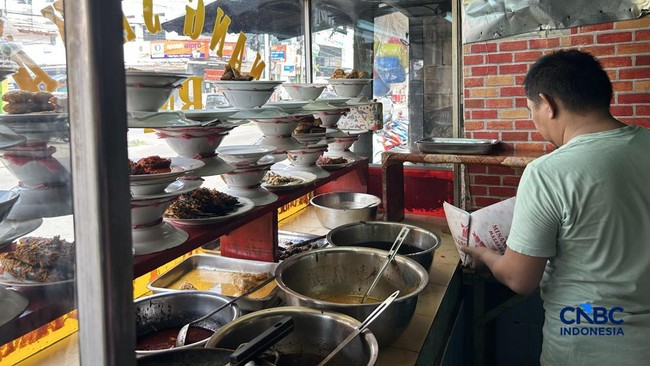
Business owners of Padang restaurants are currently facing numerous challenges, ranging from the rising prices of raw materials to a decline in public purchasing power. They are hoping for economic improvements capable of restoring sales volumes.
Several managers of Padang restaurants in the Tebet area, South Jakarta, stated that sales conditions have declined compared to the Covid-1s pandemic period. Ridwan, one of the owners, admitted that turnover decreased by approximately 20% in 2026. This is because customers tend to choose more economical menus from mid-month to the end of the month, typically opting for options such as egg, potato fritter, or aubergine rice priced at around Rp 18,000.
“So far, it is usually quiet from mid-month until the end of the month as they try to save money,” Ridwan told CNBC Indonesia on Tuesday (8/6/2026). He added that due to extreme frugality, he often encounters customers who only purchase vegetables and sambal without rice to take home, or those who only buy side dishes to share with their families.
Conversely, during the beginning of the month or payday periods, customers frequently purchase premium packages including fish, minced meat, rendang, or tendon, which are priced at Rp 20,000 and above. While complete packages priced at Rp 27,000 were previously popular, sales of these sets have also begun to dwindle towards the end of the month.
Furthermore, Ridwan complained about the soaring market prices of essential ingredients such as beef, chicken, eggs, and chillies. These price hikes present a significant challenge for business owners attempting to maintain their restaurants’ existence. Aldi, another manager in Tebet, also noted that sales trends in 2026 have been declining, claiming they are not even better than during the pandemic when mobility was restricted. During the pandemic, Aldi’s restaurant frequently received large bulk orders, a trend that has failed to continue recently.
Aldi views the weakening purchasing power, alongside unstable economic conditions, as the primary cause of the decline. He noted that this issue is shared by many other Padang restaurant operators. “We are in a Facebook forum for this; even in the Bogor and Depok areas, they have had to lower their prices,” he told CNBC Indonesia.
In addition to sluggish consumer demand, challenges have arisen regarding the limited availability of raw materials. Aldi cited examples where suppliers, such as poultry distributors, have experienced falling sales, which subsequently impacts their ability to supply Padang restaurants. He also highlighted the persistent high prices of meat, chillies, and onions. “I am confused about the meat. Why is the price rising and not coming down? Usually, last year, it would rise and then drop. This time, it remains stagnant. Furthermore, chillies and red onions, which used to be Rp 40,000–Rp 45,000 per kilo, are now reaching Rp 60,000 per kilo,” he explained.
This situation has forced Aldi to gradually increase his menu prices by Rp 1,000 annually. He hopes for concrete government intervention to control raw material prices, such as through market operations.
Similarly, Ijan, another entrepreneur in Tebet, observed that public purchasing power appears to be struggling, reflected in a sales drop of over 10% recently. Ijan explained that while his restaurant’s dishes used to sell out by 2:00 PM, the lunchtime rush has noticeably thinned. He also noted a shift in consumer behaviour, with more customers seeking packages priced between Rp 15,000 and Rp 20,000, typically consisting of rice, omelette, chicken, and vegetables. “People are finding it harder to earn money now, as all food needs are essential. They often look for the Rp 15,000 packages,” he added. Like others, Ijan has implemented a Rp 1,000 price increase on certain menus, particularly those involving meat, since the start of 2026.
In the Cikini area, Central Jakarta, Taufik, another restaurant owner, also experienced a decline in sales. He observed a shift in preferred menu packages; whereas customers previously favoured premium items like beef rendang and chicken, they are now opting for cheaper options like egg rice, potato fritter rice, or spicy potato rice. Some regular customers who previously bought rendang have even switched to chicken. He also noted that customers frequently request larger portions of vegetables.
Source: jawawa.id (https://jawawa.id/newsitem/new-phenomenon-emerges-in-padang-restaurants-what-is-happening-to-the-indonesian-economy-1780984495)
Originally published by CNBC Indonesia (https://www.cnbcindonesia.com/news/20260609111836-4-741310/fenomena-baru-muncul-di-rumah-makan-padang-ada-apa-dengan-ekonomi-ri), translated from Indonesian