
New Phenomenon Emerges in ITC: Cheaper Phones Are No Longer Selling
Consumers need to prepare for potential smartphone price increases in the near future. Rising memory component costs and a shrinking supply of cheaper parts are beginning to squeeze the global smartphone industry. This situation also risks making budget phone options increasingly scarce in the market.
Research firm TrendForce reported that global smartphone production reached 284 million units in the first quarter of 2026. That figure represents a 1.7% decline compared to the same period last year.
TrendForce explained that the impact of rising memory prices has so far been relatively limited because many manufacturers are still using stocks of cheaper memory components they had stockpiled previously. However, those inventories are now beginning to run low.
For the full year 2026, TrendForce projects global smartphone production will reach only 1.051 billion units. That total represents a sharp 16.2% drop compared to the previous year.
“The annual decline could become steeper if memory price increases remain high and smartphone brands are forced to repeatedly raise selling prices to consumers,” TrendForce stated in its report.
The impact of these cost pressures is not expected to be felt evenly by all manufacturers. Companies focused on the premium segment are considered to be in a stronger position because they can secure larger profit margins, enabling them to absorb rising production costs. Conversely, Chinese brands that have relied on sales of entry-level and mid-range phones are expected to face heavier pressure.
In the first quarter of 2026, Samsung was the world’s largest smartphone manufacturer with total production reaching 62.6 million units, up 2.3% compared to the same period last year. The increase was supported by a production ramp-up ahead of the Galaxy S26 series launch. However, TrendForce assessed that Samsung’s lower-end phone lines still face challenges due to thinner profit margins, though the company benefits from strong financial support from its broader business group.
In second place, Apple produced 60.2 million iPhone units during the first quarter of 2026. This figure surged 19.7% compared to the same period last year, thanks to high demand for the iPhone 17e. TrendForce noted that Apple’s very strong profit margins give the company an opportunity to expand its market share amid difficult market conditions.
Rounding out the top five global smartphone manufacturers were Oppo with production of 29.5 million units, Xiaomi with 26 million units, and Vivo with 22 million units. Outside the top five, Transsion recorded production of 19.8 million units in the first quarter. Although several of these brands have recorded growth in recent years, TrendForce warned that the emerging component shortages could erode their profitability levels.
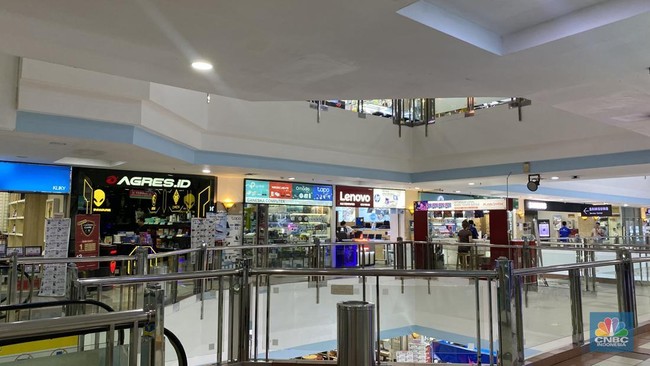
Based on CNBC Indonesia’s field observations, retailers admit it is now increasingly difficult to find new phones in the Rp1.5 million price range. A mobile phone shop employee at ITC Kuningan in South Jakarta said the rising US dollar exchange rate has also pushed up the prices of various electronic products, including smartphones. As a result, the budget phone segment that was previously much sought after by the public is gradually disappearing from the market.
“Yes, everything has gone up, all new and used devices have also increased, the rises are severe, everything is expensive,” the employee told CNBC Indonesia.
According to him, a few years ago consumers could still get a new smartphone for around Rp1.5 million. But the current situation is very different. “Now, there are no new ones at Rp1.5 million. What used to be priced at Rp1.5 million is now Rp2 million, Rp2.3 million, up to Rp2.5 million,” he said.
For consumers with a budget of Rp1.5 million, the available options are used or second-hand devices. “The cheapest new phone now is Rp2 million. For second-hand, there are still some at Rp1.5 million to Rp1.6 million, usually with 6 GB RAM,” he said. Nevertheless, the used phone market still offers some choices for people looking for devices priced below Rp1.6 million.