
New Phenomenon Emerges in Coffee Shops: What's Happening with Indonesians' Finances?
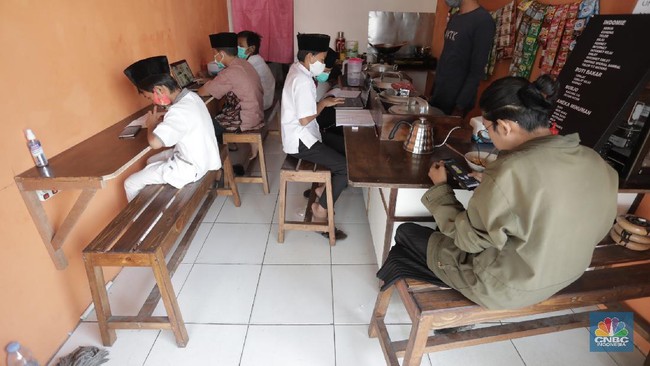
Jakarta - Activity at a number of coffee shops appears to be running normally. Customers still come to rest or simply spend time while having coffee. However, behind this condition, vendors are beginning to see a change in people’s spending behaviour. The change is visible in customers’ increasingly frugal consumption patterns when choosing menus and spending money. If previously customers came and ordered food such as noodles, mung bean porridge and drinks, now some only buy beverages or the most affordable items like fritters.
“Some eat, some just buy iced drinks,” said Doni, a coffee shop attendant in Ciputat, South Tangerang, when met on Tuesday last week. Some customers still order food as usual, but quite a few only buy soft drinks or just stop by without spending much. Even so, Doni admitted that the number of visitors coming to his shop has not yet experienced a significant decline. Activity at the shop still goes on almost all day because the location operates 24 hours. “Alhamdulillah, from the past until now there hasn’t been any decrease in visits. At most, people just stop by, just drop in,” he said. Coffee shops remain an affordable place to gather and rest. Customers who come genuinely hungry still buy food. It’s just that each customer has a similar consumption pattern. “But if they’re hungry, sometimes they order food too,” said Doni.
A similar signal is also felt by other coffee shop vendors. Iis, a coffee shop owner who has been selling for about 25 years in South Tangerang, assesses that people are now more calculating in spending their money on eating out. According to her, customers prefer cheap but filling food compared to buying a more complete menu as before. “Yes, better just fritters, as long as you’re full. There are those who spend only Rp5,000, or under Rp10,000, but Alhamdulillah,” said Iis. Iis feels the pressure on her business is more real because daily turnover has fallen quite significantly compared to a few years ago. Rising operational costs have also made profit margins increasingly thin. Vendors see this change as part of the public’s adjustment to the pressure of the rising cost of living. When the prices of daily necessities rise, consumption outside the home becomes one of the easiest expenditures to cut. Iis even assesses that this condition has been going on for quite a long time and has become increasingly felt in recent months. “For me, it was during the Covid era. Before Covid, selling was really great. But moving forward, it’s getting worse, worse today, these months,” she said.
Meanwhile, Maman, a coffee shop vendor who previously sold in Jakarta, said the phenomenon of declining sales is not only happening in one location. According to him, many small business owners are experiencing the same condition. “I’m new here, previously I looked after a coffee shop in the city area (Central Jakarta), it’s been declining lately too,” said Maman. The condition in South Tangerang turns out to be not much different from Jakarta. Yuyun, for example, as a coffee shop business owner in the Pancoran area, South Jakarta, admitted that her customers are increasingly thrifty when buying snacks at her place. Usually, people buy coffee complete with instant noodles and eggs, but now they only buy one or two items. “At most, they just buy iced coffee. Those buying Indomie are also starting to become rare, especially during the daytime like this,” she said. Not infrequently, Yuyun also encounters customers who only want to cook instant noodles like Indomie at the coffee shop where she sells. Ultimately, Yuyun also realises there is a decline in people’s purchasing power. In fact, Yuyun has also had discussions with other coffee shop business owners and found the fact that coffee shop turnover has collapsed in recent times.
Still in the Pancoran area, an employee at a coffee shop named Asep admitted there is a slight change in customer behaviour towards the end of the month. Usually, at the beginning of the month, people order menus according to their taste such as fried rice, magelangan, and instant noodles with egg. Conversely, when entering the end of the month, most of them only buy a rice and egg menu priced at Rp10,000 per portion. “Mostly, if they buy Indomie single (one pack) without egg, but add rice, it becomes Rp13,000,” Asep revealed. In fact, currently some coffee shop customers have also started to rarely order instant noodles with egg, more often ordering instant noodles plus plain white rice. Nevertheless, Asep views that sales of the coffee menu are still stable to this day because people cannot yet break away from the habit of consuming coffee. “Usually the busy time is after maghrib and earlier at 12 during lunch,” he explained.
Moving to another coffee shop, Iqbal as an employee sees that turnover at his workplace has started to decline. This is one piece of evidence that people’s spending is starting to be limited when buying snacks at coffee shops. Currently, the coffee shop where Iqbal works has started to become quiet of buyers outside of nighttime hours. In fact, the number of visitors to the coffee shop during the daytime can be counted on one hand. But fortunately, sales of instant noodles and coffee at the coffee shop where Iqbal works are still relatively stable. On the other hand, sales of the mung bean porridge menu are not very high. Moreover, the price of mung beans is currently experiencing an increase, so one portion of mung bean porridge which was previously priced at Rp8,000 per portion has now risen to Rp10,000 per portion. One coffee shop visitor, Rifky, admitted he orders instant noodles at the coffee shop with an additional pack of instant noodles that he buys at a Madura shop. He does this to suppress his spending budget. “For coffee, I still buy it. For Indomie, I still use egg. Now I’m starting to save just on the Indomie,” he explained.