
New Peer-Reviewed Study Confirms Innovative Technology Capable of Breaking the Four-Hour Limit for ESR
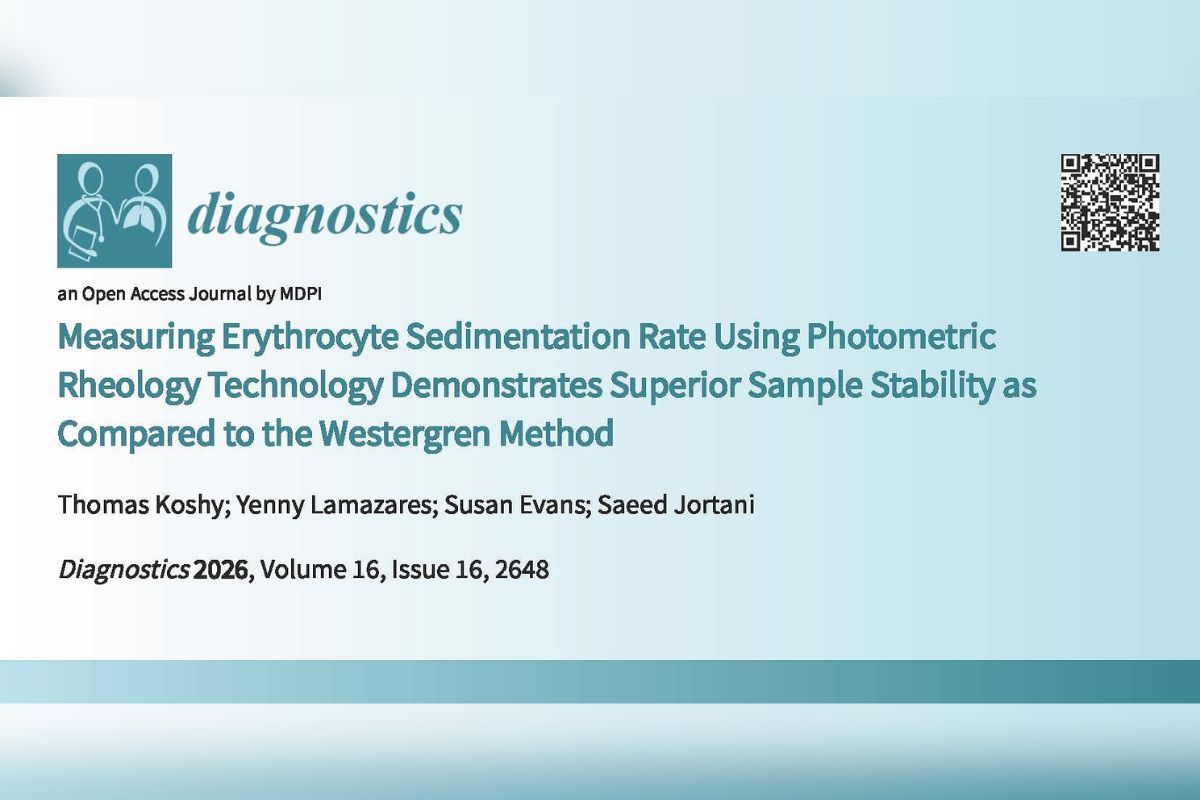
The iSED® analyzer from ALCOR Scientific is transforming laboratory workflows and improving patient care for one of the most widely used medical tests.
Independently validated, with stability up to seven times longer. ESR samples analysed using the iSED analyzer from ALCOR Scientific continue to provide accurate results for up to 28 hours at room temperature and 48 hours if stored in a refrigerator, far exceeding the four-hour limit of conventional Westergren testing.
A new breakthrough for modern laboratory logistics management. This longer sample stability helps clinical laboratories save time and costs, particularly when handling dispersed blood collection sites, longer delivery routes, and labour shortages.
Improved quality of patient care. With stability of more than a full day at room temperature, samples that arrive late or are received outside of working hours can still be tested with reliable results, thereby reducing sample rejections and re-draws while improving testing outcomes and the patient experience.
Smithfield, Rhode Island, (ANTARA/PRNewswire) - For one hundred years, a single figure has quietly served as a benchmark in Erythrocyte Sedimentation Rate (ESR) testing, used by doctors to help diagnose and monitor infections, autoimmune conditions, and various other diseases: four. This refers to four hours, a very limited timeframe for testing or storing conventional ESR samples in a refrigerator before the results are no longer reliable. A new peer-reviewed study published in Diagnostics shows that this deadline is now obsolete.
The study found that ESR samples measured using the photometric rheology method with the iSED® analyzer from ALises Scientific continue to provide accurate results for up to 28 hours at room temperature and 48 hours if stored in a refrigerator, seven times longer than the four-hour limit at room temperature with the conventional Westergren method.
The impact is highly significant. One of the most widely used medical tests is no longer constrained by a four-hour deadline. This longer sample stability provides direct benefits to clinical laboratories and the patients they serve, especially amidst challenges such as dispersed blood collection sites, longer delivery routes, and labour shortages.
The full study, titled “Measurement of Erythrocyte Sedimentation Rate Using Photometric Rheology Technology Shows Better Sample Stability Compared to the Westergren Method,” is available at https://www.mdpi.com/2075-4418/16/16/2648.
The hidden problem behind the sample delivery process
ESR is one of the oldest and most frequently requested medical tests, with millions of tests performed annually. ESR is a rapid and affordable inflammatory marker test used to help detect and monitor various conditions, ranging from infections and autoimmune diseases such as rheumatoid arthritis to inflammatory conditions like giant cell arteritis, as well as certain types of cancer. Unlike tests that measure specific molecules, ESR measures a process: how quickly red blood cells aggregate and settle in a tube, making the results highly vulnerable to the influence of time and temperature.
This vulnerability presents a particular challenge in modern laboratory operations. Simultaneously, laboratories are becoming more centralised in large-scale facilities with high testing volumes, while also having to manage an increasing number of blood collection sites and face labour shortages. Between the blood collection process and laboratory analysis, there is a network of couriers transporting samples simultaneously through routes with multiple stops, often for hours in vehicles without adequate temperature control. Meeting the strict four-hour deadline throughout this process is often impossible. Even worse, this issue remains invisible because degraded-quality samples arrive without any sign or warning. Such samples appear completely normal upon arrival, so the results are still reported and used as a basis for medical action, just like any other sample.
Beyond the sedimentation method: a new way to measure inflammation
The iSED analyzer uses an entirely different approach for ESR testing. Using photometric rheology technology, this analyser optically captures the process of red blood cell aggregation—the earliest and most critical stage in the erythrocyte sedimentation process—within a flow cell under controlled temperatures, allowing results to be obtained in less than 20 seconds. By reading the earliest stage of the aggregation process in a controlled environment, the iSED analyzer is largely unaffected by time-based changes that can reduce the reliability of conventional measurement results, allowing sample stability to last seven times longer than conventional testing.
From four hours to 28 hours: a breakthrough for laboratories
Extending ESR sample stability from four hours to 28 hours represents a breakthrough in laboratory logistics management, providing direct and tangible benefits for both laboratories and the patients they serve, including:
Reliable results: increasing confidence in the reliability of every test result, especially when samples must be transported over long distances or experience delays.
Fewer rejected samples: samples that experience delays in delivery or are received when staffing is limited can still be tested with reliable results.
Fewer needle sticks for patients: reducing the burden on patients by eliminating the need for repeated blood draws for common blood tests.
Single tube [processing]
Source: jawawa.id (https://jawawa.id/newsitem/new-peer-reviewed-study-confirms-innovative-technology-capable-of-breaking-the-four-hour-limit-for-esr-1789707657)
Originally published by Antara (Indonesian) (https://www.antaranews.com/berita/5746873/studi-baru-yang-ditinjau-sejawat-konfirmasi-teknologi-inovatif-yang-mampu-mendobrak-batas-waktu-empat-jam-untuk-esr), translated from Indonesian