
New pathway for carbon reduction established on Chinese tropical island
Haikou (ANTARA) - As an operator slowly pulls a lever, a giant claw moves to grip a pile of waste at a Waste-to-Energy (WtE) plant. The giant claw lifts no less than five tonnes of waste at once, enough to generate electricity equivalent to the annual usage of an average household.
The lifted waste is fed into an incinerator that performs combustion at temperatures exceeding 850 degrees Celsius. Located in Hainan, China’s southernmost province, the WtE plant is capable of processing approximately 4,200 tonnes of household waste every day, generating about 1.7 million kilowatt-hours (kWh) of electricity, which is roughly equivalent to the daily electricity consumption of at least 200,000 households.
This transformation of waste into energy is part of a broader low-carbon experiment in Hainan, a province known for its blue seas, tropical forests, and abundant sunshine. Since 2021, Hainan has closed 16 household waste landfill sites. With eight WtE plants now operational, the province has achieved zero landfilling of untreated household waste, saving valuable land resources while reducing methane emissions, a potent greenhouse gas produced by landfills.
However, managing waste in a more environmentally friendly manner is only part of the story. Hainton is also striving to reduce waste at the source, starting with plastic bags. This change is visible in a fresh produce market in the provincial capital, Haikou. Each of more than 300 stalls has a digital record tracking where their shopping bags were purchased, while a system generates green, yellow, or red codes daily to indicate whether the bags meet environmental requirements.
Since the digital system was introduced last April, the use of fully biodegradable bags in the market has surged from 18 per cent to 81 per cent. The call to use biodegradable bags in the market was initially met with scepticism, with some traders even hiding non-compliant bags from inspectors.
“Implementing a zero-carbon retrofit amidst high heat, high humidity, and frequent typhoons means there is no ready-made model to use as a reference,” said Zeng Youwen, chief engineer of the Hainan branch of the China Academy of Urban Planning and Design.
A meat trader surnamed Wu, who has worked in the market for seven years, was among those sceptical, assuming that more environmentally friendly bags would only be more expensive. “Only after comparing them did I realise that biodegradable bags here are cheaper than those sold elsewhere or online, and also more durable,” said Wu.
The market is just one small part of an effort spanning the entire province. Hainan is the first province-level region in China to implement a province-wide ban on non-biodegradable single-use plastic products through legislation. By the end of 2025, alternatives to the banned plastic products reached an average of 80.2 per cent in key locations, including schools, hospitals, supermarkets, and fresh produce markets.
“A ‘waste-free island’ is not just about waste management, but a green transition that encompasses the entire operation of a city,” said Wang Chenye, deputy head of the Hainan Academy of Environmental Sciences.
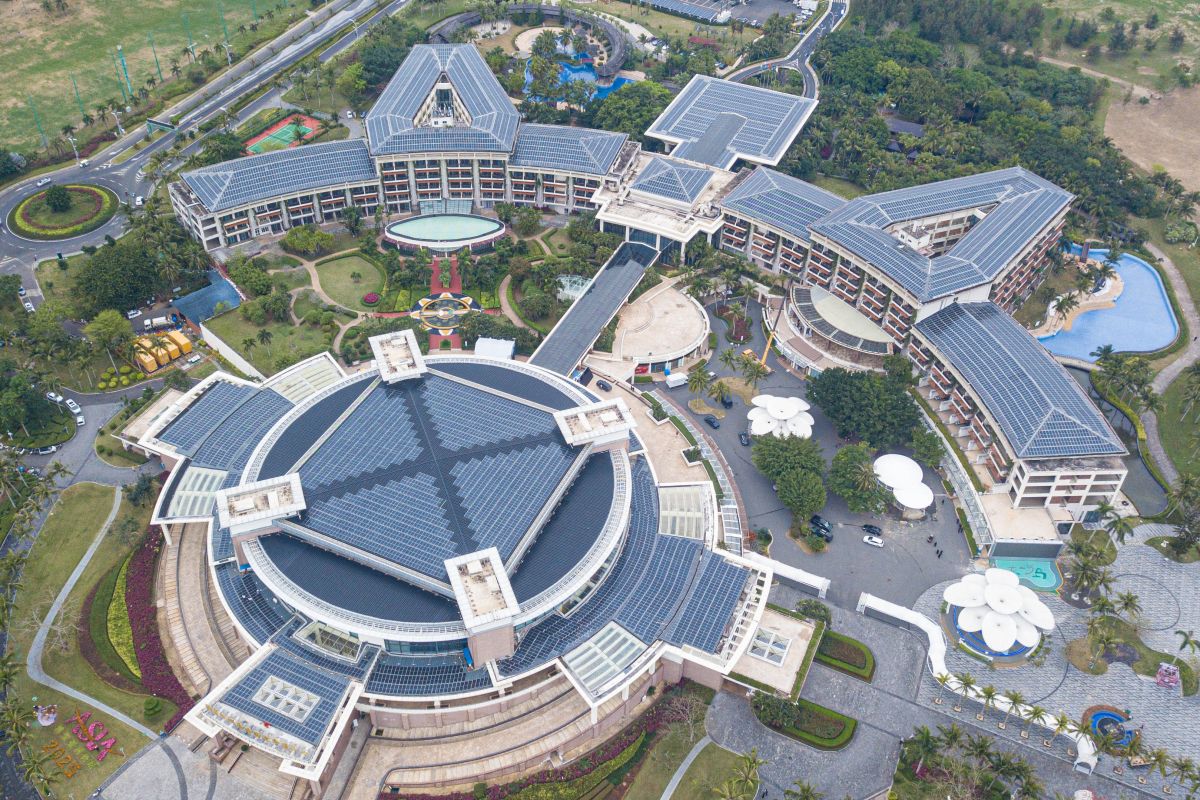
Approximately 100 kilometres from Haikou, a low-carbon experiment is also underway in Boao. The Boao Zero-Carbon Pilot Zone, China’s first project to achieve zero-carbon operations through urban renewal, was formed by retrofitting existing areas rather than building from scratch.
In a hotel kitchen on Dongyu Island, Boao, chefs swing woks over sizzling stoves, but no flames are visible. Hotel kitchens across the island have transitioned entirely to using electricity. “An entirely electric kitchen alone can cut carbon dioxide emissions by 7.5 tonnes per day,” said Luo Hu, an engineer at COSCO SHIPPING Boao Co., Ltd., a company involved in the zero-carbon pilot zone project. He added that carbon tracking has been implemented for one-fifth of dishes to help customers better understand their carbon footprint.
Across Dongyu Island in Boao, hotels and conference centres have undergone green renovations, while vehicles and ships have switched to new energy. Overall, the transformation covers 18 projects including green buildings, renewable energy, and more environmentally friendly transport, according to Luo.
The efforts have yielded results. The zone now produces more green electricity than it consumes and has entered sustainable zero-carbon operations. Energy-related carbon dioxide emissions from buildings and urban infrastructure in the zone fell from approximately 11,350 tonnes in 2019 to just 14.6 tonnes in 2025, a reduction of 99.9 per cent.
Hainan aims to take these low-carbon practices further during the 15th Five-Year Plan period (2026-2030). Based on the province’s plan for a low-carbon island, Hainan intends to complete the development of a low-carbon island before 2045 and reduce annual CO2 emissions by 70 per cent from their peak levels. The plan maps out changes in the energy, industry, transport, and building sectors, alongside efforts to strengthen the island’s carbon sinks. These efforts have already yielded tangible benefits in Hegui Village, Lingao region. Approximately 48 hectares of mangrove forests, long valued for protecting the coast from waves…