
New 'Mountain' Emerges in Java, Spewing Hot Mud and Toxic Gas
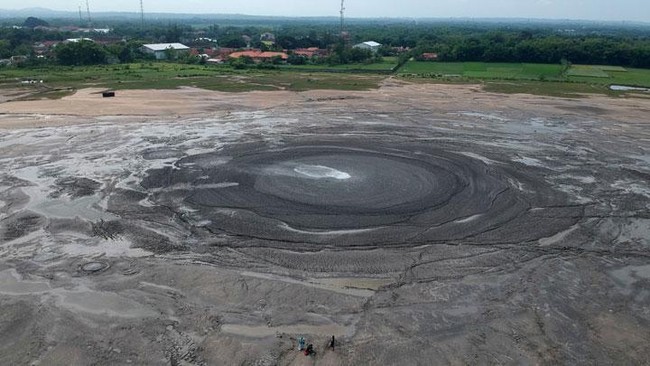
The emergence of a new hill, referred to by local residents as a ‘new mountain’ in Grobogan Regency, Central Java, has become a subject of intense discussion on social media. Many have questioned whether the phenomenon is linked to volcanic activity or the birth of a new volcano in Java.
During the event, large mounds of earth were captured in videos and photos circulating online, showing eruptions of earth resembling volcanic activity. This unusual occurrence has sparked widespread speculation, particularly as it follows a magnitude 6.5 earthquake on 22 March 2024.
Responding to the commotion, the Head of the Geological Agency of the Ministry of Energy and Mineral Resources, Muhammad Wafid A.N, clarified that the mound in Grobogan is a mud volcano. The mound stands approximately 25 metres above ground level. Its formation was caused by natural gas rising to the surface through a vertical strike-slip fault (conduit), carrying mud with a lower density than the surrounding sediment, according to the official EGSA UGM website.
According to research cited by EGSA UGM, various materials such as mud, gas, rocks, sulphur, salt, and water are ejected to the surface, forming a cone-like structure similar to a mountain. The recent earthquake caused the migration of hydrocarbons and mud to become more active due to fractures or faults resulting from shallow seismic activity, forcing hot mud to erupt with significant force.
EGSA UGM noted that mud volcanoes in Groboge are not an extraordinary incident, as they occur frequently in the region. The anomaly is attributed to rocks undergoing longitudinal faulting from the southwest to the northeast, allowing gas to escape to the Earth’s surface through permeable rock.
Regarding the risks, while mud volcanoes are not as explosive as traditional volcanoes, their eruptions impact the surrounding area, specifically causing damage to local farmland. Furthermore, the periodic and shifting eruptions of hot mud can destroy crops and fields. There is also a significant health risk from toxic gases such as hydrogen sulphide and carbon dioxide, which can be dangerous if inhaled in high concentrations. Hydrogen sulphide, which smells like rotten eggs, can cause irritation to the eyes, nose, and throat, while high concentrations of carbon dioxide can lead to shortness of breath, dizziness, or even death.
The government is expected to provide alternative solutions for residents who have lost their livelihoods due to agricultural damage. However, the phenomenon also presents opportunities for the local community in the tourism and creative industries. The mud contains valuable minerals such as lithium, kaolinite, and calcite, alongside unique microorganisms like halophilic bacteria, making it a promising material for industrial and environmental conservation applications. Further research and sustainable technology development could maximise these benefits for both society and the environment.
Additionally, the mud volcano serves as a significant research site for geologists, biologists, and environmental scientists to study chemical compositions and Earth’s crust processes, potentially uncovering valuable information regarding natural resource potential and applications in agriculture, energy, or health.