
New Ministry Urged to Strengthen Downstreaming and Energy Transition Strategies
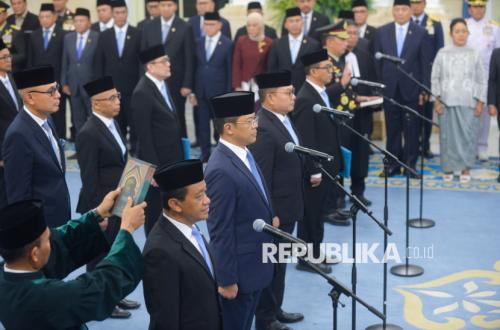
The Institute for Development of Goods and Finance (INDEF) is urging the Coordinating Ministry for Downstreaming and Energy Transition to refine downstream strategies to ensure that existing investments generate greater added value for the national economy. Improvements are necessary to address various issues, ranging from overlapping regulations and mismatches between production capacity and raw material supply to technological readiness and workforce skills.
Imaduddin Abdullah, Director of the INDEF Green Transition Initiative, believes that the formation of this coordinating ministry presents an opportunity to strengthen cross-ministerial coordination in executing the downstreaming agenda. The success of the programme depends on the alignment of government decisions, including investment licensing, raw material supply, factory construction, energy availability, and market access.
“The establishment of this coordinating ministry is an opportunity for Indonesia to advance further in the fields of energy transition and downstreaming,” Imaduddin stated in Jakarta.
According to him, downstreaming requires policy orchestration so that all industrial stages proceed in tandem. If any link in the chain lags behind, the benefits of investment and domestic value addition may fail to reach their full potential.
Imaduddin explained that the development of the critical minerals industry still faces several hurdles, including licensing issues, the need for energy infrastructure, and raw material supply risks. These problems must be resolved through cross-ministerial coordination to ensure that the development of the processing industry aligns with supply chain readiness.
On the other hand, some processing stages are actually experiencing overcapacity. This condition reflects a mismatch between production capacity, raw material availability, and market demand, which can hinder the optimisation of investment.
Technological and workforce readiness also pose challenges for the processing industry in generating greater domestic added value. Imaduddin warned that existing investments have not yet fully realised their expected production capacity, state revenue, job creation, and inter-sectoral linkages.
“Investments have been made, but production capacity, state revenue, and job creation have not yet met expectations. Downstreaming requires targeted cross-ministerial support, ranging from licensing and energy to market access. When one link in the chain is left behind, the benefits are not optimal. Therefore, the role of the coordinating ministry as a policy orchestrator is vital,” he said.
INDEF encourages the new ministry to oversee every national decision across ministries by considering the readiness of the entire downstream chain, from upstream to downstream. The certainty of demand prospects for value-added products must also be considered to ensure that built industrial capacities align with market needs.
In addition to improving downstreaming, the new ministry is expected to accelerate the energy transition agenda to support industrial needs. One programme requiring attention is the development of Solar Power Plants (PLTS) with a capacity of 100 gigawatt peak (GWp).
Imaduddin explained that the development of 100 GWp solar power requires the alignment of industrial policy, energy planning, spatial planning, infrastructure, and investment. Good institutional coordination can link the development of solar power plants with industrial estates as centres for clean energy demand.
Based on studies by the INDEF Green Transition Initiative (GTI) and Systemiq, eight priority industrial estates have the potential to absorb clean electricity of approximately 24–31 terawatt-hours (TWh) per year. This potential is equivalent to a solar capacity of about 8–13 GW, or 8–13 per cent of the 100 GWp national target.
However, realising this potential depends on resolving bureaucratic hurdles and ensuring the readiness of the power grid, land, and financing. INDEF GTI encourages the new ministry to immediately establish a cross-ministerial acceleration agenda with clear targets and deadlines, including removing barriers to renewable energy procurement and ensuring guaranteed grid access.
A mechanism for escalation to resolve strategic projects stalled by overlapping regulations or authority must also be formulated. Imadising assessed that simplifying bureaucracy through the concept of Renewable Energy Zones (REZs) could expand the potential for clean energy development.
“The new coordinating ministry can expand this potential through bureaucratic simplification via the Renewable Energy Zones (REZs) concept,” he concluded.
Source: jawawa.id (https://jawawa.id/newsitem/new-ministry-urged-to-strengthen-downstreaming-and-energy-transition-strategies-1791165250)
Originally published by Republika (https://ekonomi.republika.co.id/berita/tmere8423/kementerian-baru-diminta-perkuat-strategi-hilirisasi-dan-transisi-energi), translated from Indonesian