
New KDM Regulation: School Subsidies in West Java Now Require Waste Management
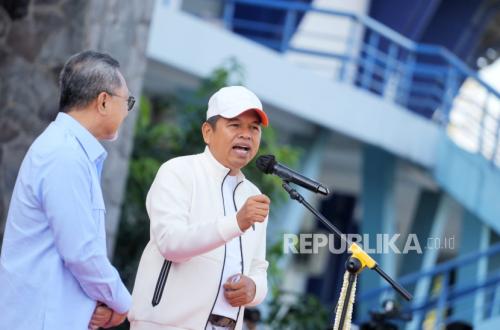
The West Java provincial government is set to enforce a policy requiring all senior high school (SMA) and vocational high school (SMK) students to collect and sort waste.
The environmental care practice will be integrated directly into Natural Sciences (IPA) lessons. Governor Dedi Mulyadi confirmed the policy after leading the Jabar Berseka Alert Ceremony at the West Parking Area of Sport Jabar Arcamanik, Bandung City, on Friday (24/7/2026).
“Later, I will enforce this for all SMA and SMK students in West Java, as these levels fall under provincial authority. Collecting and sorting waste will become part of IPA practical learning,” he said.
KDM, as Dedi Mulyadi is familiarly known, revealed that the initiative was inspired by the success of Bandung Islamic University (Unisba) in waste management. At that campus, waste management is even converted and credited as equivalent to 10 Semester Credit Units (SKS).
“My thanks to Unisba for initiating this excellent waste management programme that has been incorporated into 10 SKS,” he added.
As a concrete commitment to realising the Jabar Berseka (Clean, Healthy, Tidy, Beautiful) programme, the West Java provincial government has also made waste management an indicator and requirement for schools to receive education subsidies.
Schools are required to be able to sort and process both organic and inorganic waste into useful products.
To support the circulation of waste after sorting, the provincial government has partnered with the private sector.
“I have already cooperated with an industrial-scale waste management company. So, waste that has been sorted at schools will be transported directly to that recycling company,” KDM explained.
To strengthen regulation at the broader community level, KDM is preparing a gubernatorial regulation (pergub) banning indiscriminate waste disposal. The regulation contains firm sanctions in the form of administrative fines or penalties for violators.
“Finally, I will issue a pergub banning littering, and violators will face fines or penalties,” he asserted.
Appreciation and Synergy
The Jabar Berseka Alert Ceremony, attended by more than 4,000 participants from various elements of society, was also attended by the Coordinating Minister for Food Affairs, Zulkifli Hasan. Zulkifli expressed high appreciation for the proactive steps taken by the West Java provincial government.
“I greatly appreciate the West Java provincial government and all elements of society present at this ceremony. I am convinced that if this movement becomes as massive as this, Indonesia will be ASRI (Safe, Healthy, Tidy, Beautiful),” he said.
According to Zulkifli, the waste problem is a shared responsibility that must be resolved at its source. He encouraged firm, tiered regulation at the regional level.
“There must be strict rules and synergy from governors, regents, mayors, down to communities so that waste problems are resolved where they arise. If we work hand in hand, I am confident that by 2029 we can handle 80 per cent of the national waste problem,” Zulkifli asserted.
As a sign of joint commitment, the Waste Management Declaration was signed at the ceremony by the Coordinating Minister for Food Affairs, the Governor of West Java, regional leaders (the Mayors of Bandung and Cimahi, the Deputy Regents of Bandung and West Bandung, and the Regional Secretary of Cimahi City), as well as the rectors of universities in Greater Bandung (ITB, Unisba, Digitech University, UTB, and Unikom).
The occasion was also marked by the handover of innovative waste-processing equipment from the National Research and Innovation Agency (BRIN) by the Coordinating Minister for Food Affairs, as well as the presentation of the West Java Governor’s Charter of Appreciation to several figures and institutions that have made tangible contributions to environmental management.
KDM is optimistic that the Jabar Berseka programme, running in parallel with the Coordinating Ministry for Food Affairs’ programme, will accelerate the creation of clean urban environments.
“Cities in West Java are already beginning to look cleaner. Going forward, they will become even cleaner in step with Pak Coordinating Minister’s programme, as organic waste will be converted into organic fertiliser supporting food productivity. Hopefully this becomes the spirit of all of us towards Jabar Berseka and an ASRI Indonesia,” the Governor concluded.