
New Einstein Wormhole Theory: Hidden Time Mirror
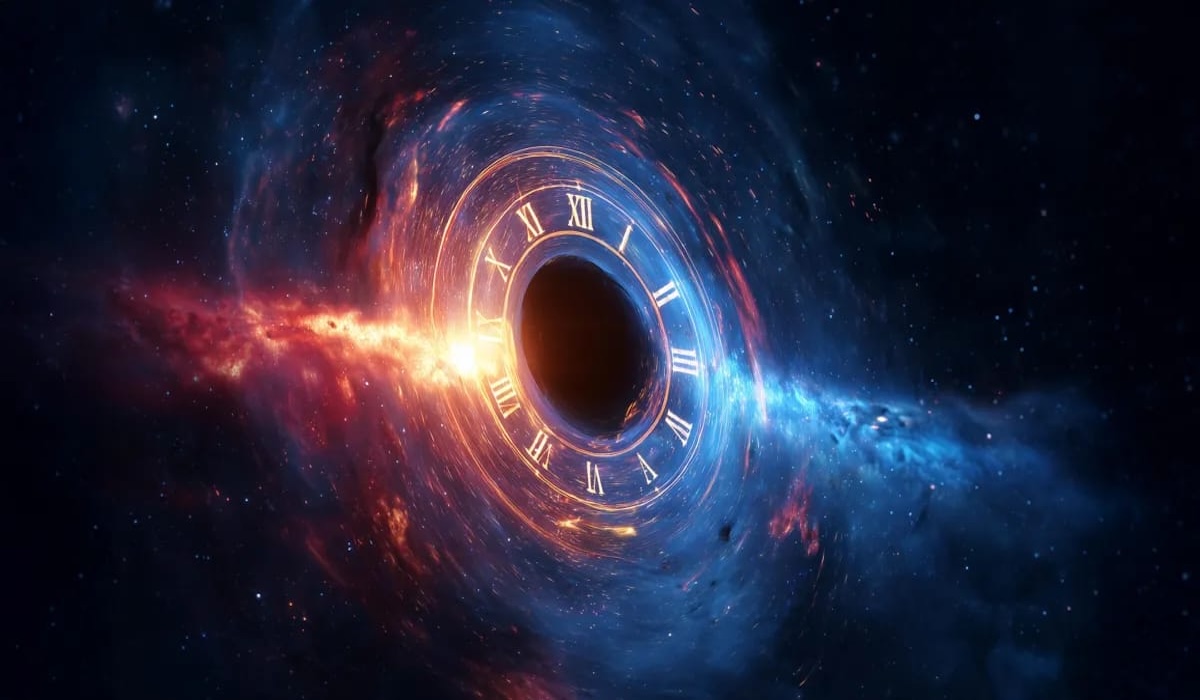
The concept of wormholes, long known as intergalactic tunnels, has received a revolutionary new interpretation. Recent research suggests that the original idea by Albert Einstein and Nathan Rosen is likely a ‘time mirror’ connecting two opposing directions of time. The study revisits the ‘Einstein-Rosen bridge’ concept introduced in 1935. Rather than functioning as a physical pathway through space, the mathematical model is understood as a unique space-time connector where one side moves forward in time while the other moves backward. This new approach is seen as key to unifying general relativity and quantum mechanics, which have long been difficult to reconcile. Additionally, the time mirror theory offers a solution to the black hole information paradox popularised by Stephen Hawking in 1974. Researchers argue that information entering a black hole is not lost but instead shifts to the opposite time direction. This also sparks scientific speculation that the current universe may have formed from within a black hole in another cosmos, or as a transition from a previous cosmic phase. Although not intended to prove the existence of time machines, the theory provides scientists with a fresh perspective on gravity and the early history of the universe. ‘The Einstein-Rosen bridge can be understood as a connector between two different time directions. On one side, time moves forward, while on the other it moves backward like a mirror reflection,’ the research report states, as cited from Science Daily. (Z-10) Within the framework of special relativity theory, Einstein stated that the speed of light in a vacuum is constant and independent of photon energy or observer conditions. Low and high-energy photons arrive simultaneously, in line with Einstein’s special relativity predictions. Mars has gravity approximately one-fifth that of Earth’s and is farther from the Sun. The discovery comes from the Laser Interferometer Gravitational-Wave Observatory (LIGO) in the United States, in collaboration with Italy’s Virgo team and Japan’s KAGRA. Using ultra-fast lasers and specialised cameras, scientists have successfully replicated the Terrell-Penrose effect in a laboratory for the first time.