
New Earthquake Early-Warning Breakthrough in Indonesia Uses Mosque Loudspeakers
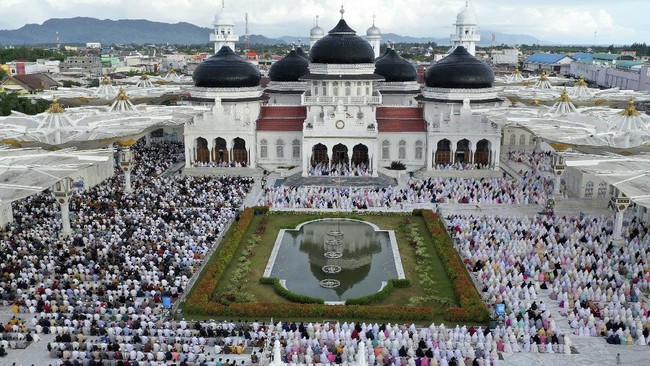
Jakarta, CNBC Indonesia — Scientists designing an earthquake early-warning system in Indonesia are taking an unconventional approach. Drawing on the country’s strong religious life and local wisdom, they are developing an alarm network capable of reaching remote villages using one principal tool: mosque loudspeakers.
In a five-year pilot project, a team of researchers is testing whether mosque loudspeakers, normally used to broadcast the call to prayer, can also serve as earthquake early-warning sirens.
“Almost every settlement in Indonesia has a mosque,” said project leader Dr Inoue Hiroshi of Kyoto University’s Disaster Prevention Research Institute in Japan, according to The Guardian, as quoted on Tuesday (13 October 2026.
The idea first occurred to Inoue nearly two decades ago, when he was studying the impact of the devastating 2009 earthquake in Sumatra, which killed more than 1,000 people. He believes many lives could be saved if people received a warning seconds before severe shaking began.
A practical solution to infrastructure challenges
Given Indonesia’s vast geography and archipelagic landscape, a network of mosque loudspeakers offers advantages that few other countries can match. There are hundreds of thousands of them, and they have a vital additional benefit: local communities maintain them themselves.
“The greatest challenge in disaster infrastructure is maintenance. Mosque loudspeakers, however, are always looked after because residents take care of them directly,” Inoue said.
Andi Eka Sakya, a senior researcher at the National Research and Innovation Agency (BRIN), described the initiative as a potential major breakthrough. Unlike tsunami warnings, which can provide several minutes or even hours of lead time, seismic waves travel very quickly. A village 50 kilometres from an earthquake’s epicentre, for example, may have only five to 10 seconds to respond.
Although the project remains at the prototype stage and is not yet broadcasting widely to the public, it is expected to run until 2030 and aims to give residents crucial time to get to safety.
Safety guidance tailored to local building characteristics
As well as using mosques, the research examines differences in how people respond to earthquakes in Japan and Indonesia.
In Japan, official guidance tells people to take cover under a table (“drop and cover”) because buildings are earthquake-resistant. By contrast, Indonesia has many low-rise homes made of unreinforced brick masonry that are highly vulnerable to collapse. People are therefore more likely to survive by running straight outside.
Researchers are now testing and developing disaster-mitigation guidance best suited to the characteristics of Indonesian buildings and the habits of local communities.
Other countries take note
The use of places of worship for emergency response is attracting interest in other countries.
In the United Arab Emirates, mosque loudspeakers are being prepared for use in warnings about nuclear radiation leaks. In Uzbekistan, the government and the United Nations Development Programme are running a pilot project across 272 mosques to provide early warnings of flash floods, landslides and avalanches.
The approach has been adopted because mosques are considered trusted social institutions with strong influence and close emotional ties to local communities.
Source: jawawa.id (https://jawawa.id/newsitem/new-earthquake-early-warning-breakthrough-in-indonesia-uses-mosque-loudspeakers-1791888660)
Originally published by CNBC Indonesia (https://www.cnbcindonesia.com/tech/20261013115122-37-775688/terobosan-baru-peringatan-dini-gempa-di-ri-pakai-toa-masjid), translated from Indonesian