
New Criminal Code: Perbarindo DKI urges rural banks to strengthen governance and compliance
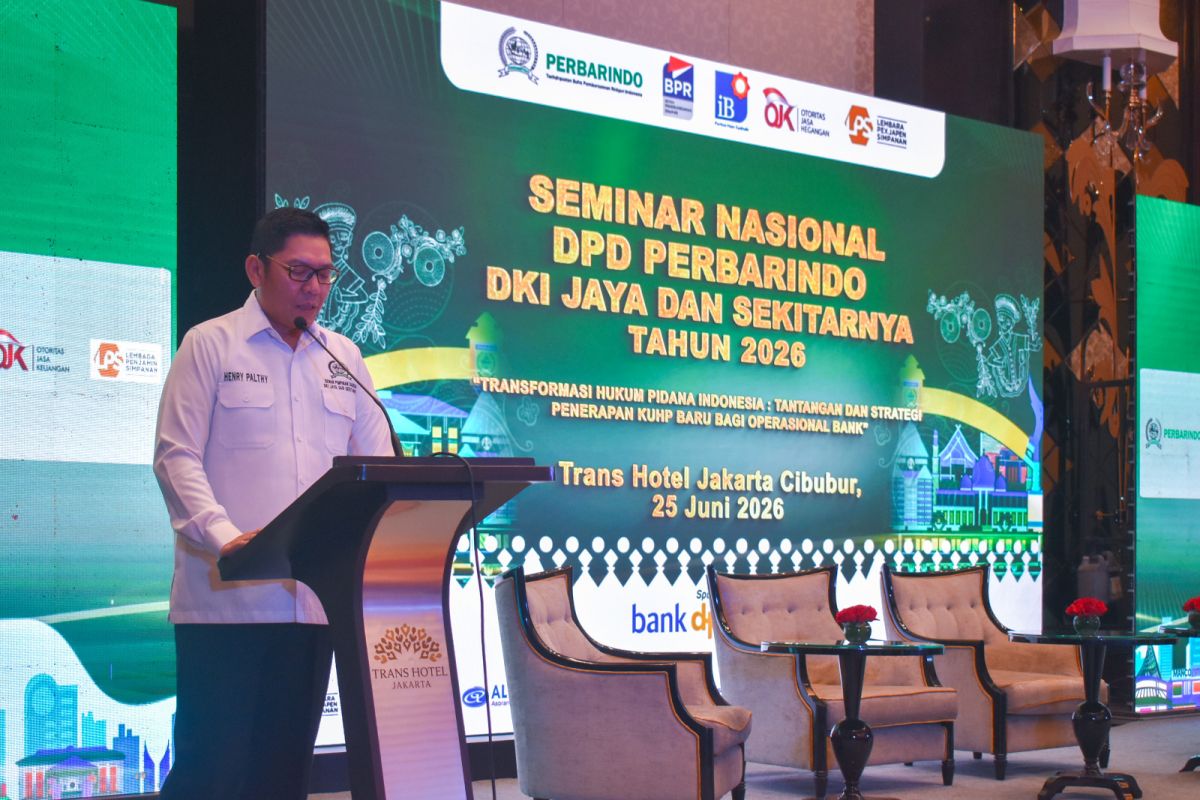
The Regional Leadership Council (DPD) of the Indonesian Rural Banks Association (Perbarindo) for DKI Jaya and Surrounding Areas is urging Rural Banks (BPR) and Sharia Rural Banks (BPRS) to strengthen governance and compliance in implementing the new Criminal Code (KUHP). The national criminal law reform was enacted through Law Number 1 of 2023 concerning the KUHP and Law Number 8 of 2025 concerning the Criminal Procedure Code (KUHAP).
Henry Palthy, Chairman of DPD Perbarindo DKI Jaya and Surrounding Areas, stated in Jakarta on Friday that the implementation of the new KUHP is a concern for the banking industry as it brings changes that BPR and BPRS personnel must understand, particularly regarding legal risk mitigation. “The enactment of the new KUHP is our concern so we can be better prepared to face compliance challenges, governance, and legal risk mitigation. This KUHP is not just for the legal world, but its implementation also affects the banking industry,” Henry said.
Speaking at the opening seminar of the Second Regional Work Meeting (Rakerda) of DPD Perbarindo DKI Jaya and Surrounding Areas in Jakarta on Thursday (25/6), he said the BPR and BPRS industry plays a strategic role in maintaining public trust. Therefore, it is necessary to understand the policy direction of the new KUHP, from exploring the perspectives of academics and criminal law practitioners to formulating banking operational adaptation strategies and strengthening prudential principles and transparent governance. “BPR and BPRS will be highly risky if not run with good governance. This KUHP will ensnare stakeholders and executors in legal entanglements. Hopefully, this seminar brings real benefits, strengthens integrity, and becomes a strategic step in building a more resilient banking sector in the era of Indonesia’s criminal law transformation,” Henry added.
Meanwhile, Teddy Alamsyah, General Chairman of the Perbarindo Central Executive Board (DPP), noted that as of December 2025, the BPR industry had disbursed loans amounting to Rp156.29 trillion with third-party fund collection reaching Rp148.44 trillion. However, the non-performing loan (NPL) ratio for BPRs remains at 11.83 percent, while capital growth was recorded at 28.95 percent. Teddy said this condition demands that BPR/BPRS strengthen credit risk management, maintain liquidity adequacy, sustain healthy capital, and enhance supervision.
He also highlighted several violations that need attention in banking operations, including fictitious credit disbursement, unrecorded deposits or savings in bank openings, credit instalment payments not forwarded to the bank, fund withdrawals without customer knowledge, and receiving gratuities in credit provision. To prevent these violations, he assessed that the banking industry needs to strengthen good corporate governance, fraud risk management, cybersecurity, system access control, and the implementation of anti-money laundering programmes, among others.
Beniharmoni noted that the most fundamental change in the new KUHP is the recognition of corporations as subjects of criminal law. “The new KUHP is a step in transforming the subject of criminal law from individuals to corporations, in accordance with the mandate of Article 45 paragraph (1) of Law 1/2023, where corporations are subjects of criminal acts. This is a new era for national criminal law,” he said. He therefore reminded BPR industry players to avoid criminal risks such as manipulation, abuse of authority, document forgery, or unlawful acts, as they can be subject to criminal sanctions under the latest KUHP provisions and the Banking Law. “If negligent, they can be charged under KUHP Articles 391-392 and Article 49 paragraph (1) of Banking Law 10/1998 concerning document forgery, with penalties of 5 to 15 years imprisonment and fines of Rp10 million to Rp200 million,” Beniharmoni revealed.