
New Chapter in the Seyegan 'Fire House' Mystery
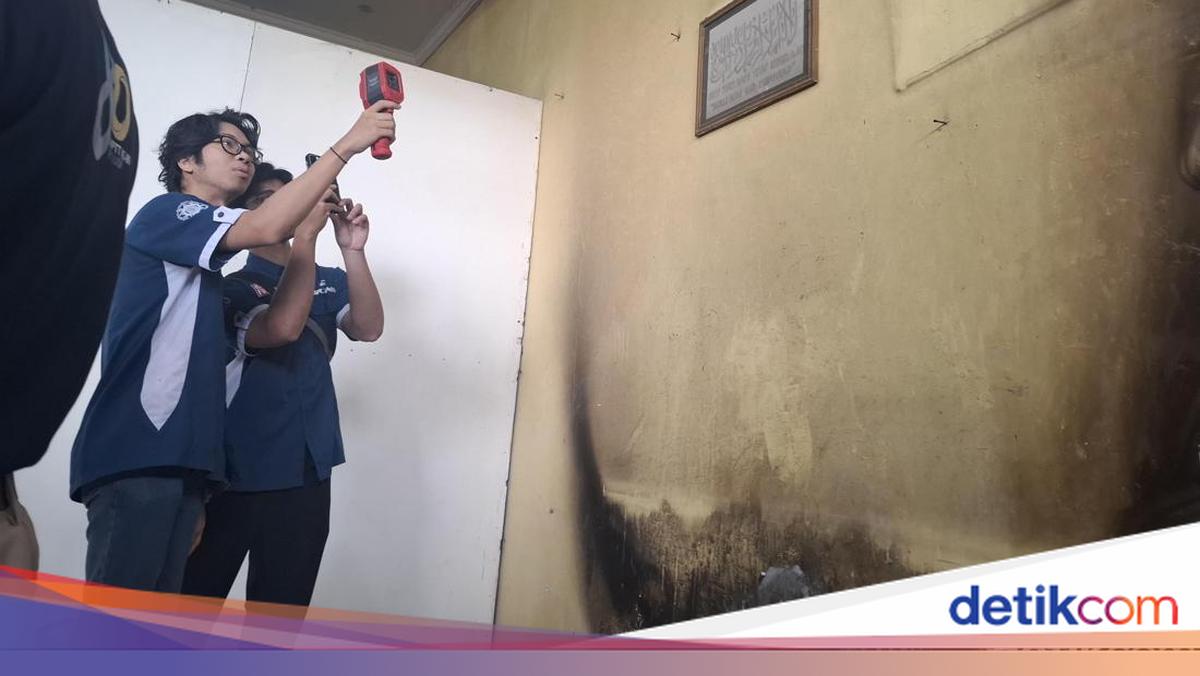
The Sleman Regency administration has concluded that the series of fires which broke out at the home of Mutfia, a resident of Seyegan, Sleman, were not caused by a natural phenomenon. Police have now stepped in to investigate the possibility of human involvement in the repeated fires. The conclusion that the fires were not a natural phenomenon was delivered by two research teams from Universitas Gadjah Mada (UGM) and UPN ‘Veteran’ Yogyakarta.
The Centre for Entropy Degradation Studies (PKPE) at UGM’s Faculty of Engineering concluded that the fire terror phenomenon at the Seyegan resident’s home was unrelated to gas. The appearance of the fire is suspected to be associated with polyvinyl chloride (PVC) resin. “The source of the fire is not from natural gas seepage from below the surface (floor), there is no thermal anomaly and no gas was found that could self-ignite naturally at room temperature,” explained the head of the PKPE FT UGM team, Prof Alva Edy Tontowi, to journalists at FT UGM on Saturday (13/6/2026). Based on the research results and referring to the Fire Triangle Theory principle, the team concluded that the electromagnetic field was measured at a safe level, meaning it was not the ignition source for the flames. The fire that burned materials in this case is likely associated with the presence of PVC resin, which is flammable when it encounters an ignition source. This suspicion arose after PVC resin was found on the burned materials. On Friday (12/6), the team took further samples from fire residue on ceramic wall surfaces and wood/plywood, and analysed them using the FTIR method. “The FTIR analysis results show that these samples contain polyvinyl chloride (PVC), which is not commonly found on ceramic wall or wood/plywood surfaces,” he explained.
A similar view was expressed by the geologist team from UPN ‘Veteran’ Yogyakarta. The UPN research team found no connection between the gas discovered in the Nepen River and the fire case at Mutfiana’s house. “We are officially closing (the research). So, there is absolutely no connection between the gas in the Nepen River and the house that caught fire,” said the Dean of the Faculty of Mineral and Energy Technology (FTME) at UPN ‘Veteran’ Yogyakarta, Prof. Dr. Ir. RM. Basuki Rahmad, when met by journalists at the Sleman Regency office on Monday (15/6/2026). This conclusion was drawn from a series of research results conducted by the UPN geologist team, including surface geological observations. From these, the team obtained initial clues in the form of dark claystone strongly suspected to be the source of swamp gas. “However, it turned out that when we checked the gas with a flame, it would not ignite. So, the bubbles are indeed strong,” he continued. Other data also indicated the presence of several faults, which were then validated using geoelectric and geomagnetic methods. The results of both observations found a fault directly beneath Fia’s house. “So, we narrowed it down and concluded that we found no connection between the house that burned and the gas bubbles we found in the Nepen River, which are 250 metres away,” he concluded.
The Sleman Regency administration delivered the final conclusion of the research into the mysterious fire phenomenon that burned items in the Seyegan resident’s home. This was stated by the Chief Executive of the Sleman Regional Disaster Management Agency (BPBD), Bambang Kuntoro, following an inter-agency meeting at the Sleman Regent’s office. The meeting was attended by teams from UGM, BPPTKG, UPN, and other relevant agencies to present their final research results. Bambang said the conclusion was that the appearance of the mysterious fires had no connection to natural phenomena. “The essence is that from the fire phenomenon that appeared in Seyegan, based on all the research results presented earlier, there is no connection (to natural phenomena) with the fire that appeared. Natural phenomena did not cause the fire that appeared in Seyegan,” Bambang told journalists at the Sleman Regent’s office on Monday (15/6/2026). In addition to the UGM and UPN research results, the agency also presented test results from BPPTKG, which stated that no indications of hazardous natural gases that could cause a fire had been found, and based on temperature measurements, no significant temperature anomalies indicating a trigger for the fire were discovered. “The gas content, whether methane, hydrogen, phosphine gas, or swamp gas, from each of these, cannot or is below the threshold to cause a fire,” he stressed.
Based on this conclusion, the police have now stepped in to conduct an investigation to uncover the cause of the recurring fires. The Head of the Criminal Investigation Unit of the Sleman Resort Police, AKP Mateus Wiwit Kustiyadi, said his party would seek out the facts in this incident. “In this case, we are looking for facts. Where will these facts lead us? So, we are gathering the facts on the ground,” said Wiwit when met at the Sleman Regent’s Office on Monday (15/6/2026). Wiwit stated that the police have not yet investigated the possibility of a criminal element in this case. Before moving to that stage, the police will first determine whether there was an element of intent or not in this incident. “Later, whether there are things beyond natural phenomena, we will still gather information, so the facts will be revealed after this,” he concluded.