
New B50 Fuel to Launch Tomorrow, Here's Its Engine Performance
The government is scheduled to officially launch a new type of diesel fuel featuring a 50% palm oil-based biodiesel blend (B50) on Thursday (9/7/2026). This policy is part of the government’s strategy to reduce dependency on diesel imports.
How, then, will the use of B50 affect vehicle engine performance?
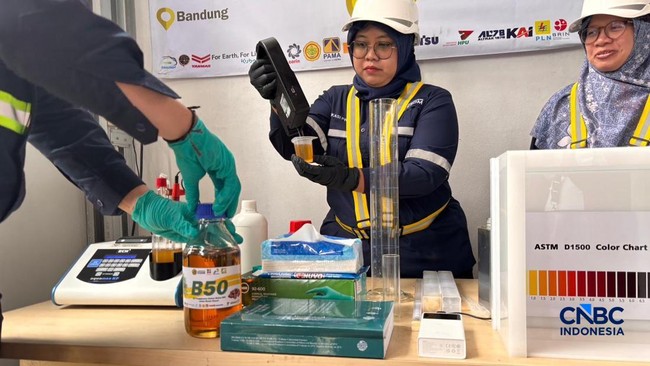
The Ministry of Energy and Mineral Resources (ESDM) has revealed the results of engine performance tests using B50 biodiesel. Based on laboratory and road tests, the quality of Bedy B50 was deemed to meet standards, notably with water content significantly below the maximum established limit.
The Director General of New, Renewable Energy, and Energy Conservation (EBTKE) at the Ministry of ESDM, Eniya Listiani Dewi, explained the technical parameters from the laboratory and field test results. One key finding was that the water content in the B50 blend was a factor in maintaining diesel engine stability during road trials.
“The water content test results are out, at 208.81 ppm. This is below the 300 ppm limit. It is better because the lower, the better. High water content is often cited as a factor that disrupts engine performance. Therefore, we are emphasising that the lower the water content, the better,” she stated at the B50 Road Test Blending and Refuelling Station in Lembang on Wednesday (8/7/2026).
The government is indeed tightening the technical specifications for B50 compared to the current B40 programme. The monoglyceride parameter has been reduced to a maximum of 0.47% by mass, and oxidative stability has been increased to a minimum of 900 minutes to ensure engine performance remains maintained despite the increased percentage of plant-based blends.
“We have set these requirements for biofuel business entities to ensure good performance. It has certainly been enhanced because we also test the performance; that is why we have set the B100 specifications to be much higher,” explained Eniya.
In addition to engine stability, the use of B50 has been proven capable of reducing sulfur levels in the fuel by up to 50%. With the reduction of half the sulfur content, the emission quality produced by diesel vehicles is claimed to be approaching Euro-4 environmental standards.
“FAME (Fatty Acid Methyl Ester) serves to reduce sulfur as well. With a 50% blend, the sulfur drops by 50%. Since there is no sulfur content in the blend itself, it is mixed to become only about half. It is approximately approaching Euro-4,” she added.
Regarding engine component conditions, the authorities reported no significant issues, such as clogging that would require rapid filter replacement. Furthermore, fuel consumption in the tested vehicles remained within the standard range set by their respective manufacturers.
“Regarding engine performance, it was reported that there was no need for filter changes. The technical team’s report confirmed this. For instance, if a manufacturer’s claim is 11 km/litre, the result was 11.04, which actually meets the manufacturer’s claim. We can confirm that,” she concluded.
Based on Ministry of ESDM data, the implementation of the B50 programme is projected to save the state’s foreign exchange by up to Rp 157.28 trillion. Beyond the economic aspect, the policy is also expected to increase national employment, with a target of absorbing more than 2.2 million workers.
From an environmental perspective, the use of B50 is targeted to reduce greenhouse gas emissions by 46.72 million tonnes of CO2 by 2026. As of mid-April 2026, the national biodiesel distribution realisation had reached 3.90 million kilolitres, or approximately 24.9% of the total initial allocation of 15.65 million kilolitres for the year.
Technically, the B50 specifications have been enhanced to maintain engine performance, including reducing water content to a maximum of 300 ppm and monoglycerides to a maximum of 0.47% by mass. Oxidative stability has also been strengthened to a minimum of 900 minutes to guarantee high fuel quality during storage and distribution across various regions.