
New B50 Fuel Begins Vehicle Testing, Here Are the Results on the Engine
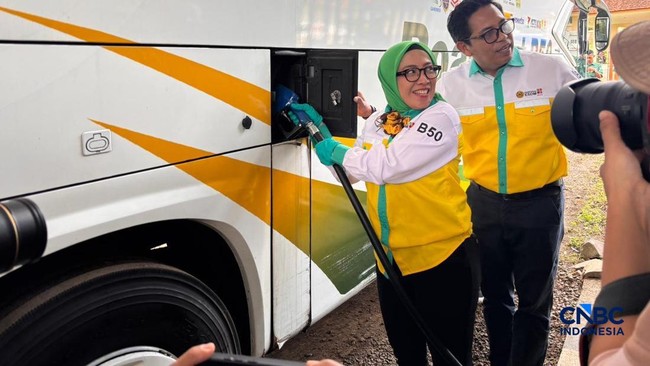
Lembang, CNBC Indonesia - The Ministry of Energy and Mineral Resources (ESDM) has revealed the results of tests conducted on a blend of petroleum fuel (BBM) with 50% biodiesel (B50). The outcomes indicate positive performance for vehicle engines.
The testing demonstrates that using a 50% palm oil mixture can reduce sulphur levels by half, nearing Euro-4 emission standards.
Director General of New, Renewable Energy, and Energy Conservation (EBTKE) Eniya Listiani Dewi explained that automotive sector testing has achieved the target of 40,000 km mileage without any technical issues on the engines. Meanwhile, the full series of tests across six different sectors is proceeding on schedule to ensure national implementation readiness.
“If the blend is 50%, the sulphur drops to 50% of its original level. There’s no sulphur content initially, but when mixed, it becomes about half from the original sulphur amount in B0. It’s roughly approaching Euro-4,” she stated at the B50 Mixing Area in Wisma Balitsa, Lembang, on Tuesday (21/4/2026).
From a technical perspective, the test results show the water content in B50 at 208.81 ppm, below the maximum threshold of 300 ppm. The tests also indicated no need for engine filter replacements during the trial period.
Eniya noted that this signifies the fuel’s characteristics are safe for diesel engines.
“That means it’s under 300 ppm. Even better because lower is better. High water content is what often affects engine performance. So we emphasise keeping water content as low as possible. And the engine performance reported no filter changes,” Eniya clarified.
The testing involved nine vehicles from Japanese and European manufacturers, such as Mercedes-Benz and UD Trucks. According to records, the trials showed that fuel consumption in passenger vehicles remained efficient and aligned with manufacturer specifications.
“The technical team’s report indicates it’s consistent. If the claim is 11, it was 11.04, so only the last two digits changed, actually matching the manufacturer’s claim. We can confirm that,” she added.
B50’s technical specifications also record an improvement in monoglyceride levels, dropping to a maximum of 0.47% by mass compared to B40. Additionally, oxidation stability has been enhanced to a minimum of 900 minutes to ensure fuel durability during storage and use.
Besides automotive, B50 testing is being conducted simultaneously in mining, agricultural equipment, maritime, power generation, and railway sectors. The team projects that all test results will be completed by next May.
Thus, the mandatory B50 programme, scheduled to begin in July 2026, is projected to deliver economic benefits with potential foreign exchange savings of Rp 157.28 trillion. Environmentally, B50 use is targeted to reduce greenhouse gas emissions by up to 46.72 million tons of CO2 in 2026.
The transition period from B40 to B50 is estimated to last about three months, covering tests in six major sectors. The automotive sector is targeted for completion in June 2026, while heavy equipment, agriculture, railways, maritime transport, and power generation will be finalised progressively until December 2026.
“By July, three sectors will be done. So automotive finished, mining finished, maritime finished. For railways, next week we’ll run it on the route from Yogyakarta to Pasar Senen, from Lempuyangan Station to Pasar Senen continuously,” Eniya concluded.