
Netravest: UPI Students Innovate AI Vest to Assist Visually Impaired Navigation
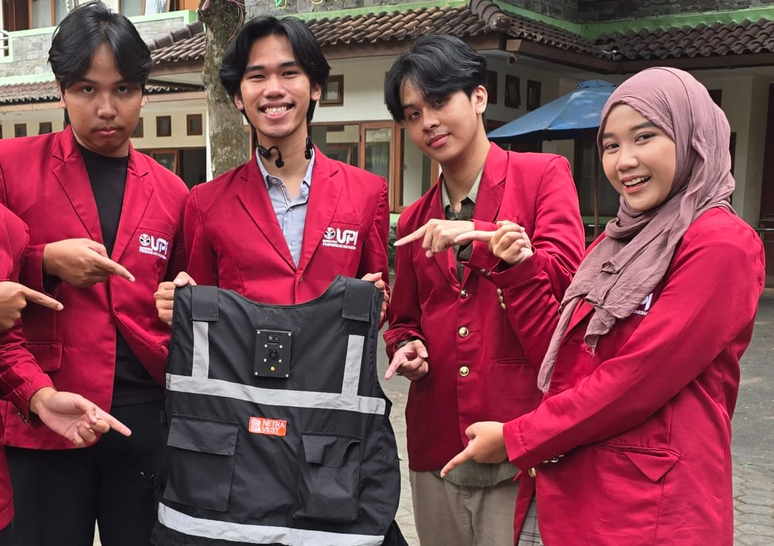
Mobility for visually impaired individuals often presents significant challenges, particularly when facing obstacles that cannot be detected by a conventional white cane. Addressing this issue, five students from Universitas Pendidikan Indonesia (UPI) have created Netravest, an intelligent navigation vest based on artificial intelligence (AI) designed to provide real-time environmental information.
This wearable device was developed by Raden Farhan Rizki Septrian, Najwa Adistia Nisrina, Muhammad Fattan Al Farisi, Sulthan Ariq Haikal, and Hanif Muzaffar Gunawan, under the supervision of lecturer Muhammad Taufle Dwi Putra, M.T.I. The project is part of the 2026 Student Creativity Programme in the field of Creative Works (PKM-KC).
Netravest does not rely on a single sensor but instead combines several cutting-edge technologies through a sensor fusion approach. At the core of the device is a computer vision system using the YOLOv8n algorithm, which has been trained with over 30,000 datasets to recognise more than 20 classes of obstacle objects.
For distance accuracy, the team has integrated LiDAR (Light Detection and Ranging) sensors. “Both information sources are then combined through sensor fusion. This approach allows the camera and LiDAR to complement each other, especially when the characteristics of an object are not sufficiently detected through a single sensor alone,” explained the Netravest Team Leader, Raden Farhan Rizki Septrian.
A primary reason for the development of Netravest is the limitation of white canes in detecting objects located above the waist, such as low-hanging billboards, banners, or tree branches. This vest is designed to detect obstacles both below and above the user’s field of vision.
Detection information is delivered via bone conduction technology. This choice is crucial as it allows users to continue hearing ambient environmental sounds without being obstructed by earphones, which is vital for the safety of visually impaired individuals in public spaces.
In addition to navigation, Netravest is equipped with a feature to recognise Indonesian Rupiah denominations. Users simply need to bring currency close to the camera (at a distance of approximately 30 cm), and the system will announce the denomination within 200 milliseconds. This feature aims to increase user independence during offline transactions.
Regarding safety, there is an integrated SOS system connected to a companion application and a Telegram bot. If a user is in an emergency, they can hold a button on the vest for three seconds to send their last GPS location and device status to a guardian or companion.
The Director of Student Affairs and Alumni at UPI, Prof. Dr. Hj. Siti Nurbayani Kusumaningsih, expressed high appreciation for this innovation. According to her, Netravest is tangible proof of how student creativity can produce inclusive social solutions.
“Netravest is a proud achievement because it does not just produce technology, but demonstrates how student knowledge and social concern can be transformed into real solutions for society,” she concluded.
Currently, the team continues to conduct functional testing and monitoring from August to September 2026 to refine ergonomic aspects and power efficiency before the device is ready for wider use.