
Netanyahu Increasingly 'Reckless' Before Trump, Brazenly Attacks NATO Ally
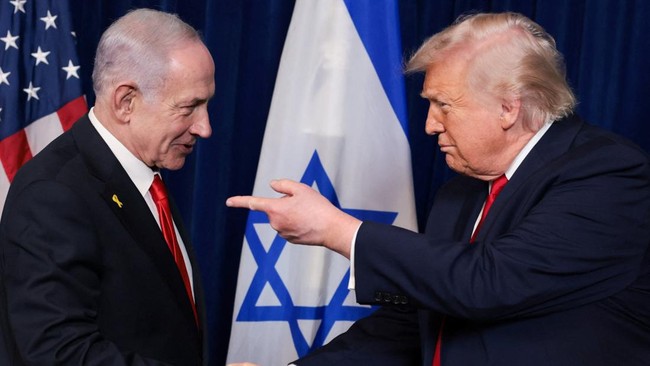
Amid growing signs of discord between US President Donald Trump and Israeli Prime Minister Benjamin Netanyahu, the impact of Israel’s military airstrike on a Syrian military site is believed to have the potential to trigger a much broader geopolitical shift.
Citing Newsweek on Thursday (20/08/2026), the site struck by Israel was the Abu al-Duhur Air Base in Idlib Province. The base had in fact only hosted a Turkish military delegation a few hours earlier, which was reported to be working to rehabilitate the facility as Ankara builds relations with the new Syrian government that had previously succeeded in toppling the dictatorial regime of Bashar al-Assad in Damascus.
Turkey’s Foreign Ministry immediately issued a strong condemnation of the attack. When Netanyahu’s office justified the brutal strike by accusing Syria of violating a security agreement by allowing Turkish forces to be stationed at the air base near Aleppo, the Turkish government dismissed the flimsy accusation.
“To legitimise Israel’s illegal airstrike targeting Syria’s sovereignty and territorial integrity,” the ministry asserted.
Surprisingly, Washington also followed Turkey’s lead in sharply criticising Israel’s reckless operation. US Special Envoy Tom Barrack publicly expressed deep concern.
“An unnecessary escalation,” he said.
This is not the first time the Trump administration has appeared to side more with Turkish President Recep Tayyip Erdogan than with Netanyahu. Moreover, Trump has yet to give full support to the Israeli PM ahead of the crucial election in October. This rift may prove highly consequential as both leaders grapple with domestic pressures pushing them in opposite directions.
Former US official Brian Katulis explained that Trump and Netanyahu are both in weak political positions at home. Trump faces his lowest voter approval ratings and a public weary of the economic pain caused by his war in Iran. This contrasts with Netanyahu, whose reputation remains severely damaged by the Hamas attack of 7 October 2023.
“Netanyahu’s primary policy and political objective centres on demonstrating that he can protect Israeli citizens once again, which is why he continues to pursue aggressive military campaigns on multiple fronts that appeal to his extreme right-wing coalition members,” Katulis said.
“Trump, on the other hand, faces a war-weary American public feeling economic hardship, so Trump is seeking de-escalation, a direction opposite to Netanyahu’s,” he added.
Meanwhile, Trump has credited Erdogan for his role in toppling the Assad regime in Syria and continues to support Ankara’s efforts to embrace the new government in Damascus led by President Ahmad al-Sharaa. The growing US cooperation with Sharaa is something Netanyahu continues to oppose.
Not only in Syria, Trump also ignored Netanyahu’s strong protests when he announced he would lift restrictions on the sale of F-35 stealth fighter jets to Turkey, which had previously been imposed due to Ankara’s purchase of the S-400 missile defence system from Russia.
Amid these tensions, various regional players now appear to be accelerating efforts to explore new deterrence networks due to major questions about the extent of current US security commitments. The most prominent development is the signing of a mutual defence agreement between Turkey, Saudi Arabia, and Pakistan, subsequently dubbed the “Mecca Pact”.
The formalisation of the three Sunni Muslim powers came just as Iran mobilised its Shia Muslim Axis of Resistance coalition forces in the ongoing war. At the same time, Israel is also increasingly aggressive in expanding a diverse alliance hexagon, including with the United Arab Emirates, India, Greece, and Cyprus.
Former Turkish intelligence officer Ali Burak Daricili assessed that Turkey’s joining of the Mecca Pact is a strategic move to respond to Israel’s actions.
“Closer strategic alignment between Türkiye, Saudi Arabia, and Pakistan can help balance Israel’s increasingly unrestrained regional actions,” Daricili said.
“Such a Sunni strategic bloc could limit Iran’s ability to rebuild its influence in the Middle East,” he added.
However, he also warned that the Erdogan-Netanyahu rivalry could prove highly precarious, as Turkey and Israel are already engaged in serious competition in various other conflict zones, from Syria to Sudan and Somalia.
Meanwhile, Trump has vocally praised the formation of the Mecca Pact.
“How the Middle East is coming together and how countries can finally defend themselves in a more meaningful way,” Trump said.
Daricili assessed that Trump’s reckless manoeuvre actually shows that the US is seeking to build a new regional order and disengage from the Middle East in order to shift focus massively towards confronting the China threat in the Asia-Pacific.
However, the protracted crisis in the Middle East appears to have once again derailed that plan due to depleted weapons ammunition and the holding back of US aircraft carriers in the region.
With the potential for direct clashes between Israel and Turkey due to these various manoeuvres and attack provocations, the US is certain to work hard to prevent the worst-case scenario. In the eyes of Tel Aviv University Vice Rector Eyal Zisser, Netanyahu’s aggressive leadership in Israel currently appears…