
Nepal Flash Flood Update: Death Toll Rises, New Danger Emerges
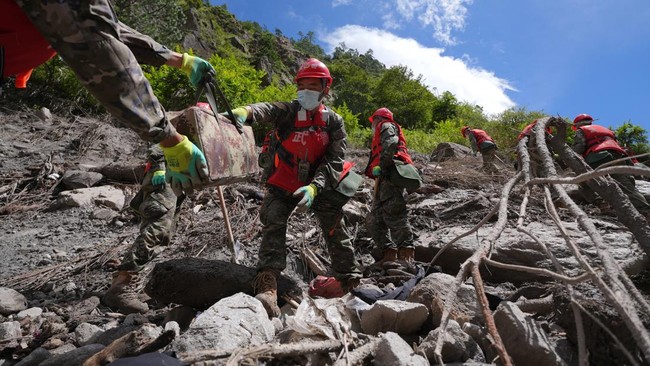
Search and rescue operations resumed in Nepal and China on Friday (28/8/2026) after a devastating flood struck the Himalayan region. Chinese rescue teams reached the Gyirong border complex for the first time, finding the area almost entirely reduced to rubble.
The disaster began on Wednesday when a glacier collapse triggered a massive flow of rock, ice, mud and other material that tore through the river system in the Himalayan region. At least 579 people died in Nepal and seven others were killed in Tibet, China.
Nepal’s disaster management authority said on Friday that the number of people still missing had nearly doubled to 1,924. Meanwhile, 558 people were reported missing in Gyirong County, Tibet, according to Chinese state broadcaster CCTV.
Of all those missing in the disaster, at least 540 were foreign nationals, most of them Hindu pilgrims from India.
Surveillance camera footage from the Gyirong border complex showed torrents of water mixed with landslide material striking buildings and people attempting to flee.
Rescue teams were only able to reach the area on Friday. Chinese state media reported that a team of 21 rescuers and a search dog had to cross mountains and valleys, using ropes to traverse forests and steep cliffs. Road access to the border complex had been destroyed.
“There is no road, it is all untouched forest and steep cliffs,” said rescue officer Zou Mingqi, as quoted by Reuters.
Upon arriving at the complex, Zou said, “as far as the eye can see, there is nothing but rubble.”
The Red Cross estimated that more than 90,000 people have been affected by the disaster.
The flood also caused the formation of a lake that began overflowing into the Lhende Khola and Trishuli rivers on Friday. The overflow triggered panic and warnings from Nepali authorities, causing rescue operations to be halted for about three hours.
The threat also prompted all Chinese rescue personnel and vehicles to be withdrawn from the site, according to CCTV. After conditions were deemed safer, search and rescue operations resumed in both countries.
Nepali officials said they still hoped to find survivors.
Amid the search efforts, Nepal is monitoring two lakes formed by natural dams upstream of the flood-affected area. An official warned that the flood risk would persist until both lakes fully drain.
Satellite imagery showed the second lake continuing to expand with no visible outlet, raising concerns that water pressure could still increase.
Meanwhile, Chinese state news agency Xinhua quoted analysis from the Ministry of Water Resources saying the first lake had begun to shrink. However, a Chinese geohazard expert warned that the lake could still be unstable.
Additionally, more than 100 glacial lakes are scattered across the region and are considered potential threats.
In Beijing, a Politburo meeting chaired by President Xi Jinping called for strengthened monitoring of glacial lakes and landslide risks. China also called for increased international cooperation in disaster response.
Chinese Premier Li Qiang, the country’s number two official, arrived in the Gyirong area on Thursday afternoon. The visit signalled that Beijing is treating the disaster as one of its highest national priorities.
The Gyirong border port plays an important role in China’s Belt and Road network connecting the country with South Asia. Over the past decade, the area has also been equipped with logistics zones and parking areas.
In the Indian state of Uttar Pradesh, police told Reuters that 10 bodies had been found at three locations in rivers flowing from Nepal.
Earlier, Nepali rescue teams used helicopters to search for survivors and drop emergency aid to thousands of people isolated in various towns and valleys.
Dibga Tamang was one of the latest victims rescued from Rasuwa on Thursday. He was flown with three others to a military base in Nuwakot.
“All our people are gone. They are dead,” Tamang said. “There is no one left waiting for me. Everything and everyone is gone. It is over.”
The military base in the area was filled with residents seeking information about missing or deceased family members. Bodies were brought to the barracks, while lists of those rescued were posted outside.
In various countries, families of missing victims are still waiting for certainty about the whereabouts of their relatives.
Meanwhile, the United Nations and its partners are also stepping up aid delivery. Around 20,000 households are estimated to need food assistance, while more than 50,000 people need clean water and emergency support, said UN spokesman Stephane Dujarric.
Several countries have offered search and rescue assistance. However, the Nepali government said it did not yet need help from other countries.
A South Korean rapid response team in Kathmandu has also not been deployed because Nepal has no plans to accept foreign rescue teams, according to South Korea’s Ministry of Foreign Affairs.
The Kathmandu Post reported that India, China, the United States, the United Kingdom, Japan, South Korea, Sri Lanka and Bangladesh have asked the Nepali government to allow their search and rescue teams to assist in the disaster response.