
Nearly 2,000 Hectares of Savanna in Tambora National Park Engulfed by Fire
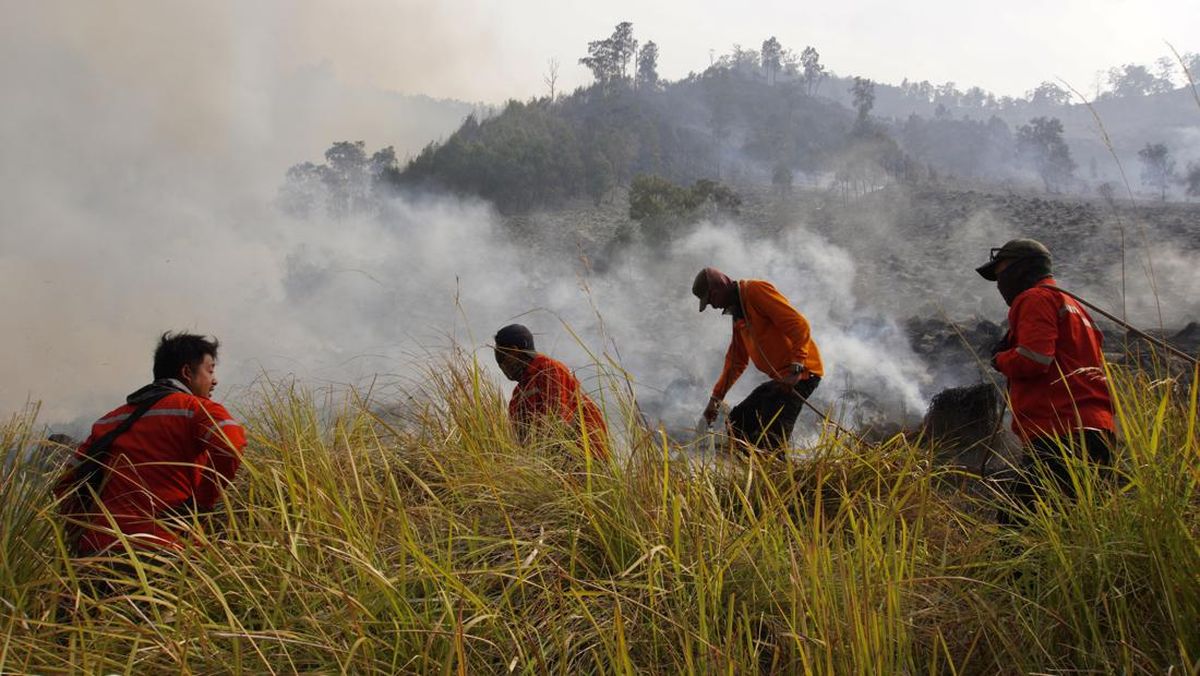
A wildfire has burned through around 1,956 hectares of savanna in the Tambora National Park on Sumbawa Island, West Nusa Tenggara, since last weekend. Dwi Januanto Nugroho, Director General of Forestry Law Enforcement, stated that the fire was first detected on Sunday (5/7) at 1.30 p.m. local time in the Piong Resort area. ‘At the time of the fire, conditions were dry, the savanna vegetation was highly flammable, coupled with strong winds, mountainous topography, and limited water sources, which caused the fire to spread rapidly,’ he said in a written statement received in Mataram on Thursday (9/7), as quoted by Antara.
He explained that the Jabalnusra Forest and Land Fire Control Centre, together with the Tambora National Park Office, the Fire Care Community (MPA), and other related parties, are continuing to battle the blaze. ‘The fire sweeping through the Tambora savanna not only threatens wildlife habitats and a high-value conservation area but also has the potential to impact surrounding communities, including disrupting air quality and affecting nature tourism activities, which are a pillar of the local economy,’ Januanto stated.
Since the initial outbreak, the Tambora National Park Office and the MPA have been carrying out early control efforts to limit the fire’s spread while monitoring developments on the ground. ‘Based on hotspot monitoring and coordination between the Tambora National Park Office and the Jabalnusra Forest and Land Fire Control Centre, the Ministry of Forestry has deployed a team of Manggala Agni firefighters from Section III Mataram to reinforce the firefighting operation,’ he explained. The personnel were dispatched from Mataram to Bima Regency to join the National Park Office, MPA, and other relevant elements in controlling the spread of the fire and protecting areas that can still be saved.
‘Fire control cannot rely solely on the government. Collaboration from all parties is needed so that prevention becomes a shared culture. At the same time, any legal violations that cause fires will be dealt with in accordance with the provisions of the law,’ he said. Meanwhile, Bambang Setyo Antoko, Head of the Forest Fire Control Centre for the Java, Bali, and Nusa Tenggara Region, stated that the firefighting operation is currently focused on suppressing the rate of the fire’s spread by adapting strategies to the terrain characteristics of Tambora. ‘The characteristics of the savanna in Tambora allow the fire to spread very quickly, especially when wind conditions strengthen and water sources are limited. Therefore, the firefighting strategy is continuously adjusted to the developments on the ground so that the spread can be controlled effectively,’ he said.
He noted that all involved elements are working in an integrated manner, prioritising personnel safety while protecting areas that can still be saved. The firefighting operation is still ongoing. The Ministry of Forestry is calling on local governments, regional authorities, area managers, tourism operators, and the public to increase vigilance during the dry season, avoid any activities that could potentially trigger forest fires, and immediately report any indications of fire so that handling can be carried out as early as possible. Tambora National Park is a conservation area spanning 71,645.64 hectares that has been designated by UNESCO as a World Biosphere Reserve. It serves as a habitat for various wildlife species, including the citron-crested cockatoo, red-headed lorikeet, rainbow bee-eater, and Timor deer. Beyond being a crucial bastion of biodiversity, Tambora is also a nature tourism destination that provides benefits to the community through environmental services and the economic activities that grow around it.
Source: jawawa.id (https://jawawa.id/newsitem/nearly-2-000-hectares-of-savanna-in-tambora-national-park-engulfed-by-fire-1783612386)
Originally published by CNN Indonesia (https://www.cnnindonesia.com/nasional/20260709202054-12-1378924/seribuan-hektare-padang-savana-di-tn-tambora-sumbawa-terbakar), translated from Indonesian