
Near Iran, Bahrain Joins US-Led Attack Drone Task Force
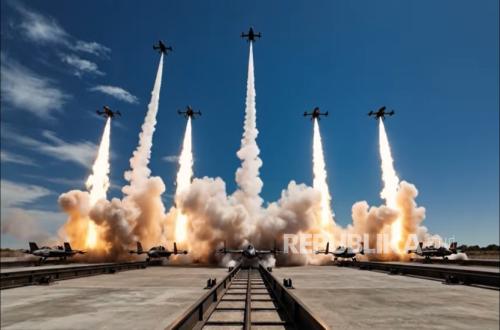
Bahrain has decided to join a US-led multinational attack drone task force. This decision expands Washington’s military integration with one of its closest allies in the Gulf at a time when unmanned aerial vehicle threats are becoming increasingly prominent in Middle Eastern conflicts.
Bahrain’s commitment was announced during the 21st US-Bahrain Military Advisory Committee meeting in Manama. The meeting was co-chaired by the US Deputy Assistant Secretary of Defense for Middle East and Central Asia, Michael P. DiMino IV, and Bahrain’s Minister of Defence Affairs, Lieutenant General Abdullah bin Hassan Al-Noaimi.
In an official statement, the US Department of Defense noted that delegations from both nations discussed regional security challenges, the increased integration of Bahraini forces with the US military, and investments in air defence capabilities. One of the systems discussed was the Advanced Precision Kill Weapon System (APKWS).
Bahrain also expressed its commitment to participate in Task Force Falcon Strike, a multinational drone task force established by US Central Command (CENTCOM) in August 2026. Washington stated that this participation will allow the Bahraini military to further utilise unmanned technology to support regional deterrence.
Anadolu Agency reported that Bahrain also plans to purchase additional ammunition and US-made air defence systems. The US Embassy in Manama stated that these steps are intended to make Bahrain’s defence capabilities stronger and more interoperable with US forces.
Drones from Air to Subsurface
Falcon Strike is no ordinary drone unit. CENTCOM describes it as the first multinational and multi-domain task force specifically designed to operate one-way attack drones.
The system will operate across three environments simultaneously: air, sea surface, and subsurface. US military personnel and regional partner nations will operate and integrate these unmanned systems.
CENTCOM announced the formation of Falcon Strike on 13 August. CENTCOM Commander Admiral Brad Cooper stated that the unit is designed to expand the use of drone technology by leveraging evolving innovations among allies and regional partners.
“Integrating and deploying our new capabilities together will help us rapidly realise the new possibilities that are on the horizon,” said Cooper during the announcement of Falcon Strike. CENTCOM subsequently began formally inviting partner nations in the region to join.
Janes reported that Bahrain is the first country openly linked to membership in Task Force Falcon Strike. When CENTCOM announced its formation in August, Washington had not yet named which partner nations would be joining.
Originating from Scorpion Strike
Falcon Strike was built upon the experience of Task Force Scorpion Strike. That unit was formed in December 2025 as the first US military unit in the Middle East specifically utilising one-way attack drones.
According to CENTCOM, Scorpion Strike subsequently achieved several operational milestones, including the launch of air-attack drones from US Navy warships. The unmanned systems were also used in Operation Epic Fury and during attacks on Iranian port facilities in July 2026.
Defense News noted that the formation of Falcon Strike reflects a larger shift in the US military approach. CENTCOM is increasingly turning the Middle East into a testing ground for the development and use of unmanned systems in combat operations.
This shift is driven, in part, by cost considerations. Attack drones can be produced and deployed in large numbers at a relatively low cost, whereas intercepting them using conventional air defence missiles can be far more expensive.
The wars in Ukraine and the Middle East have increasingly highlighted this issue. Cheap drones can be used in large quantities to overwhelm air defences, forcing adversaries to exhaust interceptor missiles or to strike critical facilities from a distance.