
Nazca Plate Tearing Triggers Devastating Mw7.4 Earthquake in Colombia
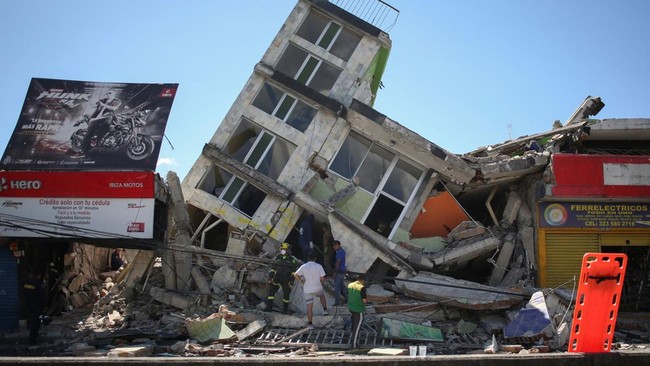
A devastating Mw7.4 earthquake struck western Colombia on Monday morning (10/8/2026) at 07:34 local time, resulting in 138 confirmed deaths and approximately 570 injuries. Hundreds more are reported missing and thousands of buildings have been damaged. The epicentre was located at 4.844° North latitude and 76.242° West longitude, 5 kilometres south of San José del Palmar, with a hypocenter at an intermediate depth of 110.3 kilometres within the Earth’s crust.
Daryono, a member of the Indonesian Association of Disaster Experts (IABI), explained that the earthquake was a direct manifestation of internal deformation dynamics within the active subduction system along the Peru-Chile Trench, where the Nazca oceanic plate is actively subducting beneath the South American continental plate. The energy release did not occur at the interplate megathrust contact but was triggered by internal deformation, accumulated mechanical strain, and faulting within the subducting oceanic slab lithosphere itself.
“As an intraslab earthquake, this event has a very distinctive seismic wave propagation behaviour,” Daryono stated. He added that the event was triggered by the fracturing or tearing of the internal part of the Nazca Plate as it subducts steeply beneath the South American Plate along the Colombia-Ecuador-Peru-Chile subduction system. At the intermediate depth of around 110 kilometres, the rigid, dense, and relatively cold oceanic slab lithosphere experiences downward gravitational pull and extreme bending as it attempts to penetrate the hotter, more viscous mantle layer.
The massive mechanical stress and strain accumulation within the plate body eventually exceeded the elastic limit of the rocks. This triggered sudden internal faulting or deformation with a normal faulting source mechanism combined with a shear component, known as oblique-normal faulting. This mechanism is highly consistent with the extensional stress regime commonly found in intraslab earthquakes due to slab pull.
“This internal deformation that tore the interior of the subducting plate released high-frequency seismic waves, radiating destructive ground shaking that propagated very efficiently to strike surface infrastructure,” Daryono explained. The seismic energy travelled through the rigid, dense, and relatively cold subducted lithospheric slab, resulting in very low wave attenuation and efficient transmission of high-frequency energy. The impact of shear wave and surface wave propagation triggered high Peak Ground Acceleration in the affected area, with sudden inertial forces acting directly on multi-storey building masses and masonry structures, causing soft-storey failures as lateral loads exceeded the capacity of main supporting elements.
“The inability of structures to withstand inter-storey drift led to progressive or total pancaked collapse, hurling debris of concrete and brittle bricks onto roadways,” Daryono described. The sudden collapse of material compressed the air and generated massive, dense dust clouds that blanketed residential areas and road intersections, crippling visibility. In addition to dust clouds and falling debris, the vulnerability of the area was exacerbated by fires breaking out in zinc-roofed buildings due to ruptured energy lines after the shaking.
Daryono noted that the entire sequence of physical damage to the built environment directly triggered panic, with residents scrambling out of buildings to avoid the risk of subsequent collapses, which also complicated self-evacuation efforts amidst the rubble and thick dust. He stressed that this is not the first destructive earthquake in Colombia, a seismically active and complex region. Historical events include the Mw8.8 1906 Colombia earthquake, the strongest off the Ecuador-Colombia border which triggered a tsunami and killed up to 1,500 people; the Mw7.9 1875 Cúcuta earthquake near the Venezuelan border that caused around 10,000 deaths; and the Mw6.2 1999 Armenia earthquake that struck the coffee-growing region and killed more than 1,900 people. Daryono concluded that these events provide a comprehensive understanding of seismotectonic mechanisms and their impact on structural failure in urban areas, offering vital lessons for Indonesia.