
Navigating Segara Anakan Waters to Safeguard the Health of Remote Residents
The roar of boat engines began to break the silence at Klaces Pier, Kampung Laut District, Cilacap, Central Java, on Tuesday morning (18/8). A day after the 81st anniversary of the Republic of Indonesia, a number of health workers resumed their journey. Aboard a boat measuring approximately 1.5 by 9 metres, they navigated the waters of Segara Anakan, surrounded by stretches of mangrove. Their aim was to reach children in schools located in remote areas. After about 30 minutes of travel, the boat finally arrived at Ujung Alang Village.
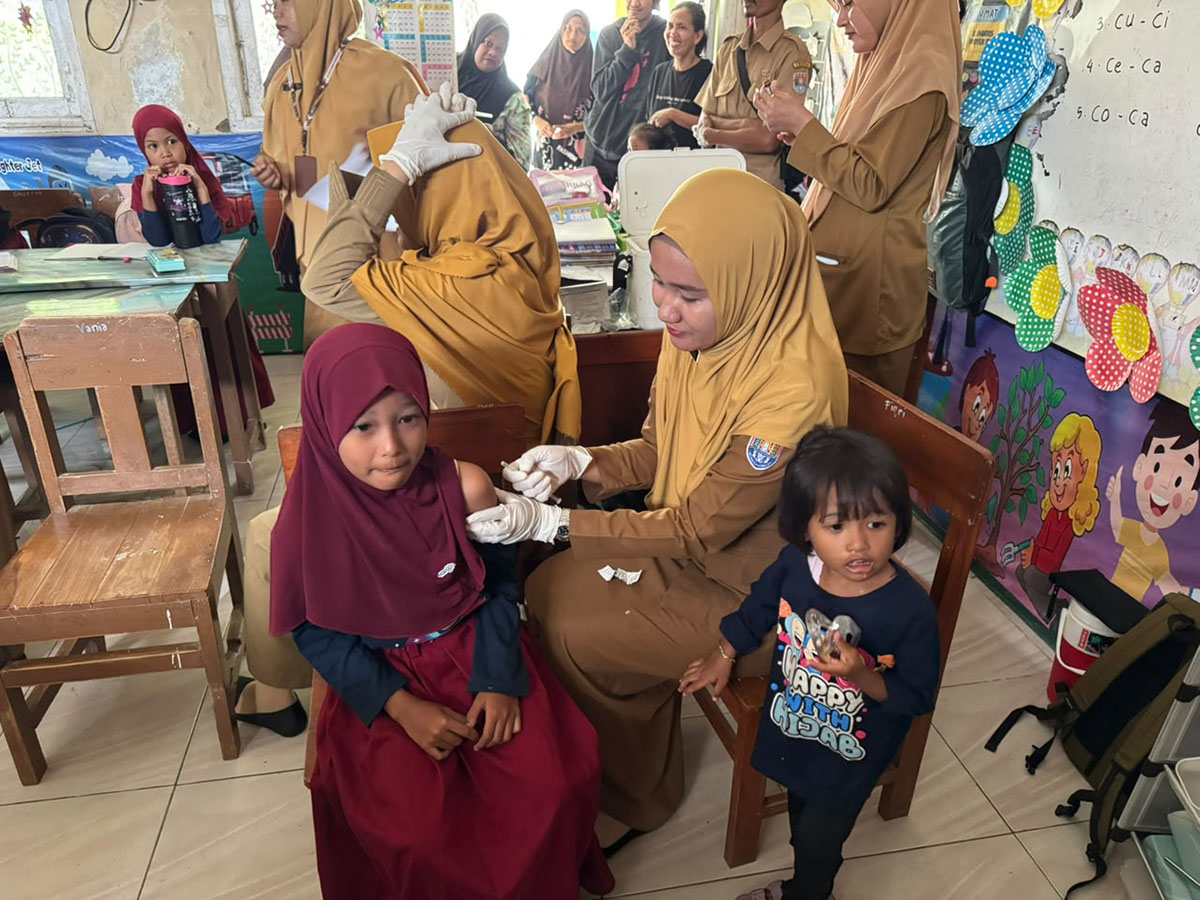
At SD Negeri 2 Ujung Alang, dozens of students were already waiting for the health services that came directly to their school. When the officers entered the classroom, some children appeared awkward. Some chose to sit quietly, while others looked slightly frightened when they saw the examination and immunisation equipment. After receiving explanations from teachers and health workers, one by one the children began to step forward.
Altar, 7, was one of the students brave enough to take his turn. After undergoing a health examination, he also received diphtheria and tetanus immunisation. “First I was examined, then immunised. Because it was an injection, it hurt, but only for a moment,” Altar said innocently. Naufal, 7, also initially felt afraid. However, the primary school student eventually took part in the examination and immunisation. “At first I was scared. But the teacher said I had to take part, so I just did,” he said briefly.
That day, health services did not only target students at SD Negeri 2 Ujung Alang. Officers also provided services to children at SD Negeri 3 Ujung Alang and SD Negeri 3 Panikel. To reach other villages, the officers had to travel by boat again.
Midwife Sukesih from Kampung Laut Community Health Centre (Puskesmas) said the geographical conditions mean health workers must have their own approach to ensure health services can reach all residents. “Health workers from Kampung Laut Puskesmas must use boats to reach villages in this district. The only village that does not require a boat is Klaces because its location is on the same landmass as the health centre,” said Sukesih, who was on duty with Midwife Zia.
Distance and time pose particular challenges for health services in Kampung Laut. For this reason, Kampung Laut Puskesmas chooses to visit residents, including children at schools, rather than waiting for them to come. To make journeys more efficient, free health checks are combined with immunisation services.
According to Sukesih, the service is part of the Free Health Check programme, with the spirit of preventing disease from an early stage while also providing treatment if health problems are found. She said that to make efficient use of time, free health checks are carried out together with immunisations. “In the Free Health Check programme: Prevent Early, Treat Completely, we do not only check health, but also carry out early prevention and treatment. For example, every six months, children in Kampung Laut are given deworming medicine. The aim is to prevent and treat worm infections. That is for children,” she explained.
Head of Kampung Laut Puskesmas, Dr Oktaryan Eko Arrianto, said the island and water-based character of the area means health services must be designed with a different approach. Health workers must be able to make the best use of travel time. One way is to visit schools to provide several services at once. “Health workers go directly to schools. Students do not need to come to the health centre. We visit them and at the same time carry out immunisations,” said Oktaryan.
During the visit, officers carried out health examinations and provided immunisations to students. For primary school children, DT or diphtheria and tetanus immunisation is available. Meanwhile, fifth-grade girls receive an additional HPV immunisation to provide protection against Human Papillomavirus infection, which can be a major cause of cervical cancer.
Oktaryan said the Free Health Check programme does not only target students. The service is also intended for the wider community. Access to health services remains a challenge that Kampung Laut residents must face. Health workers also experience similar conditions when they have to travel to other areas to obtain advanced health services. “Health workers also have to travel longer to get health services compared with other areas in Cilacap,” he said.
For Oktaryan, health examinations are not solely about knowing blood pressure figures, sugar levels, or other laboratory results. There is another more important aspect, namely ensuring residents feel heard and cared for. “This is also about listening, understanding, and ensuring every resident is treated with humanity,” he said. According to him, every examination has important meaning because behind the results there is a life that must be protected. Early detection is the first step to preventing more serious health conditions.
Source: jawawa.id (https://jawawa.id/newsitem/navigating-segara-anakan-waters-to-safeguard-the-health-of-remote-residents-1787716269)
Originally published by Media Indonesia (https://mediaindonesia.com/nusantara/926008/menembus-perairan-segara-anakan-menjaga-kesehatan-warga-terpencil), translated from Indonesian