
Navigating Investments, Reading the Future of Industry
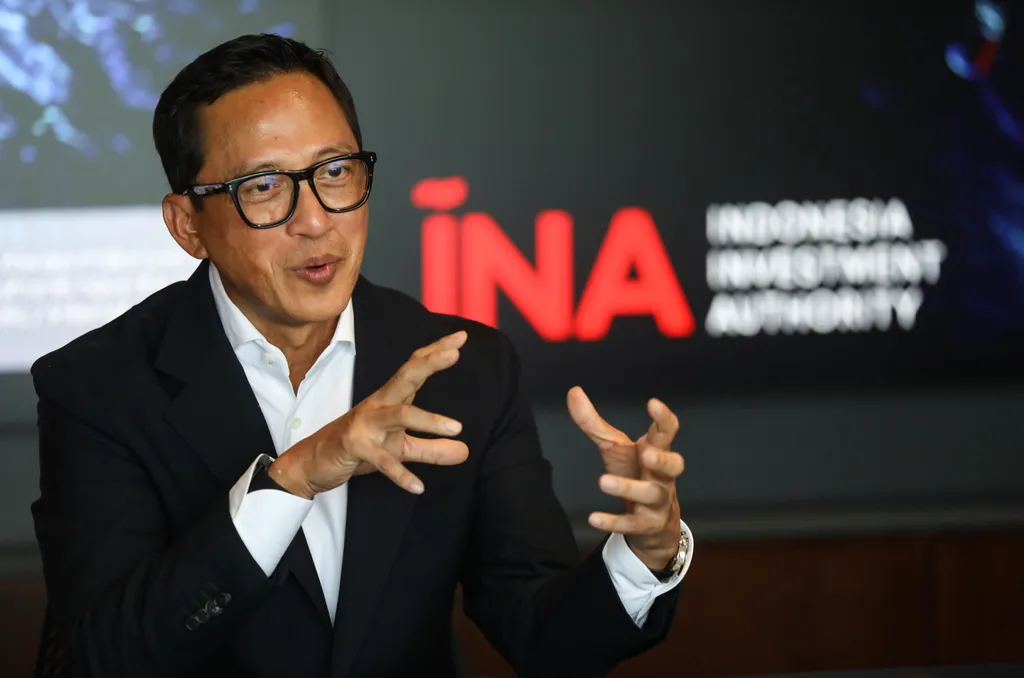
Investment is not only about which sectors yield results today, but also about industrial development for the long term. INA is attempting to navigate this.
KOMPAS/PRIYOMBODO
By Abdullah Fikri Ashri, Maria Susy, Maria Susy Berindra
12 Agt 2026 05:03 WIB · Ekonomi & Bisnis
Investment is not solely about the most popular sectors today. Beyond that, investment is also about long-term industrial development. Amid global economic uncertainty, the Indonesia Investment Authority (INA) is attempting to navigate investments for future industries.
INA is the first investment management institution or sovereign wealth fund in Indonesia, established in December 2020. Its mandate is to manage long-term government investments while attracting global capital to Indonesia.
One example of INA’s long-term investment is the development of Indonesia’s first lithium iron phosphate (LFP) cathode production platform in the Kendal Industrial Estate, Central Java. INA is partnering with Chinese company Changzhou Liyuan on this project.
With an investment value of approximately 200 million US dollars, this factory will become the largest LFP cathode production facility, a material for electric vehicle batteries, outside of China. Its production capacity is expected to reach 30,000 tons by 2025 and will be increased to 110,000 tons in 2026 and 120,000 tons per year by 2027.
“If the third phase of development proceeds and exports are successful, the production of materials for this battery will be equivalent to one million electric cars,” said Chairman of the Board of Directors and Chief Executive Officer of INA, Oki Ramadhana, in a special interview with the Kompas Daily (Kompas.id) in Jakarta, Wednesday (5/8/2026).
Oki acknowledged that there are still several parties questioning investments in this sector. Moreover, Indonesia does not yet have lithium reserves. However, this investment is quite promising in the long term. Bloomberg New Energy Finance, for instance, projects that LFP will continue to grow.
In 2023, LFP accounted for approximately 40 percent of global battery demand. This market share is projected to increase to over 60 percent by 2035. If operating optimally, the export sales value of LFP is projected to exceed 1 billion US dollars per year.
“Therefore, investment is not only about the industries that are popular now, but also about investments that will become the foundation of our industries in Indonesia in 10-20 years,” Oki stated.
According to Oki, the development of the service sector, particularly finance, has not been fully matched by the strengthening of industries that generate added value domestically. In fact, industrial development for the long term can reduce import dependence and strengthen Indonesia in the global supply chain.
“We are still lacking in industrialization development. This needs to be developed. President Prabowo Subianto also desires industrialization,” he stated. That is why his side is focusing on long-term investments.
In Karawang International Industrial City, West Java, for example, INA and its investor partners have established the fractionation facility of PT SKPlasma Core Indonesia. This factory is expected to meet the demand for derivative medicines, such as immunoglobulin, albumin, and factor VIII.
The construction of this facility has reached 100 percent and is now in the stage of certification for good manufacturing practices (CPOB) by the Food and Drug Supervisory Agency (BPOM). In the initial phase, this factory is projected to produce 600,000 liters of plasma per year.
INA’s investment in the future is also reflected in the development of a hyperscale data center in Batam. This US$600 million project is in partnership with DayOne, a global data center provider. The first phase of construction of the 72-megawatt (MW) data center was completed last year.
Currently, the company is developing the second phase of the data center with a target capacity of 360 MW. The management is optimistic that the realization of investment value growth and returns from this project is expected to be seen in the next 2–3 years along with the increase in capacity and tenant utilization.
These various projects are implementations of the development of five priority sectors: transportation and logistics, green energy, digital and artificial intelligence (AI), healthcare, and advanced materials. “These sectors will support industrial needs in Indonesia over the next 10-20 years,” he said.
Oki acknowledged that the returns from investments in that sector require time. However, he is confident that long-term investments in that sector will foster industry, create jobs, and position Indonesia within the global supply chain, particularly for the needs of electric vehicle batteries and data centers.
To ensure that various investments proceed, the party implements a number of strategies. First, INA collaborates with foreign investors who are experts in the sector. For instance, in the development of data centers, they partner with DayOne, a data center platform that was previously under GDS Holdings Limited.
“So, we’re not just bringing in capital, but also bringing in expertise (experts in the field). With their expertise, our investment partners can determine where this industry will go in the next decade or two,” said Oki.
The second strategy is to provide navigation to investor partners in investing in Indonesia. INA does not stop once the transaction is completed. The institution also manages investments throughout their cycle, monitors the performance of portfolio companies, identifies new risks, and seeks value creation opportunities.
The third strategy of INA to develop long-term investments is to ensure transparent and independent governance. “In the last five years, we have built institutions, business portfolios, and actively managed investments. That is why foreign investors have confidence in INA,” said Oki.
In addition to being a permanent member of the International S