
Navigating Investment, Reading the Future of Industry
Investment is not solely about which sectors are most popular today. More than that, investment is also about building industry for the long term. Amid global economic uncertainty, the Indonesia Investment Authority (INA) is attempting to navigate investment for the industries of the future.
INA is Indonesia’s first sovereign wealth fund, established in December 2020. Its mandate is to manage government investments over the long term while attracting global capital to Indonesia.
One manifestation of INA’s long-term investment is the development of Indonesia’s first lithium iron phosphate (LFP) cathode production platform in the Kendal Industrial Estate, Central Java. In this project, INA is partnering with Chinese company Changzhou Liyuan.
With an investment value of around USD 200 million, this plant is the largest LFP cathode production facility—a material for electric vehicle batteries—outside China. Its production capacity reached 30,000 tonnes in 2025 and will be increased to 110,000 tonnes in 2026 and 120,000 tonnes per year in 2027.
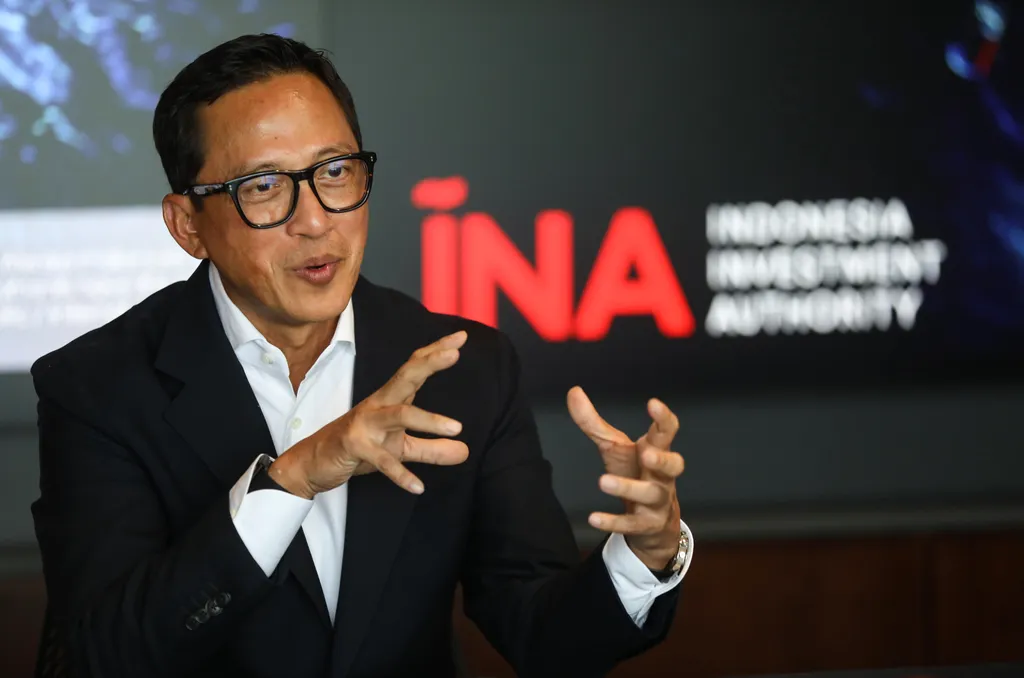
“If this third phase of development proceeds and exports begin, the production of this battery material will be equivalent to one million electric vehicles,” said INA Chairman of the Board of Directors and Chief Executive Officer Oki Ramadhana in an exclusive interview with Harian Kompas (Kompas.id) in Jakarta on Wednesday (5/8/2026).
Oki acknowledged that some parties still question investment in this sector, especially since Indonesia does not yet have lithium reserves. However, this investment is quite promising in the long term. Bloomberg New Energy Finance, for example, projects that LFP will continue to grow.
In 2023, LFP accounted for around 40 percent of global battery demand. That market share is projected to increase to more than 60 percent by 2035. If operating optimally, the export sales value from this LFP is projected to exceed USD 1 billion per year.
“So, investment is not only about industries that are popular now, but also investments that in 10–20 years will become the basis of our industry in Indonesia,” Oki said.
According to Oki, the development of the services sector, especially finance, has not been fully matched by the strengthening of industries that generate added value domestically. Yet developing industry for the long term can reduce import dependence and strengthen Indonesia’s position in global supply chains.
“We are still lacking in industrialisation development. This must be developed. President Prabowo Subianto also wants industrialisation,” he said. That is why the institution is focusing on long-term investment.
At the Karawang International Industrial City in West Java, for example, INA and its investment partners have built a plasma fractionation facility, PT SKPlasma Core Indonesia. This plant is expected to meet the need for derivative medicines such as immunoglobulin, albumin, and factor VIII.
Construction of this facility has reached 100 percent and is now in the certification stage for good manufacturing practices (CPOB) by the Food and Drug Supervisory Agency (BPOM). In the initial phase, the plant is projected to produce 600,000 litres of plasma per year.
INA’s investment for the future is also reflected in the development of a hyperscale data centre in Batam. This USD 600 million project is in partnership with DayOne, a global-scale data centre provider. The first phase of the data centre, with a capacity of 72 megawatts (MW), was completed last year.
The company is currently developing the second phase of the data centre with a target capacity of 360 MW. The institution is optimistic that the realisation of investment value growth and returns from this project will become visible within the next 2–3 years as capacity and tenant utilisation increase.
These various projects are the implementation of the development of five priority sectors: transport and logistics, green energy, digital and artificial intelligence (AI), health, and advanced materials. “These sectors will support the needs of industry in Indonesia over the next 10–20 years,” he said.
Oki acknowledged that returns from investment in these sectors take time. However, he is confident that long-term investment in these sectors will grow industry, create jobs, and place Indonesia in global supply chains, especially for electric vehicle battery and data centre needs.
To ensure these investments proceed, the institution applies a number of strategies. First, INA partners with foreign investors who are experts in the relevant sector. In data centre development, for example, it partners with DayOne, a data centre platform previously under GDS Holdings Limited.
“So, we are not only bringing capital, but also bringing expertise. With their expertise, our investment partners can ensure where this industry is heading in one or two decades,” Oki said.
The second strategy is providing navigation for investment partners in placing capital in Indonesia. INA does not stop once a transaction is completed. The institution participates in managing investments throughout their cycle, monitoring portfolio company performance, identifying new risks, and seeking value-creation opportunities.
INA’s third strategy for developing long-term investment is ensuring transparent and independent governance. “Over the past five years, we have built the institution, the business portfolio, and actively managed investments. That is why foreign investors trust INA,” Oki said.
In addition to being a permanent member of the International Forum of Sovereign Wealth Funds, INA has also achieved a score of 92 percent in the Governance, Sustainability and Resilience Scoreboard (GSR) 2026. This achievement places INA as the second-best sovereign wealth fund in Asia after Temasek.
During five years of operation, the institution has secured investment commitments of USD 25 billion, or around Rp 450 trillion, from 40 strategic partners in 15 countries. These partners include pension funds, insurance companies, sovereign wealth funds, asset managers, strategic companies, and private equity firms.
INA and its investment partners have disbursed investments totalling around Rp 74.5 trillion, or about USD 4.7 billion. Of this, Rp 33.3 trillion, or USD 2.1 billion, is INA’s own investment.
As a long-term investor, the challenge is no longer trying to predict every market change, but rather being able to distinguish between short-term volatility and structural changes that truly affect long-term investment prospects.
At the same time, INA also invites foreign capital. Up to 2025, INA has contributed to bringing foreign direct investment (FDI) into Indonesia with cumulative realisation reaching Rp 41.2 trillion (around USD 2.6 billion).
Despite continued growth, INA’s investments face a number of challenges. One is economic uncertainty due to geopolitical tensions, such as the Iran–US war or the imposition of US tariff policies. According to Oki, this uncertainty is no longer a temporary condition but has become a characteristic of the global economy.
“As a long-term investor, the challenge is no longer trying to predict every market change, but rather being able to distinguish between short-term volatility and structural changes that truly affect long-term investment prospects,” he said.
That is why the institution continues to increase investment in future sectors and strengthen partnerships with global investors. Amid global economic uncertainty, partnerships are becoming even more important. Through this strategy, Oki is confident that INA’s long-term investment will continue to grow.
“In 10–20 years, INA will become a larger and more impactful investment management institution for Indonesia,” he said.
Professor of Strategic Management at the Faculty of Economics and Business, University of Indonesia, Sari Wahyuni, assesses that investment should indeed focus on developing future sectors. In strategic management, there is the theory of dynamic capability, which involves looking at the industries needed in the future, the capabilities required, and how to achieve them.
The development of long-term investment for the future is not only related to industrialisation but also to the development of knowledge.
“The development of long-term investment for the future is not only related to industrialisation but also to the development of knowledge,” she said. In this way, investment also contributes to developing knowledge and technological mastery for Indonesia’s human resources.
Ultimately, investment is not only about which sectors generate returns today, but also about building industry for the long term. Time will test whether the capital planted today becomes the foundation for Indonesia’s industry in the future.