
Navigating Indonesia's Economic Resilience in 2026: Between Domestic Optimism and Global Pressures
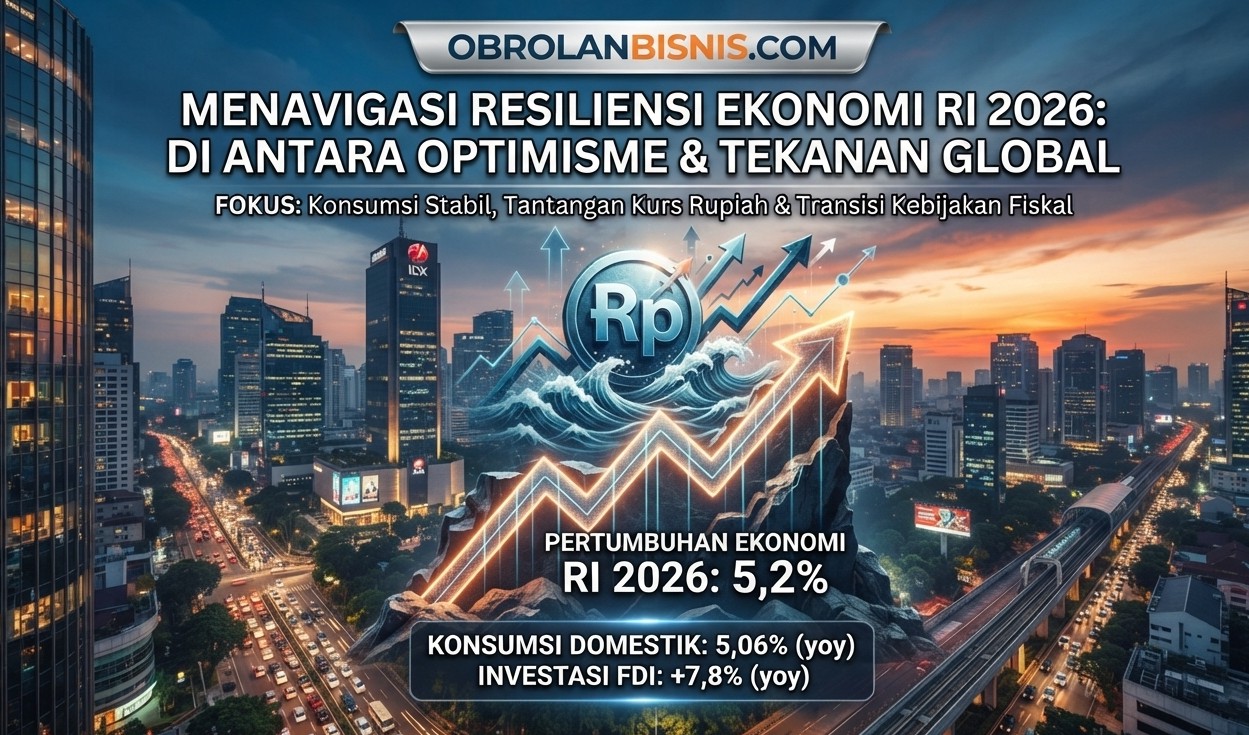
Entering the second half of 2026, the Indonesian economy continues to show a solid yet challenging performance.
Amid high volatility in global financial markets and shifting geopolitical dynamics, the country’s economic fundamentals have proven resilient, with annual growth projected at around 5.2%.
This figure reinforces a positive trend after the Central Statistics Agency (BPS) recorded that Indonesia’s economy grew 5.45% (c-to-c) in the first half of the year — one of the highest semester growth rates in the past decade. Why has the domestic economy been this resilient, and what warning signs must business players watch? Here is the editorial review by ObrolanBisnis.com.
Supporting Pillars: Consumption and Base Metal Investment
Public purchasing power remains the primary engine driving the economy. Household consumption continues to grow positively at 5.06% (yoy).
This sustained consumption is underpinned by government stimulus through social cushioning policies as well as relatively controlled domestic inflation. As of August 2026, annual inflation stood at 3.19%, moving steadily within Bank Indonesia’s target range. Meanwhile, foreign direct investment (FDI) flows have become a crucial catalyst.
Policies on downstreaming commodity industries — particularly in the base metals sector — along with the expansion of national data centre infrastructure have succeeded in attracting major international investors to continue deploying capital in the country.
Warning Signs: The Rupiah Exchange Rate and Fiscal Pressure
Although the macro indicators look impressive on paper, businesses in the real sector must not ignore external dynamics. The main issue currently drawing serious editorial attention is pressure on the rupiah exchange rate due to rampant capital outflows.
The strengthening of the US dollar, triggered by uncertainty over global central bank policy, has forced Bank Indonesia to reinforce instruments such as VASTRA (foreign exchange hedging transaction arrangements through partner banks) to manage exchange rate volatility.
For the domestic manufacturing industry, a sharp rupiah depreciation risks pushing up the cost of imported raw materials (imported inflation).
The situation is further complicated by a structural shift within the government, following a strategic reshuffle in which the position of Finance Minister is now officially held by Suahasil Nazara, replacing Purbaya Yudhi Sadewa.
This fiscal consolidation immediately prompted a swift response from capital market players who are closely watching movements in the Jakarta Composite Index (IHSG).
Editorial Notes for Business Players
Facing the remainder of 2026, optimism must be accompanied by a well-prepared mitigation strategy. The business expectation index, which has shown fluctuating signals, proves that the market is in wait-and-see mode regarding the implementation of the upcoming state budget (RAPBN).
For ObrolanBisnis.com readers, the key to surviving this period is maintaining liquidity, leveraging the digitalisation of payment systems to broaden access to financing, and beginning to shift towards local supply chain efficiency to avoid the risk of foreign currency fluctuations.
Our economy is indeed resilient, but only adaptive businesses will emerge as winners.
Source: jawawa.id (https://jawawa.id/newsitem/navigating-indonesias-economic-resilience-in-2026-between-domestic-optimism-and-global-pressures-1789487420)
Originally published by obrolanbisnis.com (https://obrolanbisnis.com/2026/09/15/menavigasi-resiliensi-ekonomi-ri-2026-di-antara-optimisme-domestik-dan-tekanan-global/), translated from Indonesian