
Navigating AI bubble: Balancing innovation and policy in Indonesia
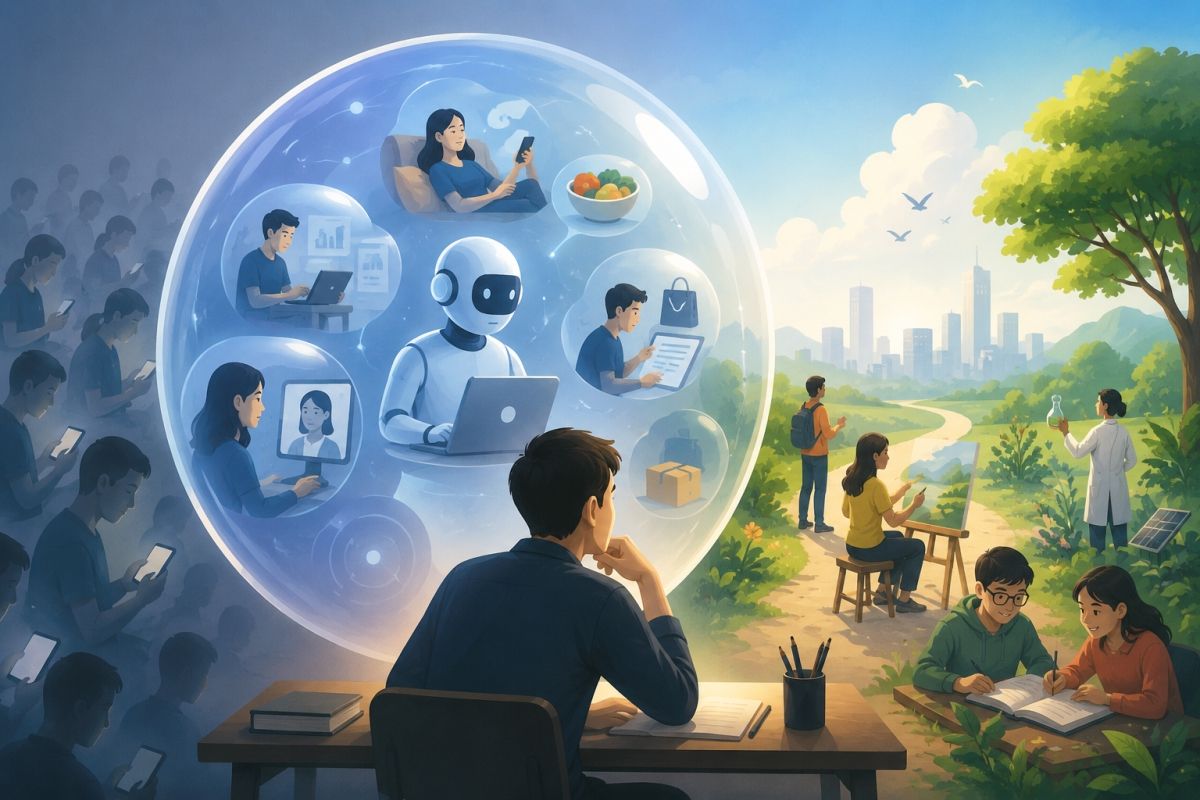
In an era where algorithms draft corporate memos, analyze medical data and even suggest what we should eat for dinner, the line between human judgement and automated assistance is blurring faster than ever.
Almost every day, people in Indonesia are introduced to the staggering capabilities of AI: from helping diagnose diseases, accelerating scientific research to improving industrial efficiency, and producing creative works in seconds.
Yet, beneath this wave of technological euphoria, a sobering realization is taking hold: the fear that our collective obsession has grown too far into a new phenomenon known as the “AI Bubble”.
This critical debate took center stage at the Big Idea Forum, titled “AI Forward 2026: What’s Next for AI?”, recently organized by a news network in Jakarta.
The conversation took a sharp, analytical turn when the Deputy Minister of Higher Education, Science and Technology, Prof. Stella Christie, challenged participants to look closely at whether the AI market is about to crash.
Her perspective serves as a reminder that rapid technological acceleration should not be accepted blindly; it needs to be constantly tested and criticized.
Prof. Christie urged the public and tech innovators to look backward to move forward.
By examining historical economic anomalies—from the devastating Tulip Mania of the 17th century to the volatile Dot-com crash at the turn of the millennium—Indonesia can avoid falling into the perilous trap of believing that AI is a magic wand capable of addressing every human grievance.
At the heart of her argument lies the vital concept of curation. This entails the human wisdom to selectively choose when AI is genuinely necessary, and when a problem can be solved without high-tech intervention.
True innovation, she argued, must always come from actual, basic needs instead of just trying to follow short-lived global trends.
This caution arrives at a time when the tech landscape is increasingly plagued by “AI Washing.”
Much like the greenwashing trends of the environmental sector, AI washing sees companies plastering an “AI-powered” label onto legacy products without implementing any fundamental, transformative changes, simply to capture market hype and inflate valuations.
Organizations are racing to adopt artificial intelligence without first identifying the problems they are intended to solve.
In such a hyperactive ecosystem, human curation is the only mechanism capable of ensuring technology investments yield economic benefits that are genuinely commensurate with the costs and resources expended.
However, describing the entire AI sector as a homogenous “bubble” lacks precision and threatens to distort public policy.
Is the issue the skyrocketing valuations of AI companies, the massive investment in data centers, the exaggerated marketing claims, the use of the term AI for commercial purposes, or the expectation that AI will replace nearly all human jobs?
These five issues have distinct characteristics and should not be grouped under a single conclusion.
The lack of clarity in definition has the potential to confuse financial speculation with technological advances that truly generate value for society.
Related news: Indonesia needs compute cluster development to boost AI capabilities
Role of government
History proves that the failure of individual companies does not equal the death of an underlying technology.
When the dot-com bubble burst in the early 2000s, hundreds of internet startups collapsed overnight, wiping out billions of dollars in speculative investment. Yet, the internet itself did not disappear.
Instead, it matured, eventually evolving into the primary foundation of the global digital economy.
Companies with high-quality products, robust corporate governance, sound business models, and tight execution capabilities did more than just survive the crash—they grew into the modern technology giants that dictate global commerce today.
What the market corrected was unrealistic expectations, not the intrinsic utility of the internet.
This historical blueprint teaches that even if certain local AI investments experience corrections in the coming years, the long-term strategic value of the technology remains intact.
Therefore, what Indonesia requires is not a paralyzing fear of AI, but a sharp capacity to distinguish between empty hype, experimental trials, and high-impact innovation.
Critical scrutiny must be directed toward the quality of implementation, not rejection of the technology itself.
AI should never be treated as an ultimate goal, but rather as an operational tool to boost productivity, accelerate decision-making, improve public services, and strengthen a knowledge-based economy.
Consequently, the role of the Indonesian government is indeed crucial. The state must master a delicate balancing act, managing both sides of the digital coin simultaneously.
On the other hand, the government needs to develop regulations capable of mitigating risks such as data misuse, deepfakes, algorithmic bias, privacy violations, cybersecurity threats, and the impact of changes in the labor market.
On the other hand, the government also needs to create an ecosystem that allows innovation to thrive through support for computing infrastructure, research incentives, funding, regulatory sandboxes, sound data policies and government procurement that provides space for domestic technology products.
Such a structural approach is essential to prevent Indonesia from becoming merely a consumer of technologies developed abroad.
Curation without a domestic industrialization strategy risks producing an Indonesian society that is highly disciplined in utilizing AI tools, yet entirely dependent on foreign products.
The state must ensure that local research can be commercialized, that homegrown startups have room to scale and that local digital talent has the sovereign space to build competitive, localized innovations.
Thus, AI will not only become a tool for consumption