
Nature-Based Solution Brings New Hope to Residents of Timbulsloko, Demak
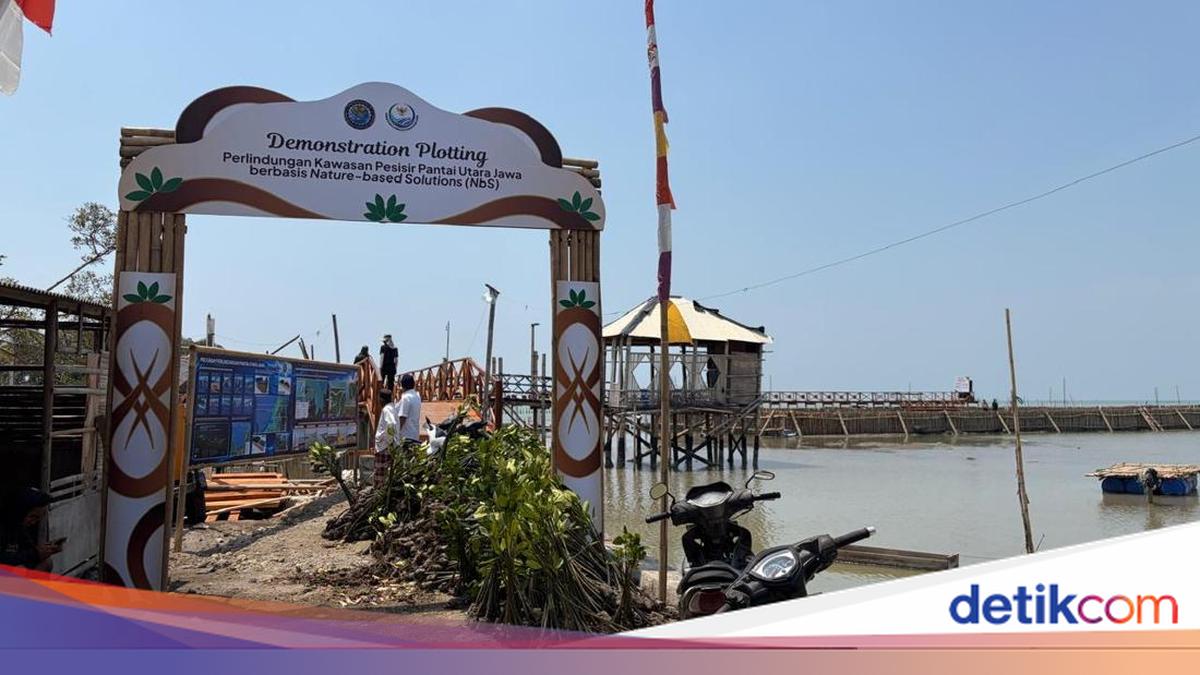
The North Java Coast Management Authority (BOPPJ) has launched a Nature-Based Solution (NbS) programme in Timbulsloko village, Sayung sub-district, Demak regency, combining mangrove restoration with wave breakers. The project is bringing new benefits and hope to local residents.
Over recent decades, Java’s northern coastline has faced land subsidence, development pressures and climate change. Together, these factors have caused erosion and tidal flooding, significantly altering the coastline.
One area affected is Timbulsloko village, where erosion averages 279 metres a year, the highest rate along Java’s north coast. Thousands of hectares of fish ponds, settlements and mangrove forest have been submerged by the severe erosion.
Local resident Mat Sairi, 53, has experienced the effects of erosion first-hand. He has lived since birth in Wonorejo hamlet, Timbulsloko, and described the loss of farmland and vegetation in the area.
“This village used to be all rice fields. On both sides, all the way from Onggorawe main road to here, it was all fields. In front of the house there were banana trees and lots of coconut trees,” Sairi told reporters at his home on Sunday (18 October 2026).
Sairi, who is also the group leader and community co-ordinator for construction of the bridge and raised embankment, recalled that salt water began entering the settlement 34 years ago. The rice fields that had provided residents with a livelihood were converted into fish ponds.
“But around 1992, the area to the north, just in front and to the right of me, started being flooded by salt water. Some of the fields began to be inundated with salt water and were turned into fish ponds,” Sairi said.
Residents initially felt their adaptation had worked. But over time, erosion became increasingly evident, continuing to eat away at homes and fish ponds in Timbulsloko.
“The ponds were still doing fairly well until 2010; we could still produce milkfish and other fish, and people became more prosperous even though the land had been turned into ponds,” Sairi said.
“Eventually, erosion reached the ponds and then the homes behind my house. It hit the area behind the house too, and people wanted to move away,” he added.
Residents lost their livelihoods after their fish ponds were destroyed by erosion. Sairi said people in the area adapted by taking other jobs, including making HexBRIck wave breakers.
For the project, BOPPJ is using the HexBRIck wave-breaker technology developed by the National Research and Innovation Agency (BRIN). The hexagonal structures are designed to reduce wave energy, trap sediment and create conditions that support mangrove growth behind them.
The HexBRIck units are being moulded and installed with the direct involvement of Timbulsloko residents as part of a community empowerment effort. This gives residents not only economic benefits, but also technical skills and a sense of ownership of coastal protection in their area.
Timbulsloko has been designated as the programme’s demonstration plot. The results will inform the possible expansion of hybrid NbS along the entire north coast of Java, tailored to the environmental conditions at each location and with communities taking the lead rather than serving merely as beneficiaries.
Sairi said at least 30 residents of Timbulsloko were involved in making the HexBRIck units. Most of them are also fishers.
“Most of them are fishers, and their income is irregular, so this work gives them a more stable income. It can be a side job: they can go out to catch prawns and fish in the afternoon, and work on the HexBRIck in the morning,” Sairi said.
Sairi said involving local people in making the wave breakers was a good move because it provided them with a steadier income. Workers can earn up to Rp150,000 a day.
“This is a very good empowerment initiative. Thank God, we can benefit from it together, and it’s easier for our friends to earn a living. The daily pay for HexBRIck work is now perhaps Rp120,000 to Rp150,000,” Sairi said.
Sairi said the NbS project launched by BOPPJ was something residents had hoped for over many years. At last, they had a concrete response to prevent their village from sinking further.
“The community has been hoping for this for a long time. When will this be stopped? The sea keeps getting closer, year after year. More than 100 per cent of the community supports it,” he said.
“We are very happy to receive help after hoping for years. Who was going to deal with this? The sea was bringing disaster faster than the land. People inland may not see the sea and think it’s nothing, but those living on the coast are all afraid,” he added.
After BOPPJ held several community consultations, known as Urun Rembuk, Sairi said he was relieved that the programme was about to be implemented. He said residents had been eagerly awaiting the project as a source of new hope.
“Before, there were consultations, and people didn’t believe them. They kept asking, ‘When?’ It seems the project will start as soon as tomorrow. This is what we have truly been waiting for. The community is very happy,” Sairi said.
Another local resident, 53-year-old Sunarti, has also benefited from the project. She sells snacks and drinks close to the demonstration plot and said her takings had increased several-fold.
“It was usually hard to make even Rp20,000; now I can earn more than Rp50,000 a day,” Sunarti told detikNews at her stall on Sunday (18 October 2026).
Sunarti’s husband, Suwardi, is also helping to make the HexBRIck units. He no longer has to travel to Semarang to find work.
“My husband is helping to make the wave breakers here. Thank God, it’s enough for our daily needs and he doesn’t have to work far away. He used to work as a construction labourer in Semarang; now he works here,” Sunarti said.
Sunarti is also grateful that the project has stopped waves from reaching her stall and home. She hopes other infrastructure improvements will follow as the Nature-Based Solution programme continues in Timbulsloko.
“Now, thank God, there are wave breakers and someone is helping. I’m just an ordinary person who sells things, and the waves no longer reach me. Thank you to BOPPJ for the wave breakers. If possible, please add more so the village will be safer, and help us with more wave breakers. I also hope the roads can be repaired,” Sunarti said.
Source: jawawa.id (https://jawawa.id/newsitem/nature-based-solution-brings-new-hope-to-residents-of-timbulsloko-demak-1792331440)
Originally published by detikcom (https://news.detik.com/berita/d-8712900/nature-based-solution-bawa-harapan-baru-bagi-warga-timbulsloko-demak), translated from Indonesian