
National Symposium Calls for Pancasila Values to Be Integrated Across All Academic Disciplines
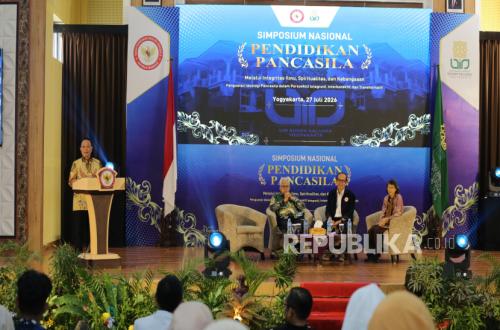
A national symposium at UIN Sunan Kalijaga has concluded that Pancasila education must not be limited to memorising the five principles, but should instead be integrated into all academic disciplines as an ethical foundation for addressing real-world issues. The event, held in Sleman, was organised by the Centre for Integrative, Interconnected, and Transformative Studies (CIINTRA) in collaboration with the Pancasila Ideology Development Agency (BPIP).
CIINTRA Director Prof. Eva Latipah stated that Pancasila values need to become a way of thinking and a basis for decision-making across various fields, from technology and medicine to economics and culture. She argued that the ideology should be present in medical practice through justice in healthcare, in technology as an ethical guide for artificial intelligence development, and in economics through the principle of equity. ‘After integrating and interconnecting these disciplines, the key question is what transformation it produces,’ she said.
Rector of UIN Sunan Kalijaga, Prof. Noorhaidi Hasan, echoed this sentiment, stating that Pancasila is not merely a philosophy but a shared moral compass. He emphasised that the integrative-interconnective paradigm must be implemented not only in teaching but also in research and community service. The symposium also paid tribute to former rectors Prof. M. Amin Abdullah, the originator of the integration-interconnection paradigm, and Prof. K.H. Yudian Wahyudi, for their roles in strengthening the university’s institutional transformation.
Head of BPIP, Prof. K.H. Yudian Wahyudi, highlighted the importance of integrating religious knowledge with science and technology to drive national progress. He noted that Pancasila serves as a unique unifying force for Indonesia’s diverse society. The symposium continued with panel sessions featuring academics, including Prof. Melani Budianta, discussing Pancasila as a foundation for academic ethics and national spirituality.