
National Survey: Indonesian Business World Still Faces Gap Between Strategy and Execution
As Indonesia marks 81 years of independence, the country’s business world faces increasingly complex challenges of change. Digital transformation, technological developments, economic dynamics, and market shifts make adaptability a crucial factor in maintaining national competitiveness.
However, the latest national survey shows a persistent gap between organisational awareness of the importance of change management and its application in day-to-day activities.
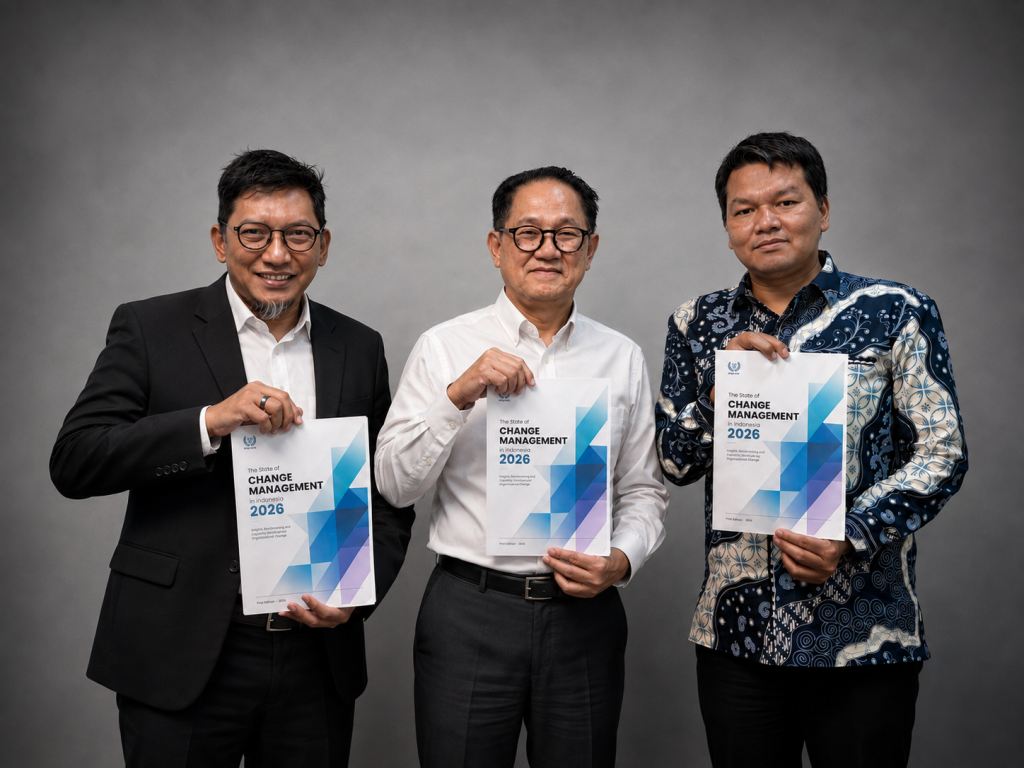
The findings were revealed in The State of Change Management in Indonesia 2026 report launched by MagnaQM (PT Magna Qaise Mandiri Utama) to coincide with the 81st anniversary of the Republic of Indonesia’s independence. The report is the first national benchmark specifically examining change management practices in Indonesian organisations. The survey involved practitioners from more than 20 industrial sectors, with organisational sizes ranging from 25 to over 35,000 employees.
MagnaQM Senior Advisor Coach Eddi Sutanto said Indonesian organisations’ awareness of the importance of change management is already quite high. However, this has not been fully matched by adequate institutional capability.
“These findings confirm that the adoption of change management in Indonesia is outpacing the institutional capability that supports it,” Eddi said in Jakarta on Monday (24/8/2026).
One of the key findings shows that 88% of respondents stated that management views change management as important or very important. Yet only 8% have made it part of their daily work culture.
The gap is also evident from a structural perspective. As many as 68% of organisations already have a formal change management function, but still face challenges in governance, competency frameworks, and the development of Change Agent networks.
On the leadership side, only 20% of change sponsors are consistently involved throughout change initiatives. Meanwhile, only 37% of organisations have a Change Agent network to support the implementation of change down to the operational level.
MagnaQM Director Akbar Azwir said the challenge for Indonesian organisations going forward is no longer simply building awareness, but ensuring that the ability to manage change can develop sustainably. “The challenge ahead is not only about awareness of the importance of change management, but also how organisations build governance, leadership accountability, and change management capability development on an ongoing basis,” Akbar said.
According to him, the ability to manage change is increasingly important because companies cannot rely on strategy alone; they must also be able to ensure that strategy is executed effectively. The gap between strategy and execution can become a barrier to transformation when companies must face technological developments, changes in business models, demands for efficiency, and increasingly open competition.
In the context of the national economy, strengthening organisational adaptability is important for building a more resilient and competitive business world.
MagnaQM is an Indonesian boutique consultancy focused on organisational strategy execution through Change Management, Project Management Excellence, and PMO Effectiveness services. The company has assisted a number of organisations, including Pertamina Group, PT Pegadaian, BRI, Bank BJB, PLN, Sinarmas Mining, and PT Geo Dipa Energi.
This assistance includes supporting PT Pegadaian’s journey to achieve the 2025 PMI World PMO of the Year award. The State of Change Management in Indonesia 2026 report also compares Indonesian findings with global data from Prosci. The report is expected to serve as a reference for organisations to identify capability gaps and determine change management development priorities.