
National Reform Day: Gus Dur and Prabowo's Economic Policies
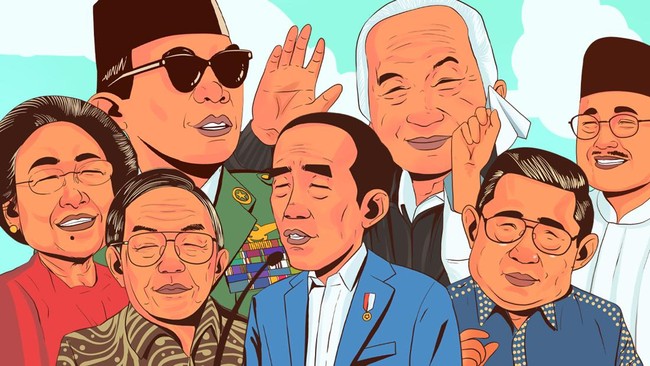
Jakarta, CNBC Indonesia - Today, Indonesia marks 28 years of reform. Since the fall of the New Order in May 1998, five presidents have led Indonesia. They have built Indonesia with their own ideas, thoughts and ambitions.
CNBC Indonesia attempts to summarize the economic policies undertaken by the five Presidents of the Republic of Indonesia since the Reform Era began. We use a variety of sources, including the ‘Indonesia’s Economic Reform Journey 1997-2016’ from the Centre for Strategic and International Studies (CSIS):
Abdurrahman Wahid / Gus Dur (1999-2001)
- Post-Crisis Economic Recovery
Positive
The Gus Dur administration continued the process of economic recovery after the 1998 crisis.
Economic stability began to improve compared with the crisis peak.
The rupiah exchange rate and inflation were relatively more contained than in the previous period.
The government continued cooperation with the International Monetary Fund (IMF) in the economic reform process.
Restructuring of the banking sector and corporations continued.
Limitations
The economy remained fragile and not fully recovered from the crisis impact.
Investor confidence in political and economic stability remained low.
Political uncertainty affected market perceptions of Indonesia.
- Political Reform & Decentralisation
Positive
The Gus Dur administration was an important part of the post-New Order democratic transition.
Decentralisation and regional autonomy began to be implemented broadly.
The role of regional governments in economic policy making increased.
Institutional reform began to reduce central government dominance as in the New Order era.
Limitations
Decentralisation generated many overlapping regional regulations.
Coordination between the centre and the regions had not yet been effective.
The institutional transition caused economic policy implementation to often be misaligned.
Unclear division of powers complicated the business and investment climate.
- Investment Climate & Economic Policy
Positive
The government began opening space for more democratic and transparent economic reform.
Several efforts were made to improve post-crisis economic governance.
Limitations
Economic reform progressed slowly due to unstable political conditions.
Policy shifts and political conflict generated uncertainty for investors.
The investment climate has not improved significantly.
Bureaucratic and regulatory reform had not been effective.
- Political Barriers & Governance
Positive
The government operated in a more open democratic climate than in previous eras.
Parliament and political institutions played a larger role in policy making.
Limitations
Political conflicts and power struggles occurred fairly intensely during Gus Dur’s presidency.
Relations between the government and the DPR (parliament) were often unstable.
Cabinet coordination was considered weak.
Political instability made economic reform difficult to implement consistently.
Frequent personnel changes and political dynamics disrupted government effectiveness.
- Overall Evaluation of Gus Dur’s Administration
Strengths
Continued the process of post-1998 crisis economic recovery.
Strengthened the democratic transition and decentralisation.
Kept economic reform moving forward during the political transition.
Weaknesses/Challenges
Political and governmental stability was relatively weak.
Investor confidence had not yet recovered.
Economic reform progressed slowly and was not yet systematic.
Coordination of central and regional policy remained problematic.
Political uncertainty hampered the effectiveness of economic reform.
Megawati Sukarnoputri Period (2001-2004)
- Post-Crisis Economic Stabilisation
Positive
The government’s main focus was restoring economic stability after the 1998 crisis.
Indonesia’s relationship with the International Monetary Fund (IMF) began to improve.
Inflation, exchange rate, and fiscal conditions were relatively better controlled than in the previous transitional period.
The government began rebuilding investor and market confidence in Indonesia’s economy.
Bank Indonesia was strengthened as an independent institution to maintain monetary stability.
The government issued the 2003 Economic White Paper as the direction of post-IMF economic reform.
Limitations
Economic recovery progressed relatively slowly.
Investment conditions had not fully recovered.
Foreign investor confidence remained weak following the crisis and political instability.
Microeconomic reform had not operated optimally.
- Banking & Fiscal Reform
Positive
The government continued restructuring the banking sector post-crisis.
Financial sector reform began to be strengthened to prevent a similar crisis from recurring.
Fiscal discipline began to improve after the surge in debt and bank rescue costs.
The government began strengthening governance of state financial management.
Limitations
The fiscal burden from the crisis and banking restructuring remained large.
Financial sector recovery had not yet been evenly distributed.
The effectiveness of reforms was still constrained by weak bureaucratic and institutional capacity.
- Investment Climate & Infrastructure
Positive
The government began pushing improvements to the investment climate as part of the economic recovery.
Economic reform began to be directed toward long-term development, not just crisis stabilization.
Limitations
Foreign Direct Investment (FDI) remained weak and briefly recorded negative in the first half of 2004.
Infrastructure and regulatory certainty remained investment barriers.
Bureaucracy and policy coordination were deemed inefficient.
Investment reform had not been able to significantly boost economic competitiveness.
- Political Barriers & Institutions
Positive
Megawati’s presidency was a period of initial consolidation of the economy and politics post-Reformasi.
The government began building a more stable economic institutional foundation.
Limitations
Reforms were carried out amid a political environment that remained transitional.
Inter-agency coordination was not solid.
The reform process still faced resistance.