
National Police Traffic Chief Reveals Parameters for Implementing Contraflow and One-Way Systems
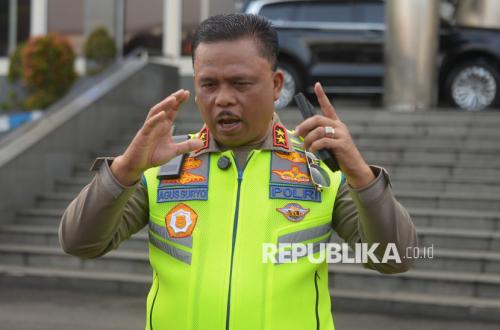
CIKAMPEK — National Police Traffic Director (Kakorlantas) Irjen Agus Suryonugroho has outlined the parameters employed by law enforcement in implementing traffic engineering measures including contraflow and one-way systems during the 2026 Ketupat Operation. These policies are established based on direct monitoring of vehicle volume on toll roads.
Vehicle flow monitoring is conducted through traffic radar installed at several strategic points. Data collected hourly serves as the basis for decision-making regarding whether traffic engineering measures should be implemented.
“Regarding contraflow on toll roads, there are parameters involved. So at kilometre 47, there is a radar that counts the number of vehicles over a continuous hour,” said Agus whilst providing a press statement at the National Police Traffic Command Centre in Cikampek, West Java, on Sunday (15 March 2026).
He explained that the radar continuously monitors vehicle volume. When the number of vehicles exceeds a certain threshold over a continuous hour, officers immediately report the condition to leadership to determine traffic engineering measures.
In the scheme prepared, said Agus, the first-stage contraflow will be implemented when vehicle volume reaches 5,500 vehicles per hour.
“If for one continuous hour the volume reaches 5,500 vehicles, we will report to the Chief of Police to implement contraflow on lane 1. Then if the following hour continues to increase to 6,400 vehicles, contraflow on lane 2 will be implemented,” said the Traffic Director.
If vehicle congestion persists after contraflow implementation, police will consider implementing one-way or one-way systems in stages on certain toll sections.
“If congestion and slowdowns continue, we will report to leadership to implement a one-way system in stages at the national one-way location. So it is not yet a national one-way system, but an initial phase on that section,” said Agus.
Officers also strengthen traffic monitoring through aerial surveillance technology. ETLE drones are deployed periodically to monitor vehicle flow on several major toll road sections.
Monitoring is focused on the route between kilometre 47 and kilometre 70, which is one of the critical points for managing vehicle flow towards the Trans-Java route.
Agus added that traffic conditions on toll roads and arterial roads remain relatively controlled. The volume of vehicles departing Jakarta has not yet reached peak holiday rush levels.
On several regional routes, traffic engineering has been implemented to anticipate increased vehicle numbers. Traffic diversion is being conducted in the Gadog area towards Puncak, whilst contraflow is applied on the Bogor–Ciawi–Sukabumi (Bocimi) route in the Cibadak area.
Holiday traffic security is also strengthened through enforcement against three-axle vehicles still using toll roads. This policy is implemented to prioritise smooth travel for holiday-makers.
Agus emphasised that the Ketupat Operation is conducted as a humanitarian operation to ensure safe public travel. Traffic management will continue to be adjusted based on vehicle flow conditions in the field.