
National Police Chief: Police in Civilian Posts Only on Request, 'If Not Asked, I Won't Send'
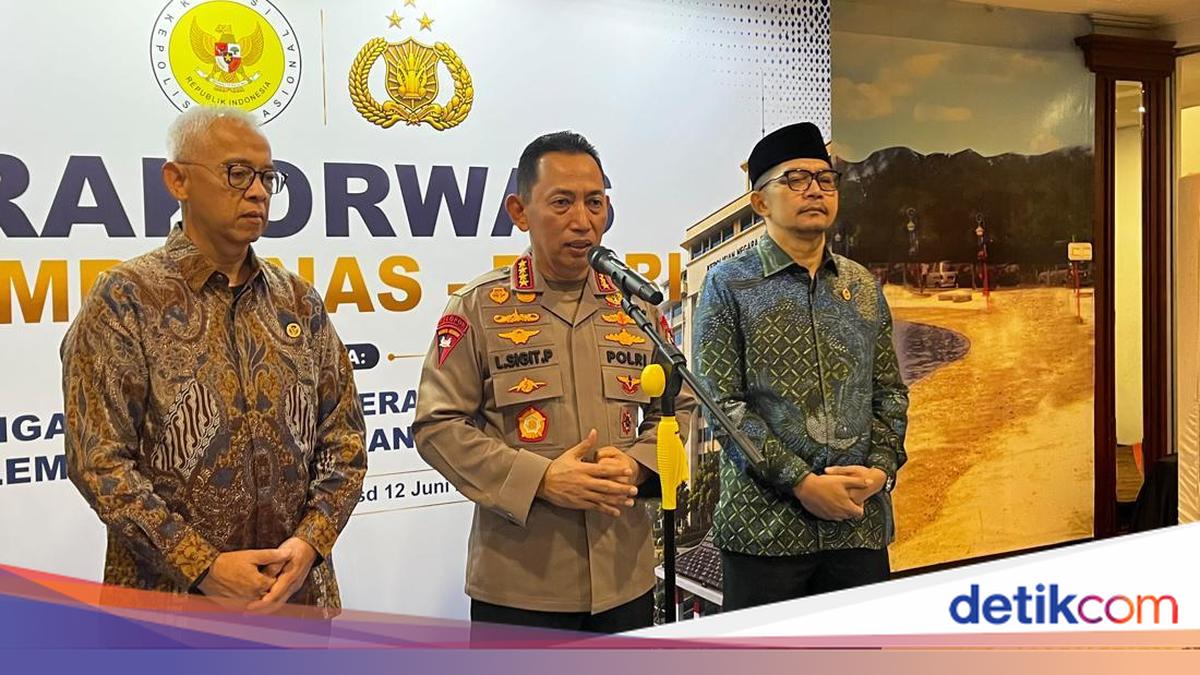
National Police Chief General Listyo Sigit Prabowo has emphasised that the filling of civilian posts by police personnel, as stipulated in the new Police Law, is contingent upon a request from the relevant agency. He asserted that he would not assign officers to civilian posts without such a request. “Regarding the placement of police personnel outside the structure, we stress that the National Police can only carry out duties outside the structure if requested. So if not asked, I will not send them,” said General Sigit during the 2026 National Police Commission (Kompolnas) Coordination Meeting in the Ancol area, North Jakarta, on Wednesday (10/6/2026).
Apart from being request-based, Sigit mentioned that assigning officers outside the institution could also be based on a presidential assignment. “However, there are also assignments from the President, which of course we could implement if the President deems that the presence of the National Police is necessary. Then, based on the President’s order, it can be carried out,” he added.
On that occasion, General Sigit also highlighted the principle of reciprocity. He expressed a wish for job openings not only to be available for police officers outside the structure, but also for State Civil Apparatus (ASN) to enter the National Police institution. Sigit explained that although this reciprocity point has not been fully accommodated in the Police Law recently passed at the DPR RI plenary session, his party will attempt to arrange this matter through derivative regulations.
“Regarding the matter outside the structure, yesterday we actually tried to raise the issue of reciprocity. So, if there are National Police personnel carrying out duties outside the structure, then we also provide space so that our ASN colleagues from outside the National Police structure can enter (the National Police),” Sigit clarified. “Yesterday it could not be accommodated in the law, but we will arrange it in a Government Regulation (PP) or Presidential Regulation (Perpres) so that this reciprocity can truly exist,” he added.
The former Chief of the National Police’s Criminal Investigation Division stressed that this policy is not aimed at taking over the job allocations of ASN in civilian agencies. According to him, the National Police will only fill positions that genuinely require police functional expertise. “It is not that we intend to disrupt the space of ASN police outside the structure, no, but this is solely because we provide space on the principle that we are needed. As long as it is in accordance with functions concerning police functions, we will carry it out,” he stated.
General Sigit also explained the existence of strict rules for personnel serving outside certain structures. “There are also rules related to those outside, where the National Police personnel must resign (retire early), which is regulated more clearly,” he elaborated.
Furthermore, General Sigit expressed hope that the new Police Law would make the Bhayangkara Corps more flexible in supporting government programmes, while remaining steadfast as a state instrument safeguarding the legal corridor. He also stressed the importance of improving the education curriculum so that National Police personnel become increasingly professional, humane, and respectful of Human Rights (HAM) in the future. In addition, strengthening external oversight such as Kompolnas also serves as an important note in the police reform process. “Our hope is that this law can accommodate notes related to the primary duties of the National Police going forward, alongside flexibility in facing existing challenges,” concluded General Sigit.