
National Nutrition Agency Mandates Expiry Labels on Free Nutritious Meal Containers
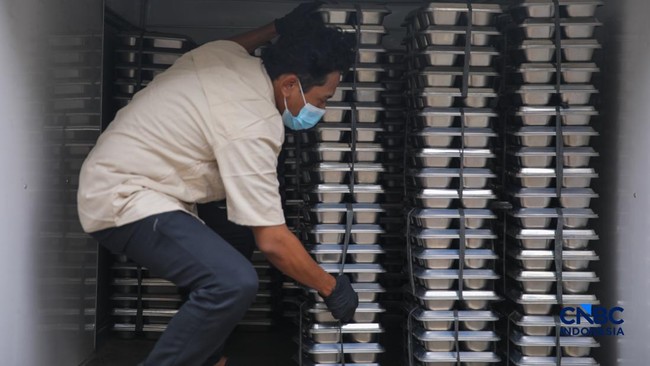
The National Nutrition Agency (BGN) is tightening food safety oversight in the implementation of the Free Nutritious Meal (MBG) Programme in schools. Starting this week, every MBG food container will be required to display a consumption time limit.
BGN Head Sudaryono stated that displaying the time limit is crucial so that teachers and students know when the food is still safe to consume. “We will enforce the obligation to write on every container a sign or a warning that it ‘must be consumed’ or ‘must be eaten before a certain time’. So the role of teachers is very important here,” Sudaryono said in a statement on Monday (10/8/2026).
Sudaryono stressed that food must not be consumed after the time limit stated on the container has passed. This rule applies to both students and teachers. “If the time on the container has exceeded the stated hour, we request that it not be consumed. Teachers must not consume it, and especially the students must not consume it once it has passed the designated time limit,” he asserted.
According to him, MBG meals are fresh food that do not use preservatives, hence they have a safe consumption window. Generally, the food must be consumed within a maximum of four hours after cooking. “Because according to the normal standards of food serving, after cooking it must be eaten within a maximum of 4 hours as this food contains no preservatives. It is truly cooked without ultra-processed food, so it is genuinely fresh and has a window where it is safe to consume,” he explained.
In line with this regulation, the BGN is also requesting that MBG meals not be taken home by students. Food received at school must be consumed on the premises within the designated time. “We ask, in accordance with the technical guidelines, that the meals should not be taken home. Ensure the food is eaten there, consumed in the classroom at the permitted time, and preferably not taken home,” Sudaryono stressed.
He noted that food taken home risks being stored for too long before being consumed again. According to him, this practice has even been a factor in several cases of MBG food poisoning, including incidents involving parents who consumed food brought home by students. “I understand this very well. Recently, at a primary school in Bogor that I visited, a student split their meal in two, saying they remembered their mother at home. This has become a poisoning case in several locations. In fact, it was not only the students who suffered poisoning, but also the parents at home who ate the food that was brought home,” he said.
Beyond tightening consumption rules, the BGN is also improving the food production monitoring system across all Nutritional Fulfilment Service Units (SPPG). Currently, there are 27,489 operational SPPGs required to use a production monitoring system. The system records the entire process, from ingredient preparation, cooking, finished meals, packaging, to delivery to schools. This allows the time from food production to serving to students to be monitored.
The BGN is also placing a responsible officer or PIC in every school. The PIC comes from the educational staff, such as administrative personnel, and is tasked with receiving and inspecting the food before it is given to students. Inspections are carried out organoleptically by looking, smelling, and tasting food samples. If the food is deemed not to meet standards, it must be withheld and not given to students. “The PIC performs an organoleptic mechanism, which is to open, take a sample, smell, taste, and look at it. If it does not meet the standard, it is mandatory not to give it to the students. So the PIC is the last second layer that ensures whether the menu is safe or not,” he concluded.