
National Forest and Land Fire Hotspots Increase by 228 Points
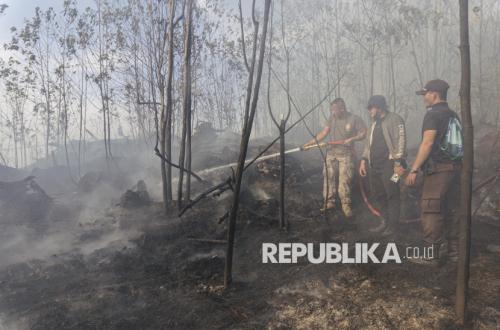
The Ministry of Forestry has announced that national high-confidence hotspots for forest and land fires (karhutla) have increased by 228 points. According to SiPongi data, national high-confidence hotspots reached 559 points on Sunday (27/09/2026), up from 331 points the previous day.
In a statement on Monday (28/09/2026), the Ministry noted that hotspots in three out of six priority provinces experienced an increase. Hotspots in Central Kalimantan rose from 30 points the previous day to 135 points. Meanwhile, hotspots in West Kalimantan increased from two points to 11 points, and Jambi rose from one point to five points.
Two provinces showed a decrease in hotspot numbers. South Sumatra dropped from 38 points to 28 points, and South Kalimantan decreased from 40 points to 25 points. Riau remained at zero.
As a result, as of last Sunday, the number of hotspots in the six priority provinces was recorded at 204 points, higher than the previous day’s 111 points. The Ministry of Forestry stated that this increase will be immediately addressed through field verification and the strengthening of operations, particularly in Central Kalimantan.
The Ministry is conducting patrols, field inspections, firefighting, wetting, mopping up, and cooling operations to prevent fires from spreading or reigniting. The Ministry reminded the public that hotspots are indications of surface temperature anomalies detected via NASA Terra/Aqua, SNPP, and NOAA-20 satellites.
A single fire incident can be detected as multiple hotspots. Therefore, the number of hotspots cannot be directly equated to the number of fire incidents or the total burned area, and all indications must still be verified through field inspections.
In its statement, the Ministry said the government has placed 61 aircraft units on standby to support national forest fire handling. 17 units are being used for patrols and Weather Modification Operations (OMC), while 44 units are dedicated to water bombing operations.
Fifty-five units are supporting operations in the six priority provinces, while six additional water bombing units have been deployed to support other affected regions. Aerial operations are being conducted alongside ground operations by the Ministry of Forestry’s Manggala Agni team and various other parties.
The Ministry stated that OMC remains a key strategy for wetting vulnerable areas. The Meteorology, Climatology, and Geophysics Agency (BMKG) recorded the implementation of OMC for peatland wetting and fire handling in Central Kalimantan from 22–27 September 2026, and in South Kalimantan from 22–26 September 2026.
On Sunday, BMKG also issued an early warning for the potential of moderate to heavy rain in several priority provinces, including Central Kalimantan, South Kalimantan, West Kalimantan, South Sumatra, Riau, and Jambi. While rainfall is a crucial factor in assisting land wetting, vigilance is still required as embers in peatlands can persist beneath the surface.