
National Food Agency Requests 11 Provinces to Revoke Permits for 25 Problematic Fortified Rice Brands
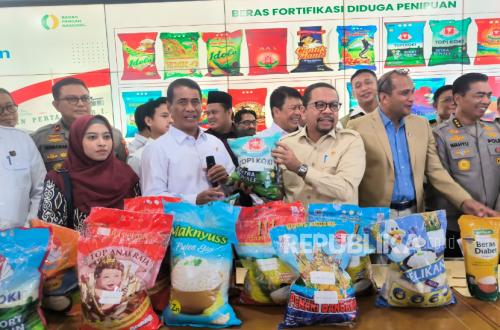
The National Food Agency (Bapanas) has requested 11 provinces to revoke the permits of 25 fortified rice brands suspected of being problematic. The revocation is a follow-up to findings of discrepancies between the nutritional content and the information printed on the product labels.
Hermawan, the Deputy for Food Availability and Stabilisation at Bapanas, stated that the agency has directed all Regional Food Security and Quality Control Bodies (OKKPD) in the 11 provinces responsible for issuing fortified rice permits to proceed with the revocation.
“That is correct. We have already urged all OKKPD in the 11 provinces that issued the circulars; they have been instructed to revoke the permits. Specifically for fortified rice, it has been done,” the official said when met at the Parliament Complex, Senayan, Jakarta, on Wednesday (16/09/2026).
Hermawan explained that fortified rice permits can be issued by regional OKKPD. He cited DKI Jakarta as an example, where distribution permits were issued for several brands that were subsequently identified by the government as problematic.
“For instance, in DKI Jakarta, several distribution permits were issued. These have now been revoked; we have directed that all of them be revoked,” he said.
In addition to revoking the permits, Bapan/as has also ordered the withdrawal of these 25 brands from circulation and the cessation of their production. This instruction was formalised in a letter from the Deputy III of Bapanas to the OKKPD to follow up on the findings regarding the problematic fortified rice.
“To direct the OKKPD to withdraw them from circulation, stop production, and revoke the permits,” Hermawan added.
The findings regarding the 25 brands originated from the monitoring of fortified rice across 11 provinces. Bapanas took 198 samples for laboratory testing; since several samples shared the same brands, the results covered 25 different trademarks.
Hermawan stated that the examination revealed issues across all 25 brands, primarily the mismatch between nutritional content and label information. He cited an example where a product claimed to contain 30 per cent Vitamin B12, but laboratory results showed only 15 per cent, with some samples containing none at all.
These findings are being followed up through an assessment process conducted alongside the Criminal Investigation Division (Bareskrim) of the Indonesian National Police. Of the 25 brands, 15 have undergone assessment, while the remaining 10 are still in progress.
“From the results of this assessment, we will determine which cases can proceed as crimes or criminal fraud. More specifically, suspected fraud,” said Hermawan.
Once the assessment is complete, the results will be evaluated before a formal case review is conducted. This stage will determine whether the matter will be escalated to a formal police report.
Previously, the Minister of Agriculture and Head of Bapanas, Andi Amran Sulaiman, revealed that the government has ordered the withdrawal, revocation of permits, and legal action against fortified rice products found to be inconsistent with their labels.
“First, we have ordered the withdrawal; second, the revocation of permits; and third, legal processing. We are being firm. And consumers, do not buy them,” Amran said in Jakarta on Monday (15/09/2026).
Product withdrawals have already been implemented in modern retail outlets. Hermawan noted that almost all identified fortified rice products have been removed from modern retail chains.
Meanwhile, Bapanas continues to monitor the availability and prices of premium and medium-grade rice to ensure that these product withdrawals do not impact the public supply. Monitoring is being conducted through the Rice Monitoring Task Force established by Bapanas in coordination with regional authorities.
Hermawan stated that premium and medium-grade rice remain available in traditional markets. Bulog has also been prepared to supply the market should price increases occur, using either medium-grade SPHP rice or premium rice.
“A total of 95 per cent of the SPHP rice budgeted by the government has been absorbed. We are currently distributing the remaining 5 per cent,” said Hermawan.
Rice monitoring is currently being conducted across Indonesia involving Bapanas, Food Security Agencies, regional task forces, and the police, from the Regional Police (Polda) to the District Police (Polres) levels. The government is continuing the withdrawal and production halt of the 25 brands as part of the ongoing monitoring of fortified rice.
Source: jawawa.id (https://jawawa.id/newsitem/national-food-agency-requests-11-provinces-to-revoke-permits-for-25-problematic-fortified-rice-brands-1789560059)
Originally published by Republika (https://ekonomi.republika.co.id/berita/tlgfkk349/bapanas-minta-11-provinsi-cabut-izin-25-merek-beras-fortifikasi-bermasalah), translated from Indonesian