
National Food Agency prepares transport subsidies to maintain stable chicken meat prices
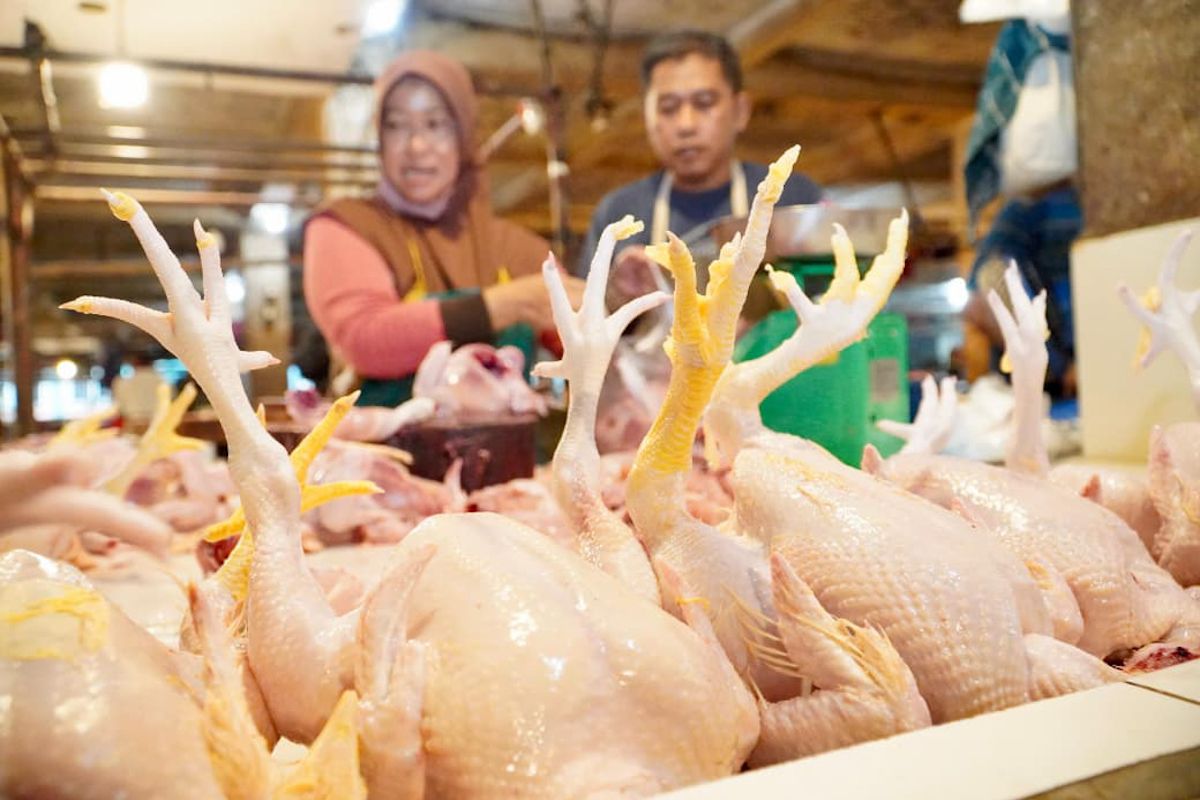
Jakarta (ANTARA) - The National Food Agency (Bocuk Bapanas) is preparing to subsidise transport costs for chicken meat to regions experiencing price volatility. This move is intended to maintain fair pricing, strengthen distribution, and guarantee supply for both the public and poultry farmers.
“For distribution transport, we can provide subsidies through Bapanas, so that production absorption from areas with surpluses can spread to all regions,” said Hermawan, Deputy for Food Availability and Stabilisation at Bapanas, confirmed in Jakarta on Sunday.
According to the Central Bureau of Statistics (BPS), broiler chicken commodities contributed to national inflation throughout September. This was driven by increased demand for broiler meat, supported by the requirements of the Free Nutritious Meal (MBG) programme in several regions, as well as fluctuations in poultry feed prices.
As an anticipation of excessive price fluctuations, Bapanas is strengthening its role to assist local governments that are not broiler chicken producers and are currently experiencing price instability. Subsidising transport costs from producing regions is the solution being prepared.
“The situation is that demand is increasing, and there may have been rises in recent months, but prices remain fair and within limits, not across the board. In many areas, prices are still low; it is only in certain places where chicken production is insufficient,” he said.
According to Hermalar, one of the frequent obstacles faced by local governments in efforts to stabilise strategic food prices is the cost of distribution from outside their regions, especially if the area is not a central production hub.
“Bapanas is ensuring that areas lacking supply will be supplied from producing regions. We still have the budget available,” said Hermawan.
Regarding current chicken meat price developments, Bapanas monitoring showed that as of 2 October 2026, the national average price stood at Rp40,961 per kilogram (kg).
“This actually represents a decrease of 0.62 per cent compared to the previous week, which was Rp41,218 per kg, and a decrease of 0.82 per cent compared to the previous month at Rp41,300 per kg,” he explained.
In terms of availability, Hermawan continued, the projection for broiler chicken stocks until the end of 2026 can still reach 1 million tonnes.
This is based on the initial stock at the start of 2026 of 200,000 tonnes, plus an estimated annual domestic production of 4.7 million tonnes, against a national consumption requirement of 3.9 million tonnes.
The surplus in broiler chicken must be managed proportionally by the government. Price equilibrium from upstream to downstream must be maintained. Downstream interventions, such as transport subsidies, are accompanied by upstream interventions targeting poultry farmers.
One such measure is the implementation of the Food Supply and Price Stabilisation (SPHP) programme for poultry feed maize. This step follows the directive from the Head of Bapanas and Minister of Agriculture, Andi Amran Sulaiman, for his staff to continue monitoring the availability of feed maize for farmers.
Previously, the Head of Bapanas and Minister of Agriculture, Andi Amran Sulaiman, instructed Perum Bulog to continue serving poultry farmers in need of feed maize at more economical prices.
The allocation for the SPHP poultry feed maize programme has even been increased by 150,000 tonnes.
The first stage of the 2026 SPHP poultry feed maize programme began in early May. The total distribution quota was set at 213.2 thousand tonnes, consisting of the feed maize needs for micro, small, and medium-scale poultry farming groups.
As of 2 October, the realisation of the SPHP poultry feed maize distribution reached 71.36 per cent of the total target for the first and second stages, which is 241.2 thousand tonnes.
In terms of quantity, 172.1 thousand tonnes have been accessed by farmers spread across 29 provinces. The regions with the highest number of farmers are East Java with 3,690 farmers and Central Java with 2,017 farmers.
The government’s commitment to the national poultry farming ecosystem is demonstrated through the increased allocation for the SPHP poultry feed maize programme. A total of 150,000 tonnes has been officially processed by the government, which will subsequently increase the assignment allocation for Perum Bulog.