
National Farmers' Day: From Renewable Energy to Food Production and Farmer Independence
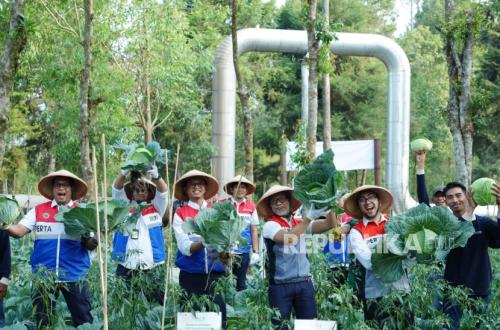
From the slopes of the Kamojang mountains in Bandung Regency, West Java, geothermal energy is being utilised for more than just power generation. For local farmers, this renewable energy is now assisting in converting waste into fertiliser, maintaining soil health, and producing food.
This idea emerged from the daily challenges faced by farmers. The cool air, combined with high rainfall and humidity, meant that the conventional drying process for organic fertiliser took up to 14 days. Furthermore, the scarcity of subsidised fertiliser and the high cost of chemical alternatives posed significant threats to the sustainability of farming enterprises.
These conditions prompted the Cikondang Forest Farmer Group (KTH) to collaborate with PT Pertamina Geothermal Energy Tbk (PGE) Kamojang Area, a subsidiary of Pertamina, to develop GeO-Fert. This organic fertiliser uses excess geothermal steam through the Kanyaah Independent Energy Village (DEB) Programme to facilitate the drying process.
By utilising geothermal heat at temperatures of approximately 60–70°C, the fertiliser drying process, which previously required up to 14 days, can now be compressed to around 12 hours.
By 2026, this innovation has processed approximately 600 tonnes of organic waste to produce 300 tonnes of GeO-Fert. The fertiliser has been applied to roughly 15 hectares of land, benefiting approximately 950 farmers.
However, for Kamojang farmers, the success of GeO-Fert is not measured solely by production volume. Success is truly realised when the fertiliser returns to the soil to produce harvestable crops.
This was demonstrated during the HAREPAN activity—Harvesting Earth’s Produce with GeO-Fert Fertiliser. From the lands using this fertiliser, farmers successfully harvested approximately 15 tonnes of potatoes and 40 tonnes of cabbage, while simultaneously achieving cost savings of around Rp82 million.
“For us, the most important thing is not just being able to make our own fertiliser, but how this fertiliser returns to the soil to produce a harvest. From something previously considered waste, it can now provide benefits for agriculture and farmers,” said Hendro Gunawan, a Local Hero from KTH Cikondang.
Renewable energy driving the food sector
Muhammad Baron, Vice President of Corporate Communication at PT Pertamina (Persero), stated that National Farmers’ Day serves as a momentum to recognise the vital role of farmers and to encourage innovations that strengthen their productivity and independence.
“Farmers are a crucial part of maintaining food security. Through the Independent Energy Village programme, Pertamina strives to bring renewable energy closer to the productive needs of the community. In Kamojang, geothermal energy is helping farmers process waste into fertiliser, tending to the land, and producing food,” said Baron.
According to him, the GeO-Fert story demonstrates that the use of renewable energy can provide broader benefits when connected to community needs.
Geothermal energy, traditionally known as a source for electricity generation, is also being used in Kamojang to support coffee drying and other agricultural activities. Organic waste is processed into fertiliser, the drying process is accelerated, and the fertiliser is reused on the land to produce agricultural commodities.
This sequence creates a cycle that provides added value to both the environment and the farmers.
Pertamina continues to develop this spirit through the Independent Energy Village (DEB) Programme across various regions in Indonesia. By 2026, Pertamina will be running 269 DEB programmes, 166 of which focus on food security.
These food security DEB programmes have supported approximately 2,091 hectares of agricultural land, with total yields reaching 21,357 tonnes.
Through DEB, Pertamina encourages the use of renewable energy and appropriate technology to support the productive activities of the community. The goal is not only to provide energy but also to create added value that can be directly felt by the people.
On National Farmers’ Day 2026, the GeO-Fert story serves as an illustration that farmer independence can grow from the potential available around them. From renewable energy, fertiliser grows. From fertiliser, crops grow. And from the harvest, hope grows for a more sustainable life for farmers.
Source: jawawa.id (https://jawawa.id/newsitem/national-farmers-day-from-renewable-energy-to-food-production-and-farmer-independence-1790222239)
Originally published by Republika (https://ekonomi.republika.co.id/berita/tlulmb430/hari-tani-nasionaldari-energi-terbarukan-tumbuh-pangan-dan-kemandirian-petani), translated from Indonesian