
National Energy Council Urges Energy Subsidy Reform, Here's Why
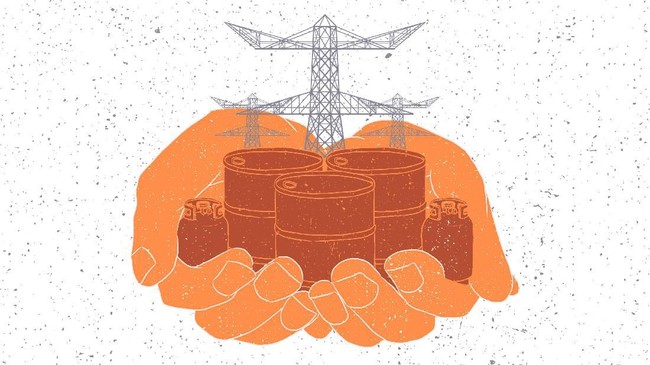
Bogor - The National Energy Council (DEN) is urging a reform of the national energy subsidy scheme to ease the mounting fiscal burden. This is deemed necessary so that the State Revenue and Expenditure Budget (APBN) allocation can be redirected to support innovation and the development of a more productive energy sector.
DEN member Satya Widya Yudha highlighted the large portion of subsidies in the state budget, which is considered to hinder the scope for domestic energy technology innovation. He stressed the need to change the pattern of aid distribution from being commodity-based to subsidies that directly target individuals to ensure social justice.
"If we look at the fiscal side, the fiscal burden of energy subsidies, the 2022 APBN was burdened with energy subsidies and compensation of Rp 551 trillion, which is equivalent to 2.8 percent of our GDP," Satya said at the DEN Energy Gathering event at the IPB Campus in Bogor.
Based on DEN records from the Ministry of Finance regarding Energy Subsidies and Compensation from 2012 to 2026, the oil and gas trade balance began to be negative in 2012 when oil and gas production declined and imports increased. The implementation of energy reform policies in 2015 implied a significant decrease in the subsidy budget. However, in 2022, the allocation of subsidies and compensation increased sharply as a shock absorber due to rising commodity prices caused by the global crisis resulting from the war between Russia and Ukraine.
It was recorded that energy subsidies and compensation reached Rp 551.2 trillion in 2022, Rp 370.4 trillion in 2023, and Rp 386.9 trillion in 2024. Meanwhile, the provisional realisation of energy subsidies and compensation for 2025 reached Rp 305.2 trillion, and in the 2026 APBN, the allocation reaches Rp 351.1 trillion.
The enormous value of subsidies, reaching hundreds of trillions, is considered an irony as it far exceeds the national research budget. The DEN assesses that dependence on commodity subsidies places Indonesia in a difficult position to develop independently because energy costs are fully borne by the state coffers.
"This means we should be entering a mood of failing to innovate because the APBN pays for everything. The long-term solution requires subsidy reform so that it is right on target, based on integrated national socio-economic data," explained Satya.
The government plans to rely on the use of big data technology and artificial intelligence (AI) to run this targeted subsidy programme. Data integration through the National Socio-Economic Single Data (DTSEN) is seen as the main instrument in dissecting barriers to energy aid distribution at the grassroots level.
"Energy security is roughly equivalent to fiscal security, and fiscal security requires data security. We must start so that the targeted subsidy problem will be resolved," he added.
He hopes that with this restructuring, Indonesia can minimise the risk of subsidy leakage, which has so far been enjoyed by affluent community groups. Satya emphasised that strong data security is an absolute prerequisite for maintaining national economic stability while ensuring that state aid truly reaches the people who need it.