
National Economic Resilience Key to Facing Global Turmoil
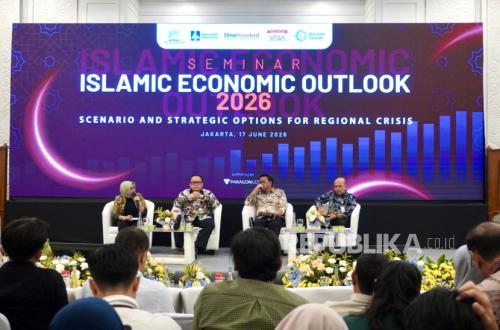
Increasing global uncertainty due to geopolitical dynamics, including the Middle East crisis, has underscored the importance of strengthening national economic resilience. This view emerged during the Islamic Economic Outlook 2026 panel session: Scenario & Strategic Options for Regional Crisis at Bappenas, Jakarta, Wednesday (17/6/2026).
The discussion, moderated by Deputy for Economic and Digital Transformation at Bappenas, Vivi Yulaswati, brought together government representatives, academics, and the National Economic Council to examine steps Indonesia must take to maintain economic stability amid global dynamics.
Director of Defence and Security at the Ministry of National Development Planning/Bappenas, Erik Armundito, explained that security stability is the primary foundation (enabler) before building prosperity, as current geopolitical dynamics increase risks to territorial sovereignty and trade routes in the Strait of Hormuz.
“Indonesia needs to strengthen its anticipatory capacity and prepare various policy scenarios to maintain national stability,” Erik said. He emphasised the importance of concrete measures such as modernising defence equipment, strengthening the maritime defence industry, and preparedness to face opinion wars and cyber threats in the digital public sphere, in line with the medium-term development plan.
Meanwhile, Executive Director for Priority Economic Programme Acceleration at the National Economic Council (DEN), Mochammad Firman Hidayat, explained that although the global crisis has triggered rupiah volatility and producer-side price increases, Indonesia’s economic fundamentals remain sound, with high cash stamina and far from the spectre of a 1998-style crisis.
“Every global change presents both challenges and opportunities. What needs to be done is to ensure Indonesia has the right strategy,” Firman stressed. He highlighted the importance of anticipatory measures through risk identification and market diversification for strategic non-oil and gas commodities such as naphtha and sulphur, given that global logistics route closures had previously disrupted the national downstream industry supply chain.
From an academic perspective, Dean of the Faculty of Economics and Management at IPB University, Irfan Syauqi Beik, assessed that strengthening the domestic economic foundation must be based on a growth through equity paradigm so that resilience is robust, involving MSMEs as the engine of the economy.
“Economic resilience is not built when a crisis occurs, but long before, through strengthening the productive sector in a socially just manner,” Irfan said. He added that Islamic economic instruments have significant potential as a concrete solution, one of which is through optimising the global halal industry and regulatory breakthroughs that allow the use of waqf assets as underlying assets for state sukuk to strengthen the fiscal position.
The panellists agreed that national resilience must be built through adaptive and inclusive policies. Synergy between strengthening security, utilising Islamic finance, and mitigating supply chain risks is Indonesia’s main capital to face global challenges towards the Golden Indonesia 2045 vision.
The forum is expected to provide input for the government and stakeholders in formulating policies that strengthen national economic resilience amidst evolving global dynamics.