
National Economic Condition Assessed as Still Resilient
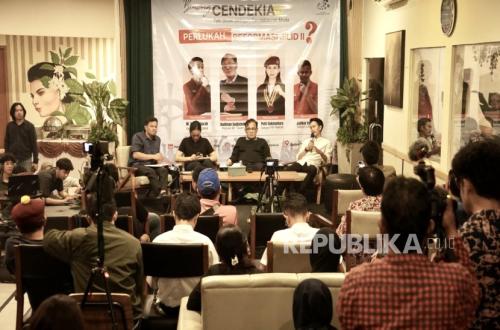
A number of student organisations have assessed that Indonesia’s current economic and political conditions cannot be equated with the situation leading up to the 1998 Reformasi. Despite various ongoing challenges, democratic space and national stability are considered to remain functional, allowing policy improvements to be pursued through available mechanisms.
This view emerged in a discussion titled “Is a Second Reformasi Necessary?” held by the Jaringan Cendikiawan Muda (Forum Sekjen Cipayung Plus) together with several student organisations in South Jakarta on Wednesday (17/6/2026).
The discussion featured Secretary General of DPP IMM Muhammad Zaki Mubarak, Secretary General of PP PMKRI Putri Sukmaniara, and Head of the Poverty Alleviation Acceleration Agency Budiman Sudjatmiko. The event was also attended by leaders of student organisations who are members of the Forum Sekjen Cipayung Plus.
Muhammad Zaki Mubarak stated that reform is an ongoing process that did not end with the political events of 1998. According to him, over nearly three decades, Indonesia has recorded various advances, particularly in the aspects of democracy and freedom of expression.
“The student movement must continue to oversee the reform agenda, but should not be trapped in romanticising terms like Reformasi Jilid II. The most important thing is to ensure that the values and spirit of reform remain alive and capable of addressing the real problems of society,” Zaki said.
Nevertheless, Zaki assessed that the government still needs to pay attention to various issues that continue to be felt by the public. Rising prices of staple goods, job availability, and improved welfare are issues that must be continuously addressed through well-targeted policies.
A similar view was expressed by Secretary General of PP PMKRI Putri Sukmaniara. She stated that Indonesia’s current objective conditions differ from the situation leading up to the 1998 Reformasi, which was marked by an economic crisis, political instability, and various other structural problems.
“Currently, the economic condition does face challenges, but it is still relatively stable and society is not in a situation like that of 1998,” Putri said.
According to her, the government still needs to evaluate various strategic programmes so that their benefits are felt more by the public. This evaluation is considered important as part of a continuous policy improvement process.
Meanwhile, Head of the Poverty Alleviation Acceleration Agency Budiman Sudjatmiko stated that the government is currently undertaking various efforts to restructure the national economy. A number of measures are being taken to broaden the benefits of development and strengthen public access to various social programmes.
Budiman assessed that criticism and input from the public and student groups remain an important part of the development process. Therefore, space for dialogue needs to be continuously strengthened so that various issues can be resolved constructively.
The discussion addressed various issues related to democracy, economic development, and the role of students in overseeing governance. Participants assessed that criticism of public policy is an inseparable part of democratic life, but it needs to be directed towards encouraging improvements and solving the problems faced by society.