
NASA Tests AI Medical Imaging Technology on International Space Station
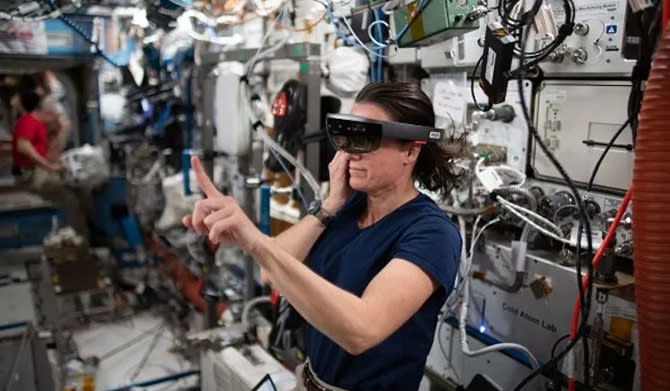
Astronauts aboard the International Space Station have tested two new technologies designed to enhance medical capabilities in space and reduce dependence on support from Earth.
The astronauts used augmented reality (AR) to guide them through ultrasonic scans of their organs. Artificial intelligence (AI) then identified these organs.
This trial represents the first instance of astronauts using AI to improve their access to emergency medical assistance during long-distance travel away from Earth.
NASA is currently preparing Expedition 74 crew to conduct a spacewalk this week to relocate cables on the left side of the orbital power output of the International Space Station for installation of new solar panels.
The astronauts have undertaken intensive preparation, including thorough examination of spacesuits to ensure there are no leaks. They are also testing the augmented reality and AI capabilities that will be used.
NASA has also conducted simulations of scenarios in which astronauts cannot rely on support from Earth. The objective is to enable them to use ultrasound equipment so that ultrasound images can be input into an AI model and accurately identify the astronauts’ internal organs.
Although NASA’s simulations represent a foundational step, they provide an initial picture of the future capabilities of augmented reality and AI systems.
When astronauts travel farther than they currently do, ground support systems will require more time to respond.
However, the new system allows direct expertise in fields that even the astronauts themselves may not be fully proficient in. In other words, the augmented reality and AI developed can provide a knowledge backup if astronauts are unable to perform their tasks and can deliver crucial assistance directly without waiting for a response from NASA.