
NASA Satellite Shows Indonesia Surrounded by Carbon Monoxide: What Are the Impacts?
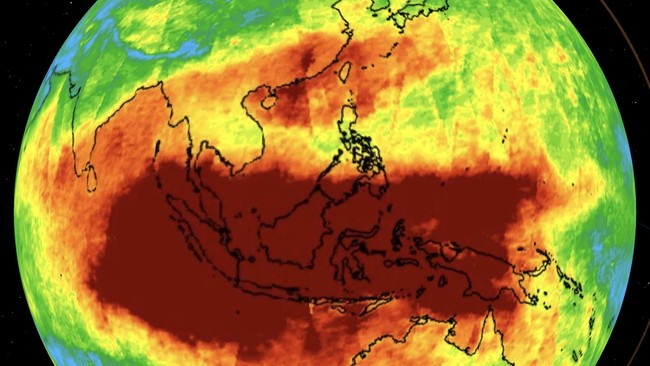
Jakarta, CNBC Indonesia – NASA satellite imagery shows carbon monoxide spreading across Indonesia from 13 to 15 October 2026. In visualisations on the Eyes on the Earth website, several parts of the country appear predominantly red.
The NASA map uses a colour gradient to show carbon monoxide concentrations in the atmosphere. Orange and red indicate higher concentrations of CO, while blue and purple indicate lower concentrations.
The data show average atmospheric carbon monoxide at an altitude of about 18,000 feet (5.5 kilometres), over a three-day observation period.
Carbon monoxide is produced by various sources, including motor vehicles, volcanoes, forest fires, and the incomplete burning of wood and fossil fuels.
NASA explains that carbon monoxide also affects levels of methane and ozone in the lower atmosphere. This makes CO an important factor in air pollution and climate change.
NASA measures carbon monoxide concentrations in ppbv (parts per billion by volume). A reading of 1 ppbv means that, in every billion gas molecules in a given volume, there is one molecule of carbon monoxide.
Understanding carbon monoxide
Carbon monoxide is an inorganic gas or liquid that is colourless, practically odourless and tasteless, and is often called a ‘silent killer’. It forms when carbon burns incompletely and burns with a violet flame.
According to the ninth edition of The Condensed Chemical Dictionary, the compound has the following physical characteristics, as cited by the official website of the United States Environmental Protection Agency (EPA) on Friday, 16 October 2026:
Solubility: slightly soluble in water, but soluble in alcohol and benzene.
Specific gravity: 0.96716.
Boiling point: −190°C.
Freezing point: −207°C.
Specific volume: 13.8 cubic feet per pound (at 70°F).
Auto-ignition temperature (liquid): 1,128°F.
Health risks
When it enters the body, CO binds to blood haemoglobin and forms carboxyhaemoglobin. This impairs the blood’s ability to carry oxygen throughout the body.
The effects can range from mild to fatal, depending on the concentration:
Low concentrations: can cause fatigue in healthy people and trigger chest pain (angina) in people with heart disease.
Moderate concentrations: can cause impaired vision, reduced brain function and flu-like symptoms, which usually ease after leaving the room.
High concentrations: can cause dizziness, severe headaches, nausea, confusion and impaired coordination, and may ultimately be fatal.
Source: jawawa.id (https://jawawa.id/newsitem/nasa-satellite-shows-indonesia-surrounded-by-carbon-monoxide-what-are-the-impacts-1792129851)
Originally published by CNBC Indonesia (https://www.cnbcindonesia.com/tech/20261016111011-37-776770/satelit-nasa-ungkap-ri-dikepung-karbon-monoksida-begini-dampaknya), translated from Indonesian