
NASA Satellite Breaks Apart as It Falls to Earth, Leaving Astronomers in Mourning
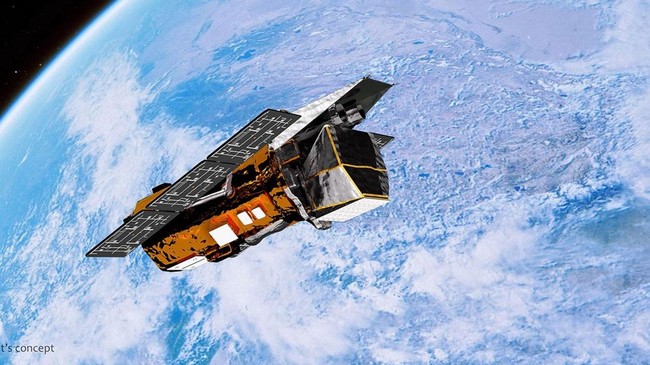
One of NASA’s legendary space observatories, the Neil Gehrels Swift Observatory, is preparing to end its journey dramatically. After nearly 22 years in orbit and a series of landmark discoveries, the spacecraft is expected to fall into and burn up in Earth’s atmosphere next week following the failure of a rescue mission.
An attempt to boost its orbit, launched in July, failed after the rescue spacecraft lost control and began spinning before reaching its target. As a result, Swift has descended to a lower orbit and can no longer lock on to astronomical targets for observation.
Last week, the US National Aeronautics and Space Administration (NASA) officially shut down all of Swift’s science operations. Researchers estimate that the observatory will enter Earth’s atmosphere on 2 November, with most of it burning up and only a small amount of debris reaching the ocean.
“We are all very sad, of course. There is clearly a sense of mourning,” said Caryl Gronwall, Swift’s science operations team leader at Pennsylvania State University, according to a report by Nature cited on Wednesday (28 October 2026.
A golden legacy of revealing the universe’s mysteries
Swift was initially designed to observe gamma-ray bursts (GRBs), flashes of high-energy radiation that are the most powerful explosions in the universe. During its career, it identified nearly 2,000 GRBs.
In 2017, Swift made history by observing the aftermath of a collision between two neutron stars. The observations provided evidence for the scientific theory that collisions between these ultra-dense stars produce valuable heavy elements in the universe, including gold and platinum.
Swift also observed supernovae and comets, and helped reveal how black holes generate enormous energy jets as they consume stars.
“The observatory’s scientific portfolio expanded and grew far beyond what its designers originally intended,” said Brad Cenko, Swift’s principal investigator at NASA’s Goddard Space Flight Center.
Leaving a gap in space science
Swift’s loss leaves a significant gap for the global astronomy community. True to its name, the observatory was highly agile, able to respond to new phenomena in the sky within minutes. This is far faster than large space telescopes such as Hubble, which have complex queues of observing assignments.
Nevertheless, NASA says Swift’s scientific legacy will endure. It was one of the agency’s first projects to make all its observational data publicly available.
“There is a huge amount of Swift scientific data in the archive that the public can still explore to make new discoveries in the future,” Gronwall said.
Source: jawawa.id (https://jawawa.id/newsitem/nasa-satellite-breaks-apart-as-it-falls-to-earth-leaving-astronomers-in-mourning-1793177493)
Originally published by CNBC Indonesia (https://www.cnbcindonesia.com/tech/20261028111021-37-780128/satelit-nasa-hancur-lebur-jatuh-ke-bumi-astronom-berduka), translated from Indonesian