
NASA Reveals Signs of Doom: Indonesian Regions in Grave Danger
NASA Reveals Signs of Doom: Indonesian Regions in Grave Danger
Jakarta, CNBC Indonesia - The United States National Aeronautics and Space Administration (NASA) has issued a severe warning regarding the apocalyptic threat to coastal regions worldwide, including Indonesia. The global sea-level rise phenomenon is reported to be accelerating at an alarming rate.
Based on the latest satellite data collected over more than 30 years, NASA records that the average global sea level has risen by about 9.4 centimetres since 1993. However, the spotlight is on the rate of rise, which has now surged to more than double its previous speed.
If in 1993 sea levels rose by about 0.18 centimetres per year, the figure now stands at 0.42 centimetres per year.
“This acceleration means we are on track to add another 20 centimetres to the global sea level by 2050,” said NASA Sea Level Change Team Director Nadya Vinogradova Shiffer in her official statement, quoted from the official JPL NASA website.
El Niño Effects and Global Warming
NASA explains that the drastic surge in the past year is inseparable from the strong El Niño phenomenon. El Niño causes rainfall that usually falls on land to shift to the sea instead, instantly increasing sea volume.
However, the main permanent “engine” behind this rise is global warming triggered by greenhouse gas emissions. Rising Earth temperatures cause polar ice to melt and trigger thermal expansion, where seawater expands as its temperature increases.
Indonesia in Grave Danger
This news serves as a danger alarm for Indonesia as an archipelagic nation. Several major cities in Indonesia located in low-lying areas, such as Jakarta, Semarang, and Surabaya, are predicted to suffer the most severe impacts.
A sea-level rise of 20 centimetres by 2050 is no small figure for Indonesia’s coastal regions, which are also experiencing land subsidence. The combination of rising seas and sinking land will accelerate the loss of land areas, damage vital infrastructure, and threaten the economic livelihoods of coastal residents.
Experts warn that without extreme mitigation steps to curb emission rates and improve groundwater management, the worst-case scenario of losing several small islands and submerging Indonesian coastal areas could occur sooner than initially estimated.
10 World Cities at Risk of Submersion
In a study, NASA found an increase in sea levels by 2100. At least 10 major cities worldwide are at risk of submersion, including Jakarta.
The increase is estimated at 3-6 feet (91.4 cm to 182.88 cm). The reason is climate change causing polar ice to melt.
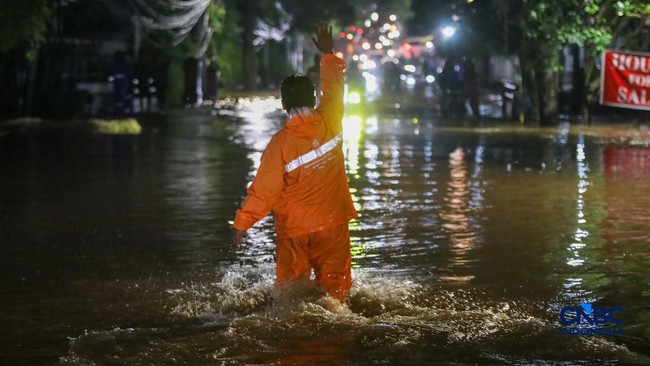
Currently, this risk is already becoming apparent. One example is the frequent flooding phenomenon, such as in parts of Jabodetabek and Java over the past few years.
Besides Jakarta in Indonesia, here are the 10 cities deemed at risk of submersion, quoted from a Sciencing report:
Alexandria, Egypt
Egypt’s second-largest city is a transcontinental trade hub, particularly for oil shipping. One of them is the SUMED pipeline terminal between the Red Sea and the Mediterranean, used to send crude oil and natural gas from the Arabian Peninsula to Europe.
However, the negative impacts haunt Alexandria due to the use of those fossil fuels. Local residents face glacier melting, and even according to UN climate panel estimates, up to 30% of the city could be inundated by 2050, displacing 1.5 million people.
Flooding could also extend to much of the Nile Delta. This risk could destroy one of the birthplaces of civilisation.
Miami, Florida
More than half of Miami-Dade County lies at an elevation of only 6 feet above sea level. At least 60% of the area is at risk of submersion by 2060.
Worse still, numerous luxury buildings have been constructed in the coastal areas. In the worst-case scenario, a submerged Miami could become the worst natural disaster in history in terms of economic damage.
Lagos, Nigeria
Africa’s largest city is frequently hit by flooding during the summer season. Lagos’s subsidence rate reaches more than 3 inches per year.
Dhaka, Bangladesh
The UN has listed Bangladesh as one of 10 countries most affected by natural disasters. Dhaka is sinking by half an inch per year.
The country’s condition continues to worsen due to climate change, with increasingly worrying frequency and intensity of flooding.
Yangon, Myanmar
Yangon is also frequently flooded. The area is threatened due to its proximity to the Sagaing Fault, which could cause groundwater wells to collapse and submerge much of the city during a major earthquake.
Bangkok, Thailand
Continuous sea-level rise has caused Bangkok to lose territory. Even its coastline is advancing inland by more than 1 km per year.
It is estimated that the majority of the city will disappear within the next century.
Kolkata, India
Kolkata is also at risk of submersion due to rising sea levels. Another issue is excessive groundwater extraction.
At least more than 10 million people are at risk of displacement if Kolkata continues to be plagued by flooding.
Manila, Philippines
Manila is recorded as continuously “sinking” by about 4 inches per year or higher than the global sea-level rise per year. The city also faces mangrove forest degradation, which should act as a barrier to erosion along Manila Bay.
130,000 hectares of mangrove forests in the area have been cleared since entering the 20th century.
Guangdong-Hong Kong-Macau Megalopolis
This region is concentrated between the Pearl River Delta and the South China Sea. The Pearl River Delta is estimated to experience a sea-level rise of 5 feet in the next 100 years.
At that level, this area is at very high risk of submersion in the future.