
NASA Reveals New Facts: Earth Does Not Actually Orbit the Sun
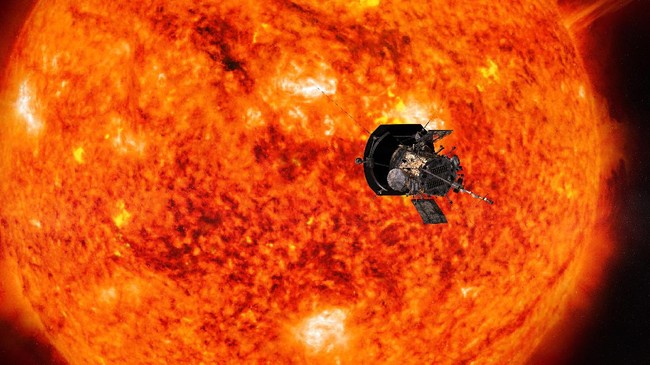
We have long been taught that the Earth and the planets in our Solar System orbit the Sun. However, the theory is not as simple as it appears.
Technically, this is not how the Solar System operates. It is stated that the Earth and the planets do not orbit the Sun itself.
To explain this, Kepler’s third law describes the relationship between the masses of two rotating bodies, which determines orbital parameters. This applies to the Solar System, where the Sun has 1,048 times the mass of Jupiter, but gravity functions in two directions.
NASA explains the concept of the ‘barycentre’, which occurs when two stars of vastly different masses rotate around a shared centre of mass. This does not depend solely on the size of each moving object.
“Movement around the barycentre with massive planets is one of the methods used to discover planetary systems with distant stars,” NASA explained.
In the Solar System, IFL Science notes that the barycentre object usually resides near the Sun due to its immense mass. However, due to the gravitational influence of Jupiter and Saturn, this object is rarely located inside the Sun.
Therefore, the Earth does not orbit a single point within the Sun, but rather at a point on its exterior. This has been confirmed by planetary astronomer and science communicator James O’Donoghue.
“Generally, the planets orbit the Sun, but technically, the planets do not orbit the Sun because of the primary gravity from Jupiter, meaning the planets orbit a new point in space,” he stated on his X account.
He added that the centre of mass of the solar system is rarely aligned with the Sun. A similar phenomenon occurs with planets and their moons.
For example, the Moon does not orbit exactly at the centre of the Earth. Instead, it orbits 5,000 kilometres from the Earth’s centre, a distance that continues to change as the Moon steadily moves away from Earth.