
NASA: Impact of Solar Storms on Earth Has No Maximum Limit
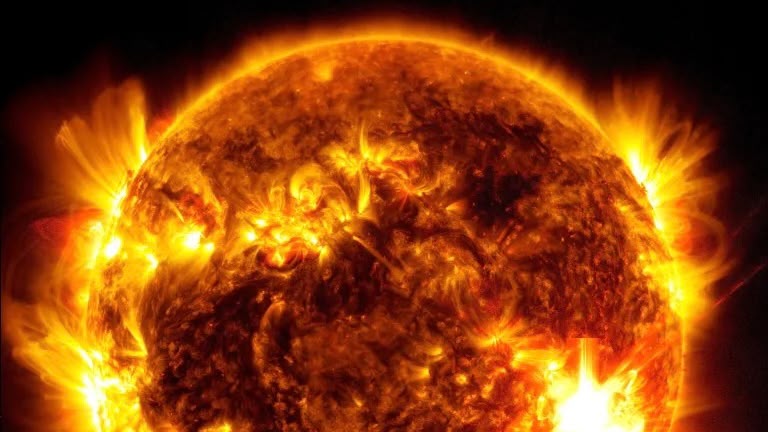
Solar storms, long assumed to have a limited impact on Earth, may in fact be far more dangerous. New findings led by the National Aeronautics and Space Administration (NASA) indicate that our planet’s response to this space phenomenon may have no upper limit, contrary to what scientists have long believed.
According to NASA, a solar storm occurs when the Sun releases large amounts of energy, charged particles and magnetic fields into space. When these eruptions are directed precisely at Earth, their interaction with Earth’s magnetic field triggers a geomagnetic storm. This phenomenon has significant direct consequences for a wide range of technological infrastructure, both on the Earth’s surface and in orbit.
Previously, researchers believed that Earth’s response to the solar wind had a saturation point or maximum limit. Under this theory, if the strength of the solar wind continued to increase, its impact on Earth was expected to rise only up to a certain point before levelling off or stabilising.
However, NASA’s latest research reveals that this assumption of a physical limit is most likely wrong. Experts believe the earlier conclusion arose from the limitations of past solar wind measurement methods, rather than from any natural ceiling on Earth’s response.
Unlike data from spacecraft positioned far away, analysis from spacecraft closer to Earth shows a direct linear relationship. The stronger the solar wind, the greater the electric current generated in Earth’s upper atmosphere, with no sign of an upper limit or saturation.
The implications of this finding for modern civilisation are extremely serious. Rare geomagnetic storms — estimated to occur once in a thousand years — are now predicted to cause far more massive damage than previously estimated.
NASA warns that this extreme space weather can trigger disruption across several vital sectors.
Through this finding, NASA stresses the importance of updating space weather prediction models. It is hoped that this step will enhance global preparedness in protecting the critical technologies that underpin society’s activities worldwide from the threat of extreme solar storms in the future.
Recent research reveals that solar storms can alter Earth’s weather patterns, such as rainfall and snowfall, within just 24 hours of occurring.
Researchers successfully identified changes in the Sun’s atmosphere three hours before a class X9 solar flare took place, opening up opportunities for early warning systems.
Using rare data from the IRIS satellite, astronomers identified unusual activity in the solar atmosphere prior to an X9 flare storm.
Scientists discovered solar radio wave bursts lasting 19 days. This rare Type IV phenomenon was triggered by a CME explosion and affected space weather.
A recent study by Kyoto University reveals the potential for solar storms to trigger earthquakes through electromagnetic disturbances in active faults in the Earth’s crust.
Astronomers discovered Beta Pictoris d, the faintest exoplanet ever directly imaged from Earth using the James Webb Telescope and the VLT.
Earth’s core is a solid layer composed of iron and nickel, located more than 5,000 kilometres beneath the Earth’s surface.
Recent research reveals that the Outer Arm and Outer Scutum-Centaurus Arm of the Milky Way are 10 per cent further away than previously estimated.
Astronomers have found an Earth-like planet that survived after its host star died and became a white dwarf. Could this be a picture of Earth’s future?
Recent research published in the journal Astronomy and Astrophysics reveals a scenario in which Earth could escape destruction when the Sun dies in 5 billion years’ time.
Source: jawawa.id (https://jawawa.id/newsitem/nasa-impact-of-solar-storms-on-earth-has-no-maximum-limit-1785304220)
Originally published by Media Indonesia (https://mediaindonesia.com/teknologi/915902/nasa-dampak-badai-matahari-ke-bumi-tanpa-batas-maksimum), translated from Indonesian