
NASA Finds Surprising Phenomenon on Mars, Leaving Scientists Puzzled
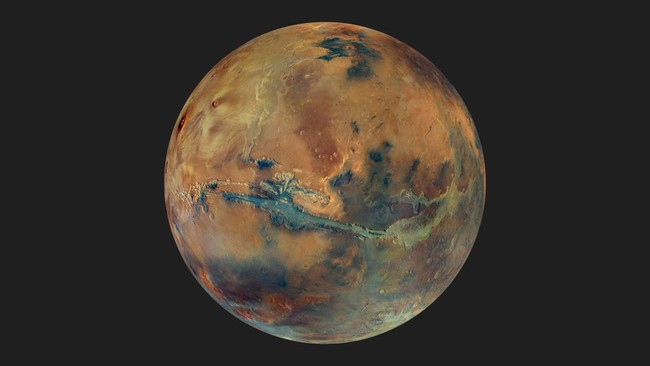
NASA has discovered an unusual geological phenomenon on Mars. In one area of the Red Planet, large rocks appear neatly arranged in long, curved rows, forming a pattern resembling a fingerprint.
The phenomenon has intrigued scientists, who have yet to establish exactly how the rock arrangement formed. The unusual formation was found in Daedalia Planum, a high plain in the Tharsis volcanic region near Mars’s equator.
Images taken in August 2024 by the HiRISE camera aboard NASA’s Mars Reconnaissance Orbiter show the rock formations extending across an area of about 5 by 15 kilometres. The bright-coloured rocks form curved rows, spaced approximately 5 to 10 metres apart.
“Bright boulders are arranged in long, curved rows spaced 5 to 10 metres apart, forming a pattern that resembles a fingerprint,” the late planetary scientist Paul Geissler of the United States Geological Survey (USGS) wrote in October 2024.
Geissler also noted that a similar pattern had not been found elsewhere on Mars. Scientists have not yet identified the geological process that produced the arrangement, ScienceAlert reported on Wednesday (25 November 2026).
One possible explanation is sorted patterned ground, a natural process that separates larger rocks from finer soil through repeated cycles of freezing and thawing. Similar formations are often found in extremely cold regions on Earth.
Daedalia Planum lies at an elevation of about 5,455 metres above Mars’s mean surface level. However, scientists cannot yet determine whether the area experiences freeze-thaw cycles intense enough to create such orderly rock patterns.
Another possibility is seismic activity, or vibrations beneath the Martian surface. Ground shaking could trigger the Brazil nut effect, in which larger material is pushed towards the surface while smaller particles move downwards.
It remains unclear, however, whether seismic activity in the Tharsis region is strong enough to produce such regular rows of rocks. Scientists also question whether this kind of shaking could create the curved, fingerprint-like pattern seen in Daedalia Planum.
The discovery is another reminder that Mars’s surface still holds many geological mysteries. Even rock formations that appear simple at first glance can pose major puzzles for science.
Source: jawawa.id (https://jawawa.id/newsitem/nasa-finds-surprising-phenomenon-on-mars-leaving-scientists-puzzled-1795603955)
Originally published by CNBC Indonesia (https://www.cnbcindonesia.com/tech/20261125132012-37-788325/nasa-temukan-fenomena-mengejutkan-di-mars-ilmuwan-bingung), translated from Indonesian