
Narabahasa's 'Pesta Receh' Celebrates Launch of Recehan Bahasa #2
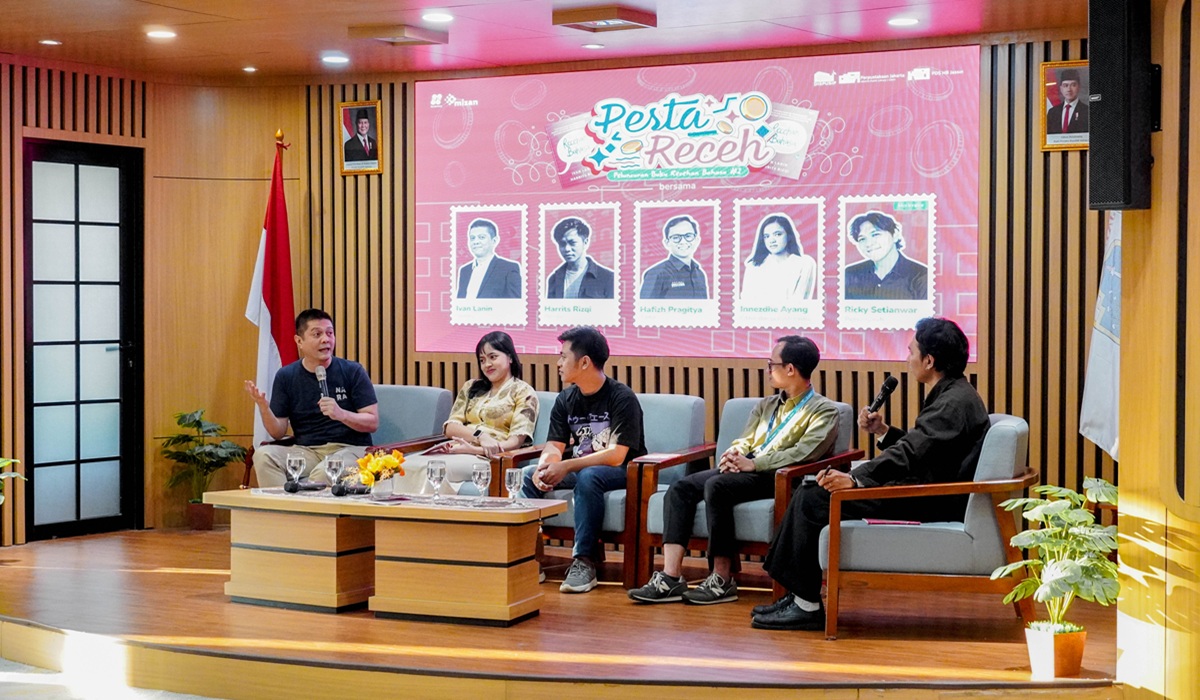
NARABAHASA officially launched their latest book, Recehan Bahasa #2, in a warm gathering titled Pesta Receh on Saturday (13/6/2026). Held at the H.B. Jassin Literature Documentation Centre (PDS) in Cikini, Jakarta, the event served as a meeting space for the community and language enthusiasts to celebrate literacy in a more relaxed and entertaining manner. In collaboration with Mizan Publishing, Narabahasa packaged the launch through a series of engaging activities, ranging from silent reading sessions and language quizzes with prizes to in-depth discussions on contemporary language phenomena that are often underestimated yet hold profound meaning. During the discussion session, Ivan Lanin, one of the book’s authors, highlighted the dynamics of language that continuously evolve with the times. According to him, the emergence of slang terms is a natural occurrence as an identity marker for each generation. “Language develops according to its generation. Slang terms will be created, whether intentionally or not, in each generation to show their identity. It is not the new generation, but the old generation that will adjust,” Ivan stated. Echoing Ivan, Harrits Rizqi, also a writer for the book, emphasised the importance of documenting these ‘receh’ (trivial) words. He argued that every word carries the trace of its speaker’s thoughts. If a word disappears from circulation, the thought behind it is also threatened with extinction. Recehan Bahasa #2 is presented as a concrete effort to nurture this culture of thought. Hafizh Pragitya, the book’s editor, revealed that Recehan Bahasa #2 not only discusses theory but also addresses debates that frequently arise in society. One unique example raised is the polemic regarding the classification of oil palm trees. “Besides close-to-home language phenomena like ‘galgah’ and ‘kapitil’, there are also phenomena such as the debate on whether oil palm is a tree or not, and that is answered in this book,” Hafizh explained. From a literary and research perspective, Innezdhe Ayang added that the use of words is not merely about disseminating information, but also about preserving history. She stressed that the responsibility of language users is to maintain the continuity of these words in the proper cultural context. Through this launch, Narabahasa hopes that Recehan Bahasa #2 can become a bridge for cross-generational thought. With its light and concise format, the book is expected to educate the public that every word created is part of the collective wisdom of the Indonesian nation that must be accounted for.