
Najib’s house arrest puts Malaysia in ‘uncharted’ legal territory, poses political challenge for PM Anwar
analysis Asia
Najib’s house arrest puts Malaysia in ‘uncharted’ legal territory, poses political challenge for PM Anwar
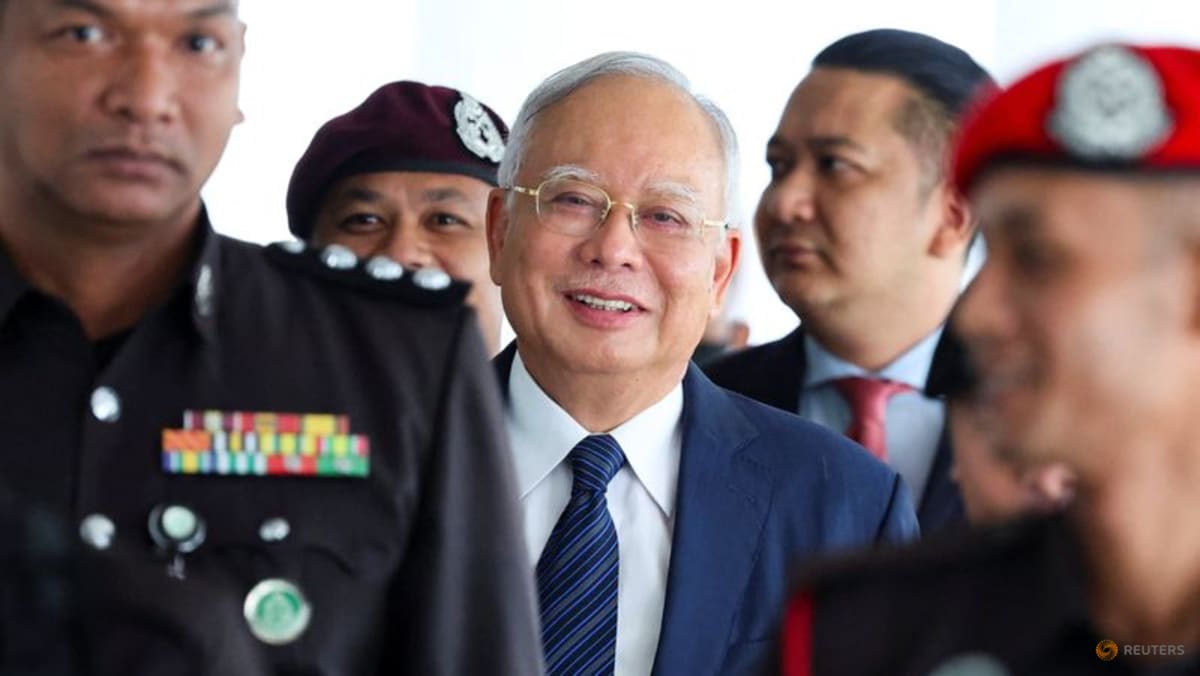
Former PM Najib Razak is likely the first convicted prisoner in Malaysia to have his sentence commuted to house arrest, experts say, adding that the move could pose a challenge for incumbent Anwar Ibrahim, given his anti-corruption pledge.
JOHOR BAHRU: The decision on Friday (Sep 18) to allow former Malaysia Prime Minister Najib Razak to serve the remainder of his prison sentence under house arrest, conditional on him paying a RM50 million (US$12.26 million) fine, breaks new legal ground for the country and could pave the way for other convicted prisoners to seek similar treatment, say legal experts.
It could also ripple through Malaysia’s political landscape, with analysts saying Najib’s conditional pardon could give a boost to his United Malays National Organisation (UMNO) and its Barisan Nasional (BN) coalition, given the influence the 73-year-old former party president still wields there.
The decision by the Federal Territories Pardons Board chaired by the king, Sultan Ibrahim Sultan Iskandar, could also pose a challenge for Prime Minister Anwar Ibrahim, particularly given his administration’s emphasis on combating corruption.
Analysts said Anwar will have to navigate differing views within his unity government over Najib’s treatment, including among members of his Pakatan Harapan (PH) coalition.
PH and BN are allies in Anwar’s federal government, but tensions between the two coalitions have been simmering recently, especially since BN is working with the opposition Perikatan Nasional coalition under a new Malay-Muslim conservative political pact in the recent Johor and Negeri Sembilan state elections.
UNCHARTED LEGAL TERRITORY
According to legal experts, Najib is likely the first convicted prisoner in Malaysia to have his sentence commuted to house arrest.
This leaves questions over how the arrangement will be implemented and what restrictions home detention will entail.
Constitutional lawyer Lim Wei Jiet pointed to a December 2025 High Court ruling that dismissed Najib’s judicial review application over an addendum order that purportedly allowed him to serve the remainder of his prison sentence at home.
Judge Alice Loke had said the house arrest order was not able to be executed under existing Malaysian law, noting that the statutory power to release a prisoner on licence rests with the Commissioner-General of Prisons alone.
“I really do not know the details, or limitations imposed on the convict (on house arrest). This is really uncharted territory,” said Lim, who runs law firm LWJ Advocates and Solicitors.
Criminal lawyers previously told CNA that Malaysia lacks specific laws to implement home detention, although the Home Minister has the exclusive power to decide and designate any location as a detention centre under the law.
An explainer by Malaysia’s New Straits Times on Friday quoted criminal lawyer S Sivananthan as saying that house arrest could involve stationing prison officers at Najib’s residence, electronically monitoring him and imposing specific restrictions on visitors.
According to Sivananthan, no prisoner in Malaysia has previously been allowed to serve a sentence under house arrest. Najib’s case, he said, could prompt other prisoners – particularly those convicted of white-collar offences – to seek similar treatment.
“This is going to open the floodgates. People serving sentences for white-collar crimes may ask, ‘Why not me?’” he reportedly said.
Questions have also been raised over the conditions attached to Najib’s house arrest and how any potential breaches would be monitored or enforced.
Former economy minister Rafizi Ramli, who left the government last year to lead the Parti Bersama Malaysia, called on Anwar to “announce in detail the conditions” of Najib’s house arrest so that “action can be taken if any of those conditions are breached”.
A separate legal question hangs over Najib’s sentence for a different 1Malaysia Development Berhad (1MDB) case.
In December 2025, the High Court sentenced Najib to 15 years in prison and fined him RM11.38 billion after finding him guilty on 25 charges of abuse of power and money laundering involving RM2.2 billion misappropriated from the state investment fund.
That prison term is due to begin after he completes his current sentence. Najib has appealed against both his conviction and sentence.
Lim said that if Najib is granted a stay of his 1MDB sentence while he appeals the case, he would not have to begin serving that sentence until the appeals process is completed.
In the meantime, he could continue serving his current sentence under house arrest until it ends.
However, if Najib ultimately loses his appeals and his 1MDB conviction and sentence are upheld, the house arrest arrangement would not automatically apply to that separate sentence.
He could therefore be required to return to prison to serve the 1MDB jail term, Lim added.
Prior to his conditional pardon, he was serving a six-year prison term slated to end on Aug 23, 2028 on three counts of criminal breach of trust, three counts of money laundering and one count of abuse of power.
The charges involved the transfer of RM42 million from SRC International, a former subsidiary of 1MDB, into his personal bank accounts in 2014 and 2015.
“BOSSKU’S” RETURN A BOOST FOR UMNO
While it remains unclear what conditions will govern Najib’s house arrest – including whether he will be allowed to participate in political activities – analysts said his departure from prison alone would boost UMNO’s morale.
Political analyst Azmi Hassan told CNA the development could “rejuvenate” UMNO and give the party further momentum following its recent electoral successes in the Johor and Negeri Sembilan state elections.
Before going to prison in 2022, Najib, who is known among supporters as “Bossku” (“my boss” in Malay), was a prominent presence on the campaign trail, with his a
Source: jawawa.id (https://jawawa.id/newsitem/najibs-house-arrest-puts-malaysia-in-uncharted-legal-territory-poses-political-challenge-for-pm-anwar-1789732249)
Originally published by CNA (https://www.channelnewsasia.com/asia/malaysia-najib-razak-house-arrest-pardon-politics-legal-implications-6394466)