
Nagekeo Students Maintain Learning Spirit in Emergency Tents Following Earthquake
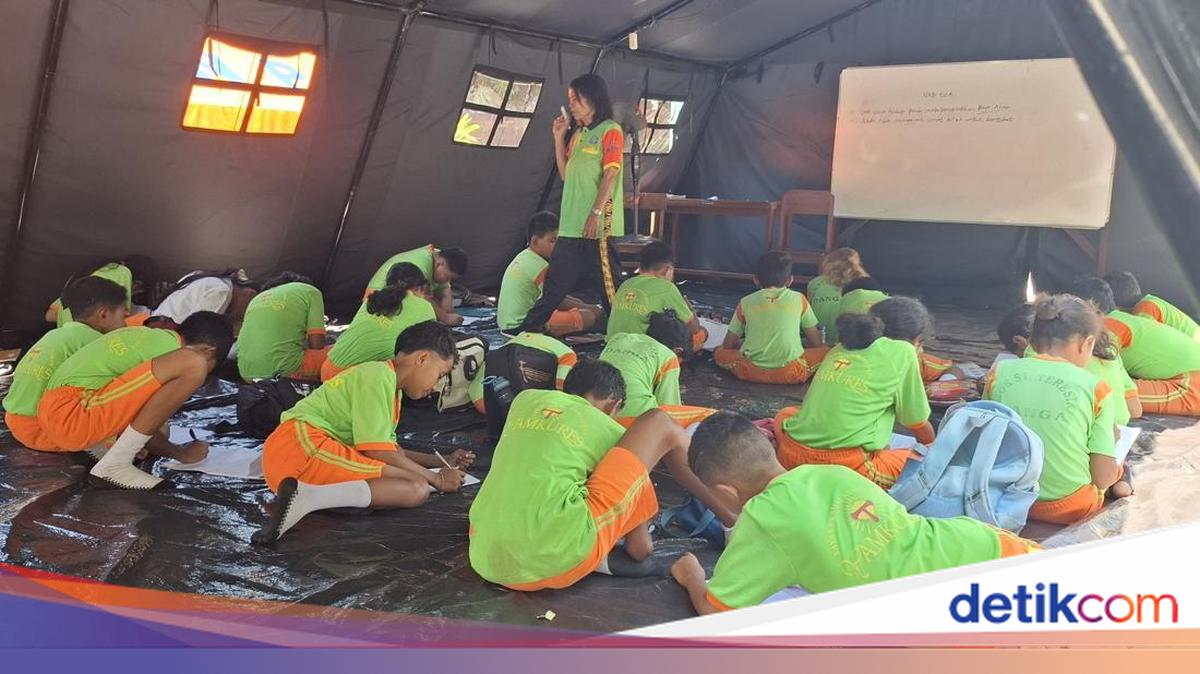
Tarpaulins serve as seating for numerous students at Santa Teresia Danga Catholic Primary School, Nagekeo, East Nusa Tenggara (NTT), during teaching and learning activities. They have returned to studying in emergency tents following a magnitude 7.7 earthquake.
Despite having to study without chairs or desks, the students appear enthusiastic about their lessons. This spirit is evident as they receive material from teachers within the emergency tents erected in the schoolyard.
“We see that the students are very enthusiastic, happy, and joyful in participating in the learning process,” said the Head of Santa Teresia Danga Catholic Primary School, Sister Bibiana Maria Immaculata Mbola, when met at the school on Monday (31/8/2026).
Bibiana explained that the learning process at the school only resumed today, following the earthquake that occurred on Saturday (15/8/2026). A total of three emergency tents were erected by members of the Yonif 834/Wakangamere infantry battalion.
The decision to conduct classes outside the classroom was made because several school rooms were affected and suffered cracks. Furthermore, some students are still experiencing trauma during aftershocks.
These conditions led the school authorities to choose the schoolyard as a learning space, with emergency tents serving as temporary classrooms for the students.
“Therefore, the learning process is held in the schoolyard using emergency tents, because if they were inside the classrooms, we fear they might crowd each other while trying to exit if another earthquake occurs,” Bibiana explained.
Students must now adapt to a learning environment that differs from the norm. There are no chairs or desks available; instead, they sit on the floor and write while crouching.
However, these conditions have not diminished the students’ attention to the lessons provided by their teachers. “Currently, they sit on the floor and must crouch to write, but their focus and attention to the teacher remain,” said Bibiana.
She noted that the learning material has also been adjusted to the current situation. Additionally, the school has implemented a rotating class schedule.
On Monday, classes 6A and 6B participated in the learning activities. From Tuesday to Friday, the learning is divided among three study groups.
“That is the system we are using because we still lack learning facilities, such as emergency tents,” revealed Bibiana.
The school still requires an additional 2-3 emergency tents. As the student population reaches 314, the learning process cannot yet run as effectively as it does under normal conditions.
Nevertheless, teachers and students are striving to adapt to the emergency conditions. Every day, students receive three subjects, each taught by a different teacher.
“In terms of effectiveness, it is effective for an emergency period, but it is not effective compared to a normal situation,” Bibini added.
Amidst these challenges, teachers continue to show up to fulfil their teaching duties. Bibiana stated that all teachers are prepared, driven by their calling as educators.
In fact, four teachers had their homes affected by the earthquake. Two houses remain habitable, while two others can no longer be used because their walls collapsed.
“Indeed, two teachers’ houses can still be occupied, but two others are uninhabitable because the walls collapsed. However, for the sake of the children’s future, they are all present today,” Bibiana explained.