
Nadiem's Plea: Observer States Budget Savings Do Not Erase Corruption Elements
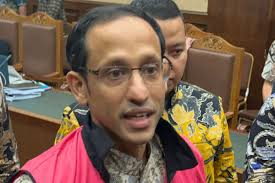
Legal and Criminal Law observer, Fajar Trio, has responded to the defence plea (pleidoi) presented by the former Minister of Education, Culture, Research, and Technology, Nadiem Anwar Makarim, in the trial regarding alleged corruption in Chromebook procurement. Fajar assessed that Nadiem’s arguments, which claim ‘investigative errors’ by prosecutors and use a Rp 3.9 trillion budget efficiency as a shield, constitute an erroneous legal simplification.
According to Fajar, within the legal regime of corruption crimes, narratives of savings or the absence of signatures on technical documents do not automatically nullify criminal liability. “There is a fatal misconception in that plea. The defendant is attempting to bring a criminal law debate into the realm of business management and budget efficiency. However, the Public Prosecutor is indicting based on unlawful acts that triggered actual state losses,” Faret stated on Tuesday.
Fajar highlighted Nadiem’s argument that choosing the free Chrome Operating System (OS) saved trillions of rupiah compared to Windows options. In his plea, Nadiem argued it was ironic to face a 27.5-year prison sentence for a policy that saved state funds. Fajar, however, identified a logical fallacy that confuses policy with execution. “In the trial, the Prosecution does not dispute the choice of the free Chrome OS. What the prosecutors are targeting is the alleged price mark-up on the hardware units purchased using the state budget (APBN),” said Fajar.
He emphasised that fictitious profits from choosing a free OS cannot offset criminal elements if trial facts prove the real price per Chromebook unit was significantly lower than the e-Catalogue contract price submitted by the ministry. “The price difference from the mark-up is what is absolutely calculated as State Financial Loss, as regulated in Article 2, paragraph (1) of the Corruption Law,” he added.
Regarding Nadiem’s claim that there was no ‘mens rea’ (criminal intent) because he did not personally enrich himself, Fajar refuted this using the construction of Law Number 31 of 1999 in conjunction with Law Number 20 of 2001 on the Eradication of Corruption. “Our law is clear: ‘enriching oneself, others, or a corporation’. Therefore, even if Nadiem did not receive a single cent, if it is proven that his policy facilitated vendors in obtaining illegal profits through mark-ups, the legal offence is fulfilled,” Fajar explained.
Furthermore, Fajar explained that ‘mens rea’ in corruption cases does not always manifest as direct intent to steal money, but can be intentionality through the awareness of a possibility. Nadiem admitted to attending a Zoom meeting on 6 May 2020 to receive a presentation on the recommendations for this multi-trillion rupiah project. According to Fajar, this presence undermines the defence of a ‘blind spot’ or total ignorance. “When a minister is aware of a massive project, and then there is an omission regarding a procurement process that violates accountability principles, the legal element of ‘knowing and intending’ (weten en willen) the deviation is considered present,” he said.
Regarding Nadiem’s defence that the decision to use 100% Chrome OS was altered at the technical team level without his knowledge, Fajar reminded him of the Minister’s position under Law Number 17 of 2003 regarding State Finance as the highest Budget User (PA). “In criminal law, there is the doctrine of Vicarious Liability or command responsibility. The absence of strict supervision from the top leadership, which results in the depletion of state funds, is a form of culpable negligence,” Fajar noted.
Finally, responding to Nadiem’s allegation regarding ‘thank you’ money flows from vendors to dozens of procurement officials who were not named suspects, Fajar stated that the Prosecution has a legal obligation to expand the case towards bribery or gratification offences. However, this does not erase the material actions of the primary defendant. “The existence of money flows to the technical team actually confirms that the procurement ecosystem under the ministry at that time was fragile and fraught with criminal conspiracy. Under Article 55 of the Criminal Code, the perpetrator is not just the physical actor (pleger), but also those who participate (medepleger). The judge will look at the bigger picture,” he concluded.
Source: jawawa.id (https://jawawa.id/newsitem/nadiems-plea-observer-states-budget-savings-do-not-erase-corruption-elements-1780866975)
Originally published by Media Indonesia (https://mediaindonesia.com/politik-dan-hukum/896138/pledoi-nadiem-pengamat-sebut-penghematan-anggaran-tak-hapus-unsur-korupsi), translated from Indonesian